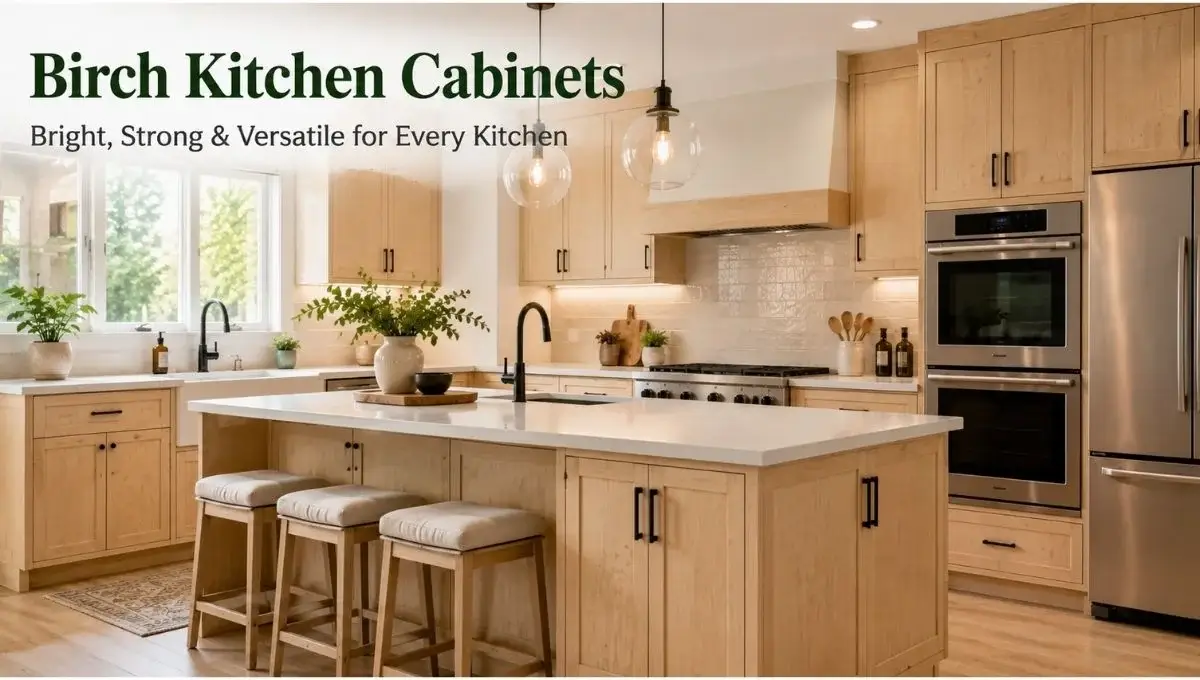
Choosing new cabinetry requires balancing cost, appearance, and durability. As you navigate your options and explore various kitchen cabinet styles and materials, you will find that wood species play a massive role in how your kitchen looks and performs over time.
Birch kitchen cabinets offer a bright natural color, fine grain, and excellent flexibility for paint or stain finishes. This strong wood works perfectly in modern designs, but checking material specifications is necessary before you buy. Understanding these details helps you get the best cabinet quality for your home.
Are birch kitchen cabinets a good choice? Yes, they are a strong, budget-friendly hardwood option that offers a smooth texture and takes both paint and stain well. They fit modern, Scandinavian, and classic homes perfectly when paired with the right hardware and colors.
What Are Birch Kitchen Cabinets?
Birch is a sturdy, close-grained hardwood grown across North America. Yellow birch (Betula alleghaniensis), sweet birch, and paper birch are common species, with yellow birch preferred for high-use cabinetry due to its strength.
To understand its durability, woodworkers use the Janka hardness scale, which measures how much force it takes to embed a small steel ball into the wood. Yellow birch has a Janka rating of 1,260 lbf (pounds-force). This means it is highly resistant to everyday dings, dents, and scratches—nearly matching the hardness of red oak (1,290 lbf) and far outperforming softwoods like pine or alder.
The wood features a straight, tight grain with occasional wavy patterns and a very smooth surface texture. Natural birch blends pale cream sapwood (the outer layer of the tree) with light reddish-brown heartwood (the inner core). This color variation means a single kitchen run will display a beautiful, organic mix of light and medium tones.
Natural Birch, White Birch, and Red Birch Explained
When shopping for cabinets, you will notice that manufacturers sort birch into different color categories. These categories do not represent different tree species. Instead, they describe which part of the tree trunk the wood came from:
- Natural Birch: This is the most common and budget-friendly option. It uses a mix of light sapwood and dark heartwood. It displays high-contrast pale yellow and light brown tones side by side, giving the kitchen a lively, organic look.
- White Birch: Workers select only the outer sapwood of the tree for these doors. This produces a highly uniform, pale cream surface that is perfect for bright, airy, and modern kitchen layouts.
- Red Birch: This premium wood is sourced strictly from the inner heartwood of the tree. It offers a rich, golden, light reddish-brown appearance. Because of its warm, luxurious tone, red birch is a fantastic, cost-effective alternative to cherry wood kitchen cabinets.
Because grading terms and sorting standards differ by manufacturer, always ask your supplier for a physical sample of their specific color grades before purchasing.
Cabinet Construction: Solid Birch, Veneers, and Plywood
Standard cabinet lines rarely consist of 100% solid wood. Instead, manufacturers combine different materials to keep prices low and improve dimensional stability—which is the wood’s ability to resist warping, shrinking, and expanding due to kitchen humidity.
- Solid Birch: Cabinet makers use solid birch for high-impact areas. This includes door frames, stiles, rails, and face frames. Birch holds nails and screws incredibly well, ensuring your cabinet hinges stay firmly attached.
- Birch Veneer: A veneer is a very thin sheet of real birch wood glued over a stable core, like Medium-Density Fiberboard (MDF) or high-grade particleboard. This is used for flat center panels on doors to prevent them from warping when the kitchen gets steamy.
- Birch Plywood: Multi-layered wood panels bonded together with adhesives. Plywood is the industry standard for high-quality cabinet boxes, structural shelves, and heavy-duty drawer bottoms.
Standard Birch Plywood vs. Baltic Birch Plywood
If you are looking at semi-custom or custom cabinets, you will likely hear the term “Baltic birch.” It is important to know the difference between this and standard cabinet-grade plywood.
Standard birch plywood typically uses a thin birch face veneer over a core made of softer woods or composite materials. The number of layers (plies) can vary.
In contrast, Baltic birch plywood is a premium product imported from Europe. It features multiple layers of solid birch veneer throughout the entire thickness of the panel, with absolutely no soft wood fillers or hidden air pockets. This multi-ply design makes Baltic birch incredibly stiff and strong. It is the gold standard for heavy-duty drawer boxes and adjustable shelves that will not sag under the weight of heavy cast-iron cookware.
What Are the Pros and Cons of Birch Cabinets?
To decide if birch is the right choice for your kitchen remodel, weigh these advantages and disadvantages:
The Pros
- Excellent Durability: With its 1,260 Janka rating, birch stands up to the daily chaos of busy kitchens, active kids, and pets.
- Super Smooth Paint Surface: Unlike oak, which has deep, open pores that swallow paint, birch is a closed-pore wood. It sands down to a perfectly flat, glass-like finish when painted.
- Budget-Friendly Price: Birch offers the strength and beauty of a premium hardwood at a fraction of the cost, helping you stretch your renovation budget further.
- Versatile Style: It looks just as beautiful in a rustic, knotty cabin style as it does in a sleek, handleless modern kitchen.
The Cons
- High Color Contrast: If you buy unsorted “natural” birch, the sharp contrast between the white sapwood and reddish heartwood can look too busy or striped for some tastes.
- Stain Blotching: Raw birch absorbs liquid stains unevenly. Without the right preparation, a dark stain can look patchy and muddy.
- Thin Veneer Risks: Low-end, budget-grade cabinet lines sometimes use paper-thin birch veneers on the sides of the cabinets, which can easily peel or scratch over time.
How to Stain Birch Cabinets Without Blotches
Because birch has areas of varying density, raw wood fibers drink up stains at different rates. If you apply a dark liquid stain directly to raw birch, the soft areas will turn very dark while the hard areas remain light.
To achieve a beautiful, professional-grade finish, professional cabinet makers follow a very specific, orderly process:
1.Prep Sanding:Sanding the wood.
Sand the raw wood surface thoroughly. Start with 120-grit sandpaper to remove manufacturing marks, and finish with 150-grit or 180-grit sandpaper. Avoid sanding too fine (like 220-grit), as this can burnish the wood and block stain absorption entirely.
2.Apply Wood Conditioner:Equalizing density.
Apply a generous coat of pre-stain wood conditioner or a highly diluted shellac washcoat. This liquid penetrates the softer wood fibers, partially sealing them so they do not over-absorb the stain. Let it dry according to the manufacturer’s directions.
3.Apply the Stain:Coloring the wood.
Wipe or spray on your chosen stain. For birch, gel stains are highly recommended. Because gel stains sit on top of the wood rather than soaking deep into the pores, they provide a much more uniform, blotch-free color.
4.Seal and Protect:Adding the clear coat.
Once the stain is completely dry, apply a high-quality polyurethane or lacquer topcoat. This protects the wood from water, grease, and cleaning chemicals, ensuring your finish lasts for decades.
Birch vs. Maple Cabinets: The Direct Comparison
Homeowners often confuse birch and maple because they share a similar light color and fine, closed grain. However, when you look closely at their physical specifications, the differences become clear:
| Feature | Yellow Birch Cabinets | Hard Maple Cabinets |
|---|---|---|
| Janka Hardness | 1,260 lbf (Very Strong) | 1,450 lbf (Extremely Hard) |
| Color Appearance | Warm cream with reddish-brown streaks | Uniform pale white to light cream |
| Grain Pattern | Straight, subtle, with occasional curls | Fine, straight, very uniform |
| Paintability | Excellent (Smooth, closed pores) | Excellent (Sands perfectly smooth) |
| Relative Cost | Budget-friendly to moderate | Moderate to premium |
If you prefer a highly pronounced, deeply textured grain pattern instead of birch’s ultra-smooth face, you might want to look at white oak kitchen cabinets as a premium, high-texture alternative.
Modern Birch Kitchen Cabinet Ideas
Birch’s light, warm tone makes it a natural fit for modern organic, Scandinavian, and Japandi (Japanese-Scandinavian fusion) designs.
- Scandinavian Simplicity: Choose flat-panel (slab) natural birch cabinets finished with a low-sheen, matte clear coat. This preserves the raw, organic look of the wood. Pair them with clean white quartz countertops and a simple tile backsplash.
- The Two-Tone Approach: Install warm natural birch cabinets for your lower base units and island, then use painted white or soft gray cabinets for your upper wall units. This keeps the upper half of your kitchen feeling open and spacious.
- Bold Modern Contrast: Mix light, natural white birch slab doors with sleek matte black hardware and dark soapstone or charcoal countertops. The deep black accents make the warm wood tones pop.
Designing Around Birch: Colors, Countertops, and Hardware
Because birch has inherent warm yellow and cream undertones, the materials you place around your cabinets will dictate the mood of the entire room.
Countertops and Backsplashes
Soft, warm-white quartz, creamy marble-look surfaces, and light gray natural stones work beautifully. If you want a striking, high-contrast look, pair natural birch with dark slate or deep charcoal countertops. Keep the backsplash simple—a handmade-look zellige tile or white subway tile adds texture without competing with the wood grain.
Paint Colors
When painting your kitchen walls, stick to colors with warm undertones. Soft creams, warm whites, light greiges, and muted sage greens complement birch beautifully. Avoid cool, blue-toned grays, as these cool shades will make the warm yellow tones in the birch cabinets look harsh and orange.
Flooring Options
Avoid trying to match your wood flooring exactly to your birch cabinets, as this can make your kitchen look like a wooden box. Instead, aim for contrast. Pair light birch cabinets with medium-toned oak floors or neutral stone-look tiles.
For homeowners who want to balance the bright, pale cream of birch cabinets with a deeper, high-end wood floor or a contrasting accent island, incorporating walnut kitchen cabinets into your design adds stunning luxury and contrast to the space.
Hardware Finishes
- Matte Black: Creates a sharp, modern, and industrial feel.
- Brushed Brass / Champagne Bronze: Adds a soft, elegant, and warm glow.
- Brushed Nickel: A timeless, subtle, and clean finish that blends in quietly.
How Much Do Birch Cabinets Cost?
Birch is widely recognized as one of the most cost-effective hardwood options on the market. It allows you to get a high-quality, durable kitchen without paying the premium prices commanded by cherry, walnut, or oak.
- Stock and RTA (Ready-to-Assemble) Cabinets: This is your most affordable route. These lines often feature solid birch face frames and door frames with veneered center panels, resting on standard pocket-screw or dowel-joined plywood boxes.
- Semi-Custom Cabinets: These offer a wider array of door styles, sizes, and factory-applied finishes. They generally feature soft-close drawers, heavy-duty glides, and thicker cabinet box walls.
- Custom Cabinets: Built to your kitchen’s exact layout. This option gives you access to premium materials, like hand-selected solid red birch doors, custom-blended stains, and solid Baltic birch drawer boxes.
To ensure your investment is protected, always ask your contractor or cabinet shop for a comprehensive, written quote. Make sure it explicitly details the door style, the exact wood species, the cabinet box materials, drawer slide ratings, finished end panels, toe kicks, shipping, and installation fees.
The Verdict: Are Birch Cabinets Right for You?
If you are searching for a highly durable, fine-grained hardwood kitchen that stays friendly to your remodeling budget, birch kitchen cabinets are an incredible choice. They offer a bright, smooth canvas that adapts beautifully to modern minimalist styles or classic painted designs. By verifying your cabinet box construction and selecting a high-quality finish, you will build a sturdy, gorgeous kitchen that easily withstands the test of time.