A kitchen geyser gives you hot water close to the sink without relying on a large bathroom heater. The main decision is not simply whether to buy 1L, 3L or 5L. You also need enough heating power for your water flow, safe electrical capacity, suitable pressure and a model that can cope with local water conditions.
For many Indian homes, a compact instant electric unit works well for utensil washing and short hot-water tasks. This guide shows how to choose the right kitchen geyser size, understand 3 kW versus 4.5 kW, estimate running cost and avoid installation mistakes before you spend money.
Quick Answer
For most Indian kitchens, a 3L instant geyser is a sensible starting point for regular utensil washing, while 1L suits light rinsing and 5L gives a larger short-term hot-water reserve. Capacity alone is not enough, because wattage, flow and inlet-water temperature control how hot the running water feels.
- Use 1L for brief, light tasks.
- Consider 3L for regular sink use.
- Choose 5L for more reserve, not automatically faster heating.
- Check pressure and hard-water suitability.
- Verify the electrical circuit before installation.
What Kitchen Geyser Size Do You Need: 1L, 3L or 5L?
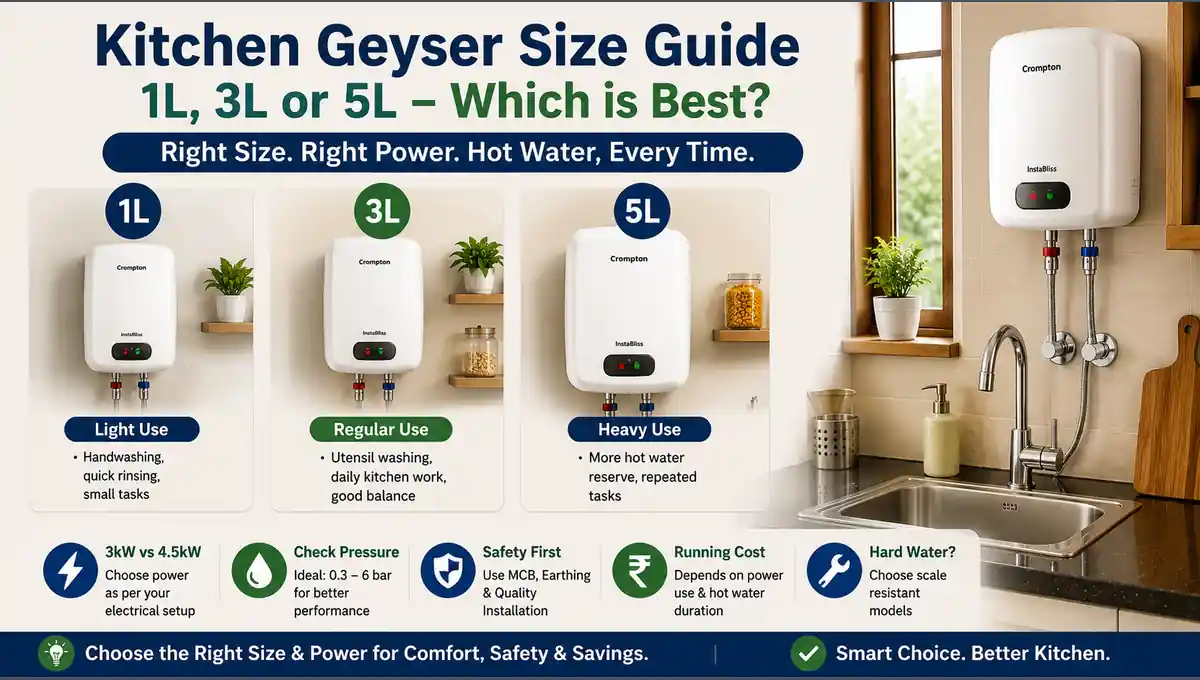
The right kitchen geyser size depends on how you use hot water at the sink, not simply how many people live in the home. A 1L heater suits short bursts, 3L covers many normal kitchen tasks, and 5L gives more stored hot water before incoming cold water dilutes it.
Current Indian product ranges confirm that compact kitchen water heaters are sold in 1L, 3L and 5L configurations. The litre figure describes water volume; it does not tell you the heater’s power or how well it will maintain temperature while the tap remains open.
| Capacity | Best suited to | Main benefit | Main limitation |
|---|---|---|---|
| 1L | Handwashing and quick rinsing | Very compact | Small reserve runs out quickly |
| 3L | Regular utensil washing in short batches | Balanced size and reserve | High continuous flow can cool the outlet |
| 5L | Repeated tasks or larger short reserve | More hot water available initially | More litres do not guarantee faster heating |
If you are planning the whole wash area, the kitchen sink guide is useful because sink position, tap type and available wall space affect heater placement.
Is 1 Litre Enough for a Kitchen?
A 1 litre geyser for kitchen use is enough for handwashing, quick rinsing and very short hot-water jobs. Current Indian 1L instant units are available at both 3 kW and 4.5 kW, so small capacity does not mean low electrical demand.
The limitation appears when you keep the tap open. Once cold inlet water starts replacing the heated volume, outlet temperature depends increasingly on heating power and flow.
Choose 1L when space is tight and hot-water use is genuinely brief. Do not choose it for long sessions of washing greasy utensils under continuously running hot water.
Is 3 Litres Enough for a Kitchen?
A 3 litre geyser for kitchen use is a good middle option for many homes because it provides a useful short reserve without taking much wall space. It suits repeated handwashing, rinsing and utensil cleaning better than 1L.
Current 3L instant products are available with 3 kW and 4.5 kW heating elements. The higher-powered version can add heat faster, but it also places a larger demand on the electrical circuit.
If you wash utensils in batches and turn the tap off between tasks, 3L is often enough. If you expect a long, uninterrupted stream of very hot water, capacity alone will not solve the problem.
When Does 5 Litres Make More Sense?
A 5 litre geyser for kitchen use makes sense when several hot-water jobs happen back-to-back or you want a larger heated reserve before cold inlet water dilutes it. It can suit frequent sink use where 3L feels easy to exhaust.
A 5L unit is not automatically hotter or faster. One current Indian range offers both 3L and 5L versions at 3,000 W, so the 5L option gains water capacity without gaining heating power.
That is the key 3L-versus-5L decision: choose 5L for more reserve. Choose higher wattage only when you need faster heat input and the electrical setup can safely support it.
You may also see 2L compact heaters in marketplaces. Treat a 2L unit as another small-size option rather than assuming it has a special performance advantage between 1L and 3L.
Is an Instant Geyser Better Than Storage or a Tap Heater?
An instant geyser for kitchen use is usually the most practical option for short sink tasks because it is compact and heats close to the point of use. A small storage heater suits longer demand, while a tap geyser or portable geyser for kitchen use can save wall space but needs closer scrutiny.
| Type | Good for | Main benefit | Main trade-off |
|---|---|---|---|
| Instant electric heater | Normal sink tasks | Compact and quick | High electrical load for its size |
| Small storage heater | Longer hot-water use | Larger reserve | More space and reheating time |
| Tap or portable heater | Very tight spaces | Heating close to tap | Quality, certification and service vary |
An electric kitchen geyser should sit close enough to the sink to keep hot-water pipe runs short. That reduces the amount of cooled water left in the pipe before warm water reaches the tap.
A tap geyser for kitchen use places the heating function at or very near the faucet. A mini geyser for kitchen use may also be marketed as a compact or point-of-use heater, but physical size does not tell you its electrical load or safety specification.
Do not assume every inexpensive heating tap is equivalent to a wall-mounted instant water heater with a pressure vessel, thermostat, thermal protection and established service support.
If a cheap portable model has poor “not heating” feedback or a very short power lead, treat those as reasons to inspect the specification more closely. Never solve a short cable by casually adding an extension lead to a high-power water heater.
If the tap itself is changing, plan the hot-water connection before you replace a kitchen faucet. A normal hot-and-cold mixer and a specialised heated tap need different plumbing decisions.
A storage water heater becomes more reasonable if you need longer periods of hot flow. A gas geyser is a separate decision because gas supply, combustion and ventilation introduce different installation and safety requirements.
Why Litres Alone Do Not Tell You Heating Performance
Litres tell you how much water a heater holds; kilowatts tell you how quickly its heating element can add energy. Water flow and inlet temperature then decide how warm the outlet feels while you use the sink.
While comparing current Indian manufacturer specifications, I found compact instant models at both 3 kW and 4.5 kW. Current 1L and 3L units use these ratings, while one 3L/5L range offers 3,000 W versions and a higher-powered 4.5 kW option.
A simple physics check shows why water flow matters:
Power in kW = flow in litres/minute × temperature rise in °C × 0.0698
At 2 litres per minute, 3 kW can theoretically add about 21.5°C to the incoming water. At the same flow, 4.5 kW can theoretically add about 32°C.
Real outlet temperature can be lower because of heat loss, thermostat control, mixing and heater design. The calculation is useful for understanding the relationship, not predicting an exact tap temperature.
The same heater can therefore feel stronger when you reduce the tap flow. It also explains why cold North Indian winter water can expose a limitation that was barely noticeable during warmer months.
If hot water feels weak only in winter, do not automatically buy more litres. Compare wattage, flow and the temperature rise you need first.
Will It Work With High-Rise Pressure and Hard Water?
A kitchen water heater in a high-rise flat needs a pressure rating that suits the building’s actual water supply. Hard water creates a different problem because mineral scale can build on heated surfaces and restrict performance over time.
Current compact instant models from multiple Indian manufacturers publish 6.5 bar ratings. That confirms high-pressure compact units are available, but it does not mean every home needs 6.5 bar or every small heater supports that pressure.
If your apartment uses a booster pump or has unusually strong water pressure, compare the supply pressure at the installation point with the chosen model’s specification. Floor number alone is not enough to make that decision.
Hard water needs similar care. Some current instant heaters use stainless-steel inner tanks and are specifically positioned for hard-water conditions.
A stainless steel tank does not stop mineral scale from forming on heating elements or inside water passages. If scale is common on your taps and utensils, service access and descaling guidance matter as much as tank material.
The best hard water geyser is therefore not the one with the strongest marketing label. Look for appropriate materials, clear maintenance instructions and authorised service in your area.
How Much Electricity Does an Instant Water Heater Use?
Electricity consumption depends on rated power and the time the heater actually operates. A 4.5 kW unit draws more electrical power while running than a 3 kW unit, but your final bill also depends on runtime and the tariff on your electricity bill.
Use this calculation:
Energy used in kWh = heater power in kW × running time in hours
A 3 kW heater running for 10 minutes uses about 0.5 kWh. A 4.5 kW heater running for the same 10 minutes uses about 0.75 kWh.
Higher wattage does not automatically mean the same kitchen task costs 50% more. A higher-powered unit may reach the required temperature sooner and operate for less time.
For a realistic monthly estimate, total the minutes the heater runs each day, convert them to hours and multiply by the rated kW. Then apply the electricity tariff shown on your bill.
Do not use BEE stars as a shortcut when comparing small instant heaters. Current Bureau of Energy Efficiency material records instant water heaters as having no BEE star rating, while storage water heaters use the 1-to-5-star system; BEE’s mandatory appliance list specifically names stationary storage-type electric water heaters.
How Much Does a Small Instant Geyser Cost in India?
Kitchen geyser price changes with capacity, wattage, model, manufacturer, seller and installation scope. Current examples checked on 24 August 2026 ranged from about ₹3,450 for a 1L retail listing to ₹6,490 MRP for a 5L instant model, with other 3L and 5L manufacturer-listed examples between those points.
This is a reference spread, not a national average. Manufacturer MRPs and retailer selling prices do not always line up, which is why a current kitchen geyser 3 litre price and 5 litre price should be compared using the same price type and date.
Prices in India vary by city, seller, capacity, offers and installation scope. Check the live selling price before ordering.
The appliance price may also exclude:
- electrical circuit or protective-device changes
- inlet and outlet pipes
- plumbing modifications
- mounting work
- installation labour
If your sink does not already have a suitable hot-water line, review the sink plumbing diagram before budgeting. A low appliance price can still lead to a higher project cost if electrical and plumbing work are both required.
Where Should the Water Heater Be Installed?
Install the heater near the kitchen sink and only in the mounting position allowed by its manufacturer. A small geyser for kitchen use does not automatically belong inside a base cabinet or directly beneath the sink.
One current Indian installation manual requires vertical wall mounting with the water connections at the bottom. It also specifies indoor use, proper grounding, protection from direct splashes and a wall strong enough to carry the filled heater.
Plan the heater together with the sink installation. Leave enough access to inspect plumbing, isolate the supply and remove the unit for future service.
If drilling or plumbing changes affect a common service shaft in an apartment, check builder or housing-society rules where applicable.
Does It Need Special Wiring?
Yes, a high-power instant heater needs an electrical circuit matched to the exact model. There is no safe universal rule that every kitchen unit simply needs a 16A socket.
At 230 V, a 3 kW heater corresponds to roughly 13 A. A 4.5 kW heater corresponds to about 19.6 A before allowing for the actual circuit design, protective devices and manufacturer requirements.
That is why you should not choose a 4.5 kW heater by looking only at the existing socket. Have a qualified electrician verify cable capacity, earthing, switching and protection against the exact manufacturer’s installation instructions.
Do not use an extension lead or improvised adapter. A built-in thermal cut-off and safety valve protect against specific appliance or pressure conditions; they cannot correct unsafe household wiring.
Follow wider kitchen safety tips around wet areas and electrical appliances as well.
Can a Geyser Be Installed Under the Kitchen Sink?
Only install a geyser under the sink if its manufacturer permits that location and mounting orientation. Under-sink cabinets can be cramped, damp and difficult to service, so a compact body alone is not proof that the position is suitable.
Protect electrical connections from leaks and splashes. Make sure technicians can reach the heater, isolation points and plumbing without dismantling the kitchen platform or fixed cabinetry.
If the installation manual specifies vertical wall mounting, follow it rather than hiding the heater wherever it happens to fit.
Why Is the Water Not Getting Hot Enough?
If the water is not getting hot enough, check flow, inlet temperature, heating power and scale before assuming the litre capacity is wrong. High flow or very cold winter inlet water can reduce outlet temperature even when the heater itself is working correctly.
Reduce the tap flow slightly and check the result. If the water becomes noticeably hotter, heating power relative to flow is probably part of the problem.
A gradual decline can also point to hard-water scale. Sudden failure may involve the heating element, thermostat, electrical supply or another component.
Do not open an electric water heater unless the manufacturer provides a safe user-maintenance procedure. Repeated breaker trips, burning smells, electrical tingling or leaks need professional attention.
A safety or pressure-relief valve that repeatedly discharges water should also be inspected. Do not block or disable the valve.
For exterior care, follow the heater’s instructions rather than treating it like a washable surface. The same principle applies when you clean kitchen appliances: keep water away from electrical connections and controls.
What Should You Check Before Buying?
The best geyser for kitchen use is the one that matches your hot-water pattern and can be installed safely in your home. There is no single best kitchen geyser in India for every flat, water supply and electrical setup.
Before ordering, check:
- Capacity: choose 1L, 3L or 5L from actual sink use.
- Wattage: confirm your electrical circuit can support the model.
- Pressure: match the heater rating to the building supply.
- Water quality: account for hard-water scale and maintenance.
- Installation: confirm orientation, plumbing and service access.
- Support: check current warranty terms and authorised service locally.
For many Indian homes, a 3L instant kitchen geyser is a sensible first shortlist. Move down to 1L for genuinely light use or up to 5L when you need more short-term reserve, not simply because a larger capacity sounds better.
Conclusion
A kitchen geyser should be chosen by litres, wattage, flow, water pressure and installation conditions together. For regular sink use, start with a 3L instant model, then check whether 3 kW or 4.5 kW suits the electrical circuit and hot-water demand.
Choose 1L for light tasks or 5L for more reserve. Before buying, have the planned location, plumbing and electrical supply checked so the heater can work safely and as expected.