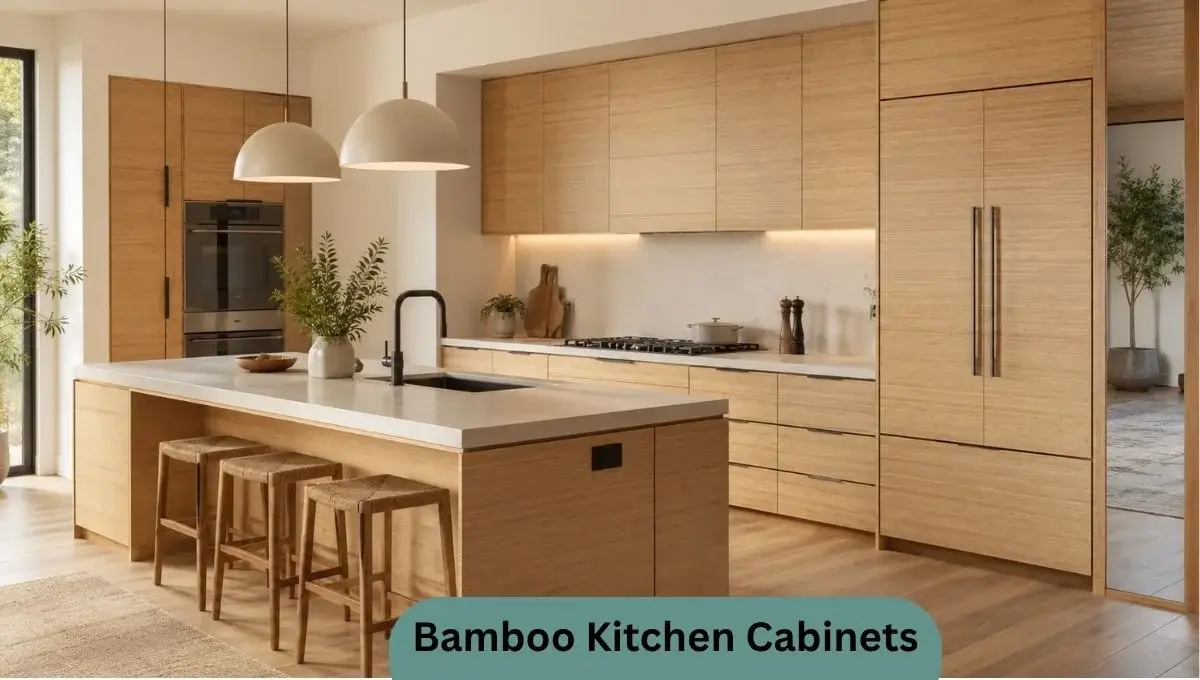
Bamboo kitchen cabinets bring a light, linear look to modern, Japandi, Scandinavian, and minimalist kitchens. They may resemble light wood, but the panels are manufactured from bamboo strips, layers, veneer, or fibers. Construction details matter as much as color and grain.
Quick Answer
Bamboo kitchen cabinets can be a good choice for homeowners who like clean grain, warm light tones, and modern cabinet styles. Quality depends on panel construction, adhesive, finish, edge sealing, cabinet-box material, and manufacturer.
- Material: Laminated bamboo, bamboo plywood, veneer, or bamboo-faced engineered cores
- Color: Pale gold and honey, with darker carbonized or stained options
- Grain: Wider visible nodes in horizontal grain; finer lines in vertical grain
- Best styles: Slab, frameless, Japandi, Scandinavian, contemporary, and selected Shaker kitchens
- Main drawback: Quality, emissions, availability, and moisture protection vary
What Are Bamboo Kitchen Cabinets?
Bamboo is a woody grass, not a traditional hardwood tree. Its stalks do not produce wide boards like oak or walnut. Manufacturers process them into strips, slats, veneers, or fibers, then bond the material into usable panels. Bamboo belongs to the grass family, although finished panels can look and work much like wood in cabinetry.
A “bamboo” cabinet may only have bamboo doors and drawer fronts. Boxes, shelves, and side panels may use plywood, MDF, particleboard, or another engineered material. For a wider comparison, see this guide to kitchen cabinet styles and materials.
FlashyKitchen’s product research found that “bamboo” can describe several constructions. Check the door material, face layer, core, panel thickness, edges, and cabinet-box material separately.
Solid Bamboo Panels vs Bamboo Plywood vs Bamboo Veneer
A solid bamboo panel is usually not one natural piece cut from a trunk. It is a manufactured panel made by laminating bamboo strips or layers with adhesive. Bamboo materials can be processed into laminated sheets and panels rather than being cut as wide natural boards.
Bamboo plywood uses multiple bamboo layers or plies. Thickness, adhesive, and exposed-edge appearance vary. Some panels show a layered edge, while others use matching edge banding.
Bamboo veneer is a thin layer of real bamboo over plywood, MDF, particleboard, or another substrate. Good veneer is not fake bamboo, but the core still affects moisture response, emissions, repair options, and cost.
A bamboo-look surface may be printed laminate with no real bamboo face. Ask for a written material breakdown and confirm whether the quote covers fronts only or a complete cabinet system.
Horizontal vs Vertical vs Strand-Woven Bamboo
Horizontal Bamboo
Horizontal, or flat-pressed, bamboo usually shows the wider face of the strips. Nodes or “knuckles” are often more visible, giving the surface a recognizable bamboo character.
Vertical Bamboo
Vertical, or side-pressed, bamboo shows narrower strip edges. This creates finer, straighter lines that look clean on slab doors and tall pantry fronts.
Ask how grain will run across drawer stacks, island panels, tall doors, and finished sides. Continuous grain can create a calmer look, while random direction may interrupt the flow. Grain matching may cost more, and replacement fronts may not match the original batch.
Strand-Woven Bamboo
Strand-woven bamboo uses compressed bamboo fibers or strands bonded with resin. It differs from standard horizontal or vertical laminated panels.
Do not assume a cabinet uses strand-woven material unless the manufacturer confirms it. Bamboo flooring hardness claims should not be used as proof that every bamboo cabinet door has the same strength or scratch resistance.
What Are the Pros and Cons of Bamboo Cabinets?
Benefits
- Light color and linear grain suit clean, modern interiors.
- Slab, frameless, Shaker, and two-tone designs are possible.
- Panels and veneers provide different construction options.
- Responsibly sourced bamboo may offer environmental advantages.
Drawbacks
- Cabinet lines may be limited in some markets.
- Door, core, adhesive, edge, and box construction vary.
- Natural color choices are narrower than many woods.
- Specialty finishes and grain matching may increase cost.
- Poorly sealed edges can be harmed by repeated moisture.
- Future replacement fronts may differ in color or grain.
Bamboo is not waterproof, scratch-proof, or maintenance-free. Performance depends on the panel, finish, edge treatment, installation, and care.
Natural, Carbonized, and Dark Bamboo Colors
Natural bamboo is commonly pale straw, soft gold, or warm honey. A clear or low-sheen finish can keep it light, while amber-toned coatings make it warmer.
Carbonized or caramelized bamboo is darkened during manufacturing with heat or steam. Dark-stained bamboo gets its color from an applied finish. They are not automatically the same product, and performance claims should be checked for the exact cabinet panel.
Lighting, editing, screen brightness, and finish sheen can change color in photos. Compare physical samples in daylight and evening light.
For a traditional light hardwood look, compare white oak kitchen cabinets. For a smoother, fine-grain alternative, birch kitchen cabinets offer a different natural appearance.
Are Bamboo Cabinets Really Sustainable?
Bamboo can regenerate quickly, but the finished cabinet is not automatically low-impact. Harvesting, manufacturing, adhesives, finishes, transport, product life, and repairability also matter.
Look for clear sourcing information, the panel manufacturer, and FSC certification where available. FSC chain-of-custody certification tracks certified material through the supply chain, but it does not by itself prove low chemical emissions or every environmental claim.
Manufactured panels may contain adhesives, while surface finishes have separate VOC considerations. A low-VOC finish does not prove that the panel adhesive is low-emitting.
Ask for product data and emissions documents. In the United States, EPA TSCA Title VI rules cover formaldehyde emissions from regulated composite wood products, including hardwood plywood, MDF, particleboard, and finished goods containing them.
Popular Bamboo Cabinet Styles
Slab and flat-panel cabinets show the grain with little interruption. They pair well with frameless boxes, full-overlay doors, integrated pulls, and simple hardware.
Shaker bamboo kitchen cabinets add a framed shape around the bamboo surface. The look is more transitional, but the rails and stiles break up the grain.
Two-tone kitchens prevent bamboo from feeling too uniform. Try bamboo lower cabinets with warm white uppers, or a bamboo island with white perimeter cabinets. Dark bamboo can also work with light walls and strong lighting.
Modern Bamboo Kitchen Cabinet Ideas
- Pair natural horizontal-grain bamboo with warm white quartz and a matte backsplash.
- Use a bamboo island with white perimeter cabinets.
- Combine black and bamboo cabinetry only where the room has enough light.
- Choose vertical-grain slab doors with integrated pulls.
- Use light bamboo lowers, warm white uppers, deep drawers, and a full-height pantry in a small kitchen.
Light bamboo can make a compact room feel calmer, but not larger. Keep contrast controlled and use under-cabinet lighting.
What Matches Bamboo Cabinets?
Warm white, cream, light gray, and beige quartz are easy countertop partners. Charcoal or black surfaces create stronger contrast in bright rooms.
Warm white, cream, light greige, muted sage, and soft gray suit the walls. Try warm white tile, cream handmade-look tile, light stone, or matte white tile for the backsplash.
Flooring needs separation. Light oak, neutral tile, polished concrete, or stone-look flooring can work well. If using bamboo flooring, compare undertones rather than matching every tone exactly.
Matte black hardware adds contrast, brushed nickel stays neutral, and brushed brass adds warmth. Integrated edge pulls support a minimalist design.
For a deeper brown natural cabinet option, compare walnut kitchen cabinets instead of forcing bamboo into a very dark stain.
How Much Do Bamboo Kitchen Cabinets Cost?
There is no useful single national average because bamboo kitchen cabinets cost depends on the complete system. Laminated panels, bamboo plywood, veneer, core material, thickness, finish, grain orientation, edge treatment, stock availability, and customization all affect the quote.
RTA bamboo kitchen cabinets may lower assembly costs, but availability can be limited. Semi-custom and custom work may add grain matching, finished sides, unusual sizes, and specialty hardware.
Compare written quotes that include:
- Door and cabinet-box materials
- Panel thickness and edge treatment
- Finished sides, fillers, toe kicks, and end panels
- Hinges, drawer glides, shelves, and hardware
- Grain direction and grain matching
- Delivery and installation charges
- Manufacturer warranty
- Emissions and sourcing documents
A price for replacement bamboo kitchen cabinet doors is not the completed cost of a full cabinet system.
How to Clean and Care for Bamboo Cabinets
Wipe spills quickly, especially near the sink and dishwasher. Use a soft microfiber cloth and a cleaner approved for the exact finish. Remove grease before buildup and dry wet areas instead of leaving water on doors or edges.
Avoid soaking the surface or using abrasive pads, strong bleach, vinegar, baking soda, furniture oil, or “bamboo oil” unless the cabinet maker approves it. Different products use different factory finishes.
Check plumbing, dishwasher clearance, exposed cut edges, and damaged finish areas during regular cleaning. Long leaks can harm both bamboo panels and engineered cabinet boxes.
Are Bamboo Kitchen Cabinets Worth It?
Bamboo cabinets may suit homeowners who want light linear grain, modern slab fronts, frameless cabinetry, custom faces, or a responsibly sourced alternative to common wood looks.
They may not suit buyers who need the lowest-cost stock cabinets, want traditional hardwood grain, or do not want to compare engineered-panel specifications.
A cabinet designer or installer can help with grain direction, large slab fronts, matching end panels, refacing, and sink-area protection. Before ordering bamboo kitchen cabinets, compare physical samples, panel construction, cabinet-box materials, edge details, emissions documents, sourcing certifications, warranties, and complete written quotes.