Choosing a two colour combination for kitchen laminates is harder than selecting two attractive swatches. Both colours must work with the kitchen slab, backsplash, flooring, cabinet layout and actual lighting.
Indian homeowners often call decorative laminate “Sunmica”, although Sunmica is a brand name. The finished kitchen also depends on colour placement, surface finish, edge banding and the plywood shutters beneath it. This guide gives you 12 usable combinations and shows where each shade should go. You will also learn how to test samples, control maintenance and avoid a colour decision that is costly to reverse.
Quick Answer
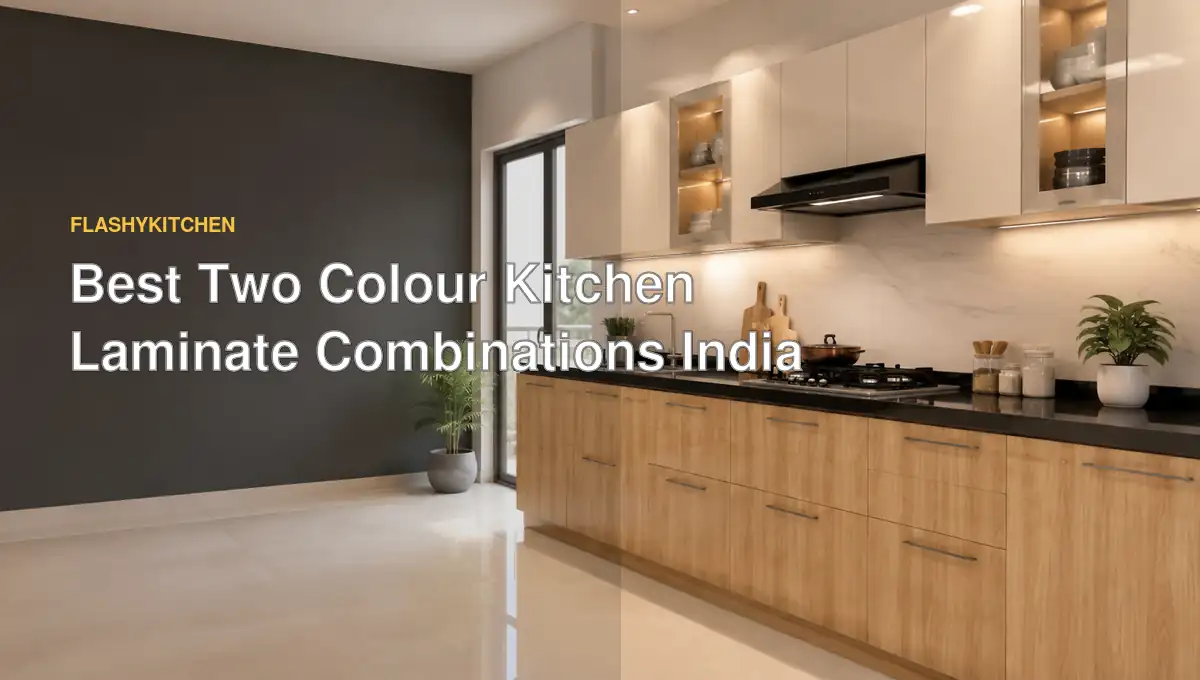
White with a light wood finish is the safest two colour combination for kitchen laminates because it suits many slabs, reflects light and does not feel cold. Grey and white are better for a sharper urban look, while cream and walnut add more warmth.
- Keep overhead cabinets lighter in compact kitchens.
- Place dark or wood colours on base cabinets.
- Match undertones with the slab and flooring.
- Prefer matte finishes if fingerprints bother you.
- Approve physical samples under actual kitchen lighting.
How Do You Choose Two Laminate Colours?
Choose the permanent surfaces first, then select one quiet base colour and one supporting accent. This prevents the cabinet palette from fighting with a black slab, patterned backsplash or warm floor tiles.
Use this five-step method:
- Record the colours already fixed in the slab, floor, backsplash and appliances.
- Choose a light neutral that relates to one of those surfaces.
- Add a darker, warmer or coloured laminate for contrast.
- Decide where the second colour will sit before approving it.
- View both samples during the day and under the final kitchen lights.
A successful two colour combination for kitchen laminates usually needs one shade to lead and the other to support it. Giving both colours equal visual weight can make a compact kitchen feel divided.
While comparing Indian manufacturer guides, a clear pattern appears: they offer many colour lists but little agreement on placement. Treat catalogue pictures as inspiration, then adjust the modular kitchen laminate colours to your room.
12 Two-Colour Combinations for Kitchen Laminates
The right combination depends on daylight, kitchen size, slab colour and your tolerance for cleaning. Each pair below includes a suitable location and a limitation, so every option is not presented as equally good.
| Colour combination | Best suited for | Suggested placement | Main risk |
|---|---|---|---|
| White and light wood | Most small and medium kitchens | White above, wood below | Pure white shows cooking marks |
| Grey and white | Urban modular kitchens | White above, grey below | Cool grey can feel flat |
| Cream and walnut | Warm Indian interiors | Cream above, walnut below | Dark walnut can overpower a small room |
| Navy and white | Bright medium or large kitchens | Navy below, white above | Navy shows dust and scratches |
| Sage green and cream | Soft, naturally lit kitchens | Cream above, sage below | Wrong green undertone may clash |
| Black and wood | Large open kitchens | Wood as the base, black as an accent | Too heavy for low-light rooms |
| Beige and dark brown | Warm flooring and brown granite | Beige above, brown below | Similar tones can look dull |
| Charcoal and light grey | Minimal kitchens with strong light | Light grey above, charcoal below | Dark solids show fingerprints |
| Yellow and grey | Kitchens needing a small accent | Grey as the base, yellow on one unit | Large yellow areas can tire quickly |
| Terracotta and beige | Warm traditional interiors | Beige above, terracotta below | Clashes with cool blue-grey flooring |
| Pastel blue and white | Small kitchens with daylight | White above, blue below | Can feel cold under cool LEDs |
| Ivory and teak | Classic Indian homes | Ivory above, teak below | Orange teak tones can look dated |
White and Light Wood
White and light wood suit the widest range of Indian kitchens. Light oak or ash-effect laminate brings warmth, while white keeps overhead cabinets from appearing heavy.
This pairing works with black granite, pale quartz and many beige floors. Pure white can show masala splashes, so an off-white or warm white may be easier to live with.
Grey and White
Grey and white produce a cleaner, more urban result. For a grey two colour combination for kitchen laminates, choose warm grey beside beige flooring and brown granite.
A cooler grey works better with black, white or blue-grey surfaces. Avoid using medium grey on every cabinet in a kitchen with weak daylight because it can look dull.
Cream and Walnut
Cream and walnut work where bright white looks harsh. This pair suits warm LEDs, cream walls and brown or beige flooring.
Use walnut on base cabinets or one tall unit. Covering every tall and overhead shutter in dark walnut can shrink the room visually.
Sage Green and Cream
Sage green introduces colour without the force of red, orange or yellow. Cream softens the result and suits brass, black or brushed-steel handles.
Check the sample against the slab. Some sage laminates lean grey, while others contain a warmer yellow undertone that may clash with cool flooring.
These neutral and wood-led combinations fit several kitchen design styles, making them easier to retain when décor changes.
Navy and White
Navy and white suit medium or large kitchens with good daylight. Use navy below the slab and white on the overhead cabinets.
Dark blue solids reveal dust, water spots and fine scratches. Skip this combination if you dislike frequent wiping or the room already has a dark floor.
Black and Wood
Black and wood can suit a spacious open kitchen, but black should remain an accent. Use it on a drawer bank, island or one tall cabinet rather than every shutter.
Flat-front slab kitchen cabinets show this contrast clearly because they have little decorative detailing. The same combination can feel severe in a narrow galley kitchen.
Yellow and Grey
Yellow and grey work when yellow occupies a small, deliberate area. Place it on one storage bank, open shelf or selected drawer fronts.
Large glossy yellow surfaces can dominate the kitchen and date quickly. A muted mustard or ochre is often easier to pair with wood and warm flooring.
Terracotta and Beige
Terracotta and beige suit warm floor tiles, wooden furniture and brass-toned handles. Terracotta also hides minor cooking marks better than pale solid colours.
Avoid this pair beside blue-grey tiles or a strongly cool white slab. The competing undertones can make both finishes look incorrectly selected.
Should Upper Cabinets Be Lighter Than Lower Cabinets?
Lighter upper cabinets usually make a compact or low-light kitchen feel less top-heavy. Darker base cabinets can also hide trolley contact, shoe marks and minor daily wear better than pale lower shutters.
This is guidance rather than a fixed rule. A large kitchen with tall windows may support dark overhead cabinets, while a very small kitchen may look calmer in one colour.
Use these placement principles for two colour kitchen cabinets:
- Put white, cream or a pale neutral on overhead cabinets.
- Use wood, grey, navy or another darker colour below.
- Treat a floor-to-ceiling tall cabinet as part of the darker lower block.
- Match loft cabinets with the wall or overhead colour to reduce visual weight.
- Use a bold shade on one complete cabinet bank instead of random shutters.
Light and dark kitchen laminates can define separate work zones. Keep colour changes aligned with full units so the kitchen does not look patched together.
The board beneath the laminate also affects durability and cost. Compare common kitchen cabinet materials before approving only the visible finish.
Match Laminates With the Slab, Floor and Backsplash
Start with the kitchen slab because changing it later is costly and disruptive. Next, check the flooring and backsplash before finalising cabinet laminates.
A black granite slab works with white and wood, ivory and walnut, light grey, cream or beige. Avoid pairing it with two dark cabinet shades unless the kitchen receives strong natural light.
Brown granite often includes warm cream, rust, brown or black details. Beige, cream, muted green and warm wood grain generally relate better to it than blue-grey laminate.
A white or pale quartz slab allows more contrast. Navy, sage, grey, terracotta and wood tones can work, but the quartz veining should guide the undertone.
A patterned backsplash already acts as a focal surface. Use one quiet laminate and one restrained accent instead of placing two bold cabinet colours beside busy tiles.
Appliances and handles also change the palette. Stainless steel suits cool greys and blues, while brass-toned handles often relate better to cream, green and warm wood.
Small accessories introduce extra colour after installation. Keeping countertop décor controlled prevents a two-tone kitchen from becoming visually crowded.
Matte or Glossy: Which Colour Is Easier to Maintain?
Matte and lightly textured laminates usually hide fingerprints better than dark high-gloss surfaces. Gloss reflects more light, but smudges and fine scratches become easier to notice.
| Finish | Effect on light | Daily maintenance | Suitable use |
|---|---|---|---|
| Matte | Soft, low reflection | Hides fingerprints well | Busy family kitchens |
| High gloss | Reflects more light | Shows marks and scratches | Pale overhead cabinets |
| Wood grain | Adds visual texture | Hides minor wear | Base and tall cabinets |
White reveals food splashes quickly but also makes dirt easy to find. Black, navy and charcoal can show dust, dried water spots and oily fingerprints.
Mid-tone grey and wood-grain patterns hide small marks better than dark solid colours. Deep texture, however, may take longer to clean if airborne grease settles into the grooves.
Wipe spills with a soft damp cloth and follow the manufacturer’s care instructions. Avoid abrasive pads that may dull gloss or damage the printed surface.
Current cabinet colour trends can provide ideas, but trend value should not outweigh daily care. Dark gloss is a poor choice for anyone who already dislikes wiping fingerprints.
Check Samples Before the Carpenter Starts
Approve a physical sample vertically against the planned cabinet position. A laminate can appear lighter, darker or warmer when it moves from a small swatch to a full shutter.
Place both samples beside the slab, floor and backsplash. Check them in morning daylight, cloudy conditions and under the artificial lights used at night.
Cool white LEDs can make grey appear bluer. Warm LEDs strengthen cream, beige and orange wood tones. This explains why a kitchen Sunmica colour combination may look balanced in a catalogue but wrong after installation.
Before fabrication:
- Record the manufacturer, décor code, finish and sheet thickness.
- Ask for matching edge banding on every visible shutter edge.
- Mark one grain direction for all wood-patterned panels.
- Confirm that visible sheets come from matching production batches.
- Check the colour of cabinet interiors and open shelves.
- Keep a labelled offcut for repairs or later matching.
Edge banding is the narrow strip covering the sides of a cabinet shutter. A poor match can leave a distracting line around otherwise well-chosen colours.
The plywood substrate is the structural board beneath the laminate. High gloss can expose an uneven shutter surface, so preparation quality matters as much as colour.
Changing laminate later may damage the shutter face and add fabrication costs. If the existing colour is acceptable, replacing handles or adjusting lighting may be smarter than re-laminating every panel. The methods used for modern oak cabinets show how hardware and light alter colour perception.
What Do Kitchen Laminates Cost in India?
The price of a two colour combination for kitchen laminates depends more on the chosen sheets and finish than on using two colours. Adding another colour may create extra sheet waste if the required quantities do not divide neatly.
An Indian manufacturer’s published guide checked in August 2026 lists some 1 mm high-gloss sheets around ₹1,500 to ₹3,500. Its matte or textured examples range from about ₹1,200 to ₹2,500 per sheet.
These are examples, not an India-wide average. Prices vary by city, brand, seller, finish and sheet size. The quoted sheet rate excludes plywood and may also exclude adhesive, edge banding, fabrication, transport and installation.
Ask the vendor to state:
- Number of laminate sheets
- Décor code and finish
- Plywood or board specification
- Edge-band type
- Fabrication and fitting charges
Choose a Pair You Can Live With
For most Indian homes, white with light wood, grey with white or cream with walnut provides a dependable two colour combination for kitchen laminates. Choose the pair that fits your slab, light and cleaning habits rather than the boldest catalogue image.
Your next step is to tape two labelled samples beside the kitchen slab for a full day. Approve their placement, finish, edge band and grain direction only after checking them under both daylight and artificial light.