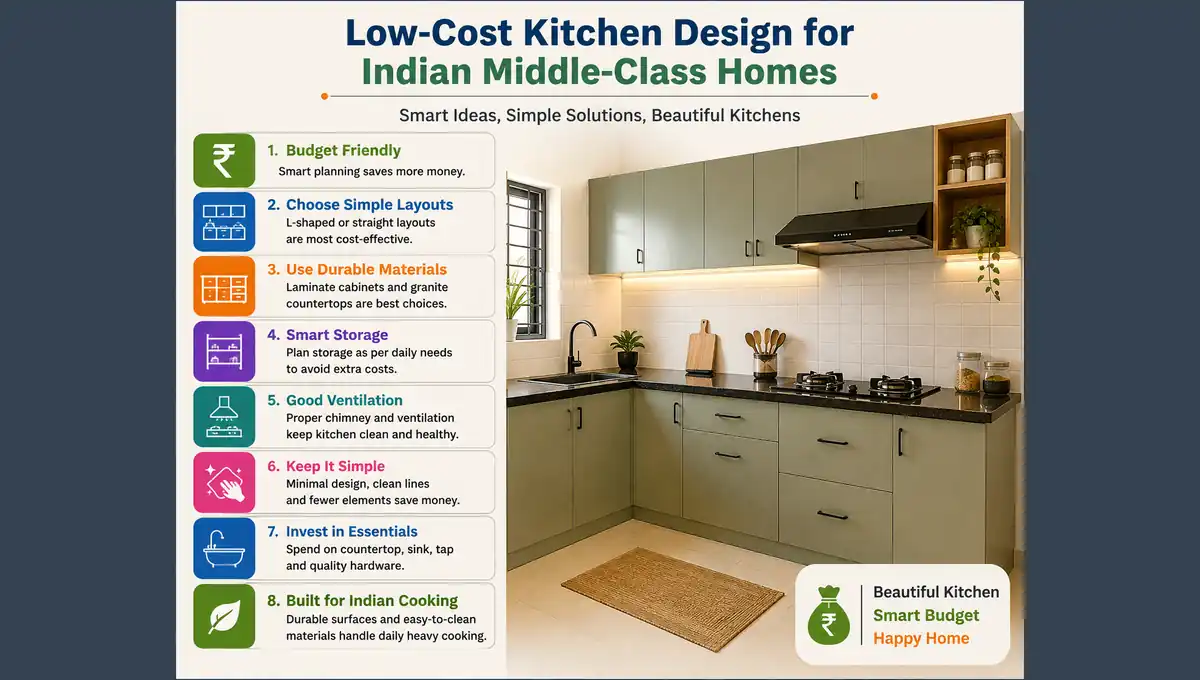
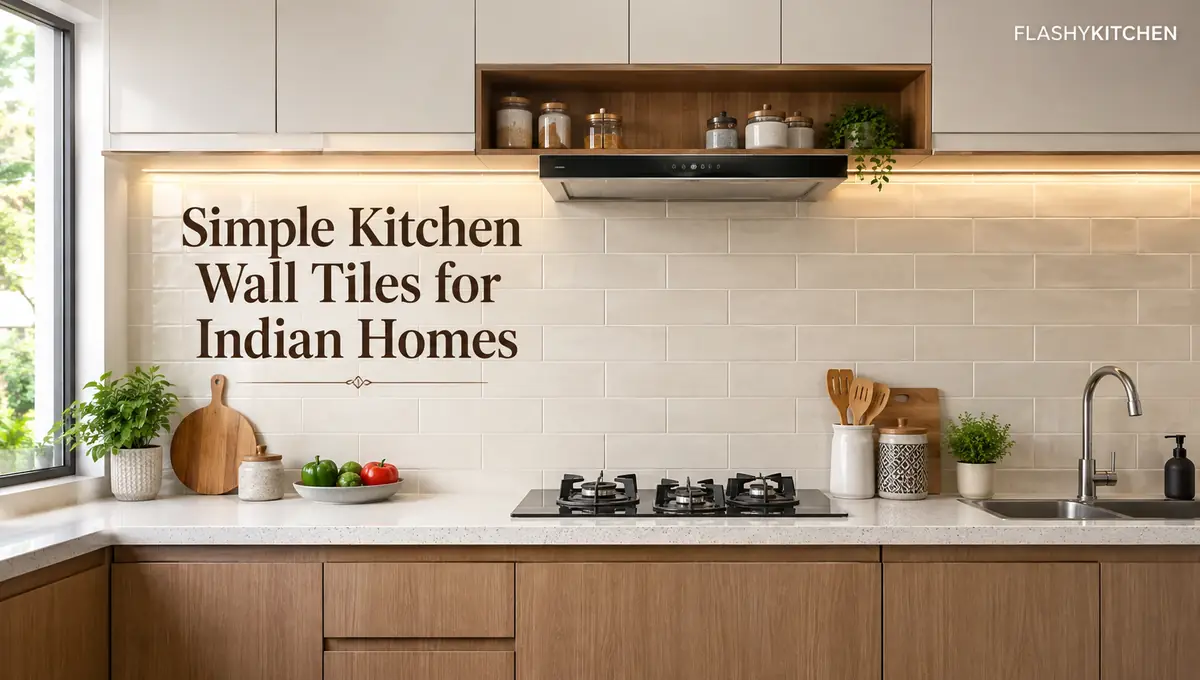
A simple kitchen wall tiles design should make an Indian kitchen easier to clean without making the room feel busy. Oil mist, tadka, turmeric, steam and dust can settle around the hob and kitchen platform, so surface texture and grout matter as much as colour. The safest approach is usually a calm tile, a smooth face and a layout that avoids unnecessary joints.
You can still add pattern, but it should have a clear purpose. This guide helps you choose the right colour, material, tile size, dado height and budget, while avoiding finishes that create extra cleaning later.
Quick Answer
For most Indian homes, start with smooth glazed ceramic or vitrified wall tiles and keep deep texture away from the hob. A simple kitchen wall tiles design works best when colour, tile size and grout are chosen together.
- Use light, low-contrast tiles in small kitchens.
- Choose larger tiles when fewer grout joints matter.
- Pick subway tiles when you want visible pattern.
- Prefer smooth glossy, satin or matte surfaces near cooking zones.
- Keep bold Moroccan or geometric patterns to one controlled area.
Simple Kitchen Wall Tiles Design Ideas That Stay Easy to Clean
The best simple kitchen tiles design gives enough visual interest without creating extra joints, grooves or competing patterns. A review of current Indian tile guidance shows repeated use of subway, neutral, marble-look, geometric and large-format designs, but daily maintenance should decide how you use them.
| Design | Best use | Cleaning level | Main drawback |
|---|---|---|---|
| Warm white or ivory | Small or dark kitchen | Easy | Light grout can show stains |
| Subway tile | Patterned backsplash | Moderate | More joints than larger tiles |
| Beige or soft grey large tile | Calm wall | Easy | Cuts may be awkward |
| Marble-look tile | Plain cabinets and slab | Easy | Strong veining can feel busy |
| Patterned accent | One focal area | Moderate | Can date faster |
| Deep textured tile | Low-splash feature wall | Harder | Grease can collect in grooves |
White, Ivory and Soft Neutral Tiles
Warm white, cream, beige and light grey work well when cabinets or the kitchen slab already have strong colour or pattern. They keep the wall quiet and can help a compact room feel less crowded.
Pure white is not automatically the easiest option. White grout can show oil and spice staining sooner, so choose the grout shade with the tile.
Modern kitchen wall tiles also do not need bold prints. A plain surface with a restrained grout colour often looks cleaner than several competing decorative elements.
Subway and Stacked Tiles
Subway tiles add rhythm without needing a printed pattern. Horizontal layouts feel familiar, while vertical stacking creates a cleaner grid.
The trade-off is joint count. Smaller subway tiles create more grout lines than a 300×600 mm tile, so choose them for the pattern rather than assuming they are lower maintenance.
Marble-Look, Brick-Look and Soft-Colour Tiles
Marble-look tiles work best when the kitchen slab is fairly quiet. Strong veining beside a busy granite slab can make a small wall feel crowded.
Muted sage, dusty blue and soft green suit white, cream and wood-tone cabinets. Brick-look tiles can suit rustic or industrial kitchen design styles, but deep relief should stay away from the frying zone.
Use Pattern in One Controlled Area
Moroccan and geometric tiles can give an Indian-style wall more character without covering every surface. Use them behind one counter run or as a short focal panel.
Literal fruit or utensil motifs are more theme-specific and can date faster. Restrained geometry or tonal pattern is easier to coordinate if cabinet colours change later.
What Colour and Tile Style Work Best in a Small Kitchen?
Light, low-contrast tiles are usually the safest choice for a small kitchen because they reduce visual weight. Large tiles can reduce grout lines, but they do not physically make the room larger.
For a small house modern kitchen tiles design, warm white, pale beige, soft grey, muted green and light blue are easy starting points. Glossy surfaces reflect more light, while smooth satin or matte finishes can reduce glare.
When choosing tiles for a small kitchen, check the sample under your actual kitchen lighting ideas before ordering. A grey tile can look blue or beige under different LED temperatures.
Comparing current Indian manufacturer ranges shows that 300×600 mm and 600×1200 mm are readily available kitchen-wall formats. The better size is still the one that fits your wall without narrow cuts around sockets, windows and corners.
If the tiles are part of a small kitchen remodel, finalise cabinet, platform, chimney and electrical positions before setting the tile grid. Dark grey or black tiles can work in a bright kitchen, but they absorb more light and may show oily smears or hard-water marks.
Ceramic, Vitrified, Glossy or Matte: Which Is Easier to Live With?
For a normal kitchen wall, smooth glazed ceramic is often enough. Porcelain and vitrified tiles can offer denser bodies, larger formats and specific finishes, but a higher-priced material is not automatically more useful on a protected vertical surface.
Indian kitchen wall tiles are available in both ceramic wall bodies and glazed vitrified formats. The right choice depends more on the required finish, size and maintenance level than on buying the more expensive label.
Ceramic vs Porcelain and Vitrified
Glazed ceramic wall tiles come in many wall-friendly sizes and finishes. Their glazed, relatively low-porosity surface is useful for an easy-clean backsplash where grease splashes need regular wiping.
Porcelain tiles are denser and generally absorb less water than ordinary ceramic. That advantage matters strongly on floors and wet areas; on a kitchen wall, finish, grout lines and installation quality may matter more to daily use.
Vitrified tiles are common in larger formats and stone-look designs. Current Indian manufacturers list both ceramic wall tiles and glazed vitrified products for kitchens, so neither label should be treated as automatically superior.
Glossy vs Matte
A glossy finish reflects light and is usually easy to wipe. A smooth satin or matte finish can also work well when you want less glare.
Current Indian guidance differs on which finish is preferable for heavy cooking. One current guide favours glossy or satin surfaces for easy cleaning, while another also recommends matt or satin options in heavy-use kitchens. Surface smoothness and location are therefore more useful decision factors than the glossy-versus-matte label alone.
Why Deep Texture Behind the Hob Is a Mistake
Deep fluting, carved relief and strong 3D texture can trap oily dust in grooves. That makes them a poor choice in the hob area if you fry often.
Textured tiles can still work on a low-splash feature wall. Keep the active cooking zone smooth so turmeric stains and oily residue can be wiped before they harden.
Current easy-maintenance guidance also recommends avoiding heavily embossed surfaces where grease is likely to collect.
What Tile Size, Grout and Dado Height Should You Choose?
Choose tile size after measuring the actual wall, not from a showroom display. Fewer grout lines can reduce cleaning, but an oversized tile may create waste or awkward slivers around sockets and cabinets.
Current Indian manufacturer ranges commonly include 300×600 mm and 600×1200 mm kitchen wall tiles. A 300×600 mm format is a useful starting point for many walls, while smaller tiles suit narrow backsplashes and decorative patterns.
For quantity planning, measure each tiled wall as width × backsplash height, then subtract large openings such as windows. Add the wall areas together before converting them to the coverage printed on the tile box.
Cuts around corners, sockets and patterns create waste. One current Indian manufacturer calculator provides a 10% wastage option, which is useful as a planning reference rather than a fixed rule for every project.
Which Grout Is Best for a Kitchen Backsplash?
Grout is the joint filler between tiles. Light grout shows staining sooner, while a colour-matched or slightly darker grout can make the wall easier to maintain visually.
Epoxy grout offers stronger stain and moisture resistance than ordinary cement grout and is commonly recommended for high-use backsplash zones. It costs more, so use it where the maintenance benefit matters.
How High Should Kitchen Dado Tiles Go?
Kitchen dado tiles protect the working wall above the kitchen platform. Around 600 mm is a common Indian planning reference, but it is not a universal rule.
Indian manufacturer guidance describes 60 cm as a typical backsplash height. The Central Public Works Department’s 2025 plinth-area rates also specify a 600 mm dado above the kitchen platform for the government housing specification covered by that document.
Your actual backsplash height should follow the wall cabinets, windows, chimney, sockets and tile module. Before ordering, measure the platform top, cabinet underside, window sill, socket positions and hob/chimney line.
If you are doing the work separately from the main renovation, understand the kitchen backsplash installation sequence before ordering materials.
Backsplash or Full Wall?
Kitchen backsplash tiles are enough when you mainly need protection between the platform and upper cabinets. Full-wall tiling makes more sense on a wall without upper cabinets or where you want one continuous washable surface.
Full-wall tiling uses more tile, adhesive, grout and labour. Outside the main cooking and sink zones, wallpaper versus paint may be a cheaper finish than tiling every wall.
How Much Do Kitchen Wall Tiles Cost in India?
Kitchen wall tile prices in India vary by material, size, finish, seller and whether the figure covers only tile or a wider installation service. Compare quote scope before comparing ₹/sq-ft figures.
As checked in August 2026, current retailer examples include 12×24-inch ceramic wall tiles around ₹75 per sq ft and 3×12-inch fluted wall tiles around ₹240 per sq ft. Both cited listings exclude GST and freight, so they are not complete installed prices.
This spread shows why small decorative tiles are not automatically the cheap option. A low-cost wall design is often easier to achieve with a common glazed ceramic format.
A complete quote may also include tile adhesive, grout, edge trims, cutting, wastage, surface preparation, labour and transport. Prices vary by city, retailer, tile collection and installation scope, so confirm what is included before comparing quotes.
Also check whether removal of old tiles or repair of uneven plaster is included. These jobs can change labour and adhesive use even when the replacement tile itself is inexpensive.
Kitchen Wall Tile Mistakes That Create More Cleaning
The biggest mistake is choosing tiles from photos without checking grease, grout and actual wall dimensions. Real-user discussions repeatedly complain about too many joints and surfaces that become difficult to clean.
Do not put deeply grooved tiles directly behind the hob. Oil mist and dust can settle in the relief.
Do not assume white grout will stay white beside frequent frying. Choose grout colour and type for maintenance as well as appearance.
Avoid mixing a busy granite slab, strong cabinet grain and heavily patterned backsplash. Let one surface lead and keep the others quieter.
Do not force a large tile onto a wall if it produces thin cuts around sockets or corners. Fewer joints help only when the finished layout still looks intentional.
Keep spare tiles from the same production batch after installation. Add the backsplash and grout to a deep-clean kitchen routine before oil mist becomes a sticky film around corners and the chimney zone.
Which Kitchen Wall Tile Should You Choose?
For most Indian homes, the safest simple kitchen wall tiles design uses a smooth, easy-clean surface, a calm colour and a tile size that fits the wall with sensible cuts. Use pattern only where it adds something, and avoid deep texture behind the hob. Measure the dado, check socket and cabinet positions, compare complete quote scope, and take the actual tile sample home before ordering the full quantity.