Indian cooking can produce a lot of smoke, steam, oil vapour and strong odours, especially during tadka, deep-frying and high-heat cooking. A kitchen chimney can remove much of that pollution at the source, but buying the wrong size or installation type can leave you with noise, weak capture and extra maintenance.
The right choice depends on your hob width, cooking intensity, duct route and cleaning tolerance, not simply the number of burners. This guide explains kitchen chimney size, suction power, filters, ducted versus ductless options, current India price examples and the installation details that matter before you spend.
Quick Answer
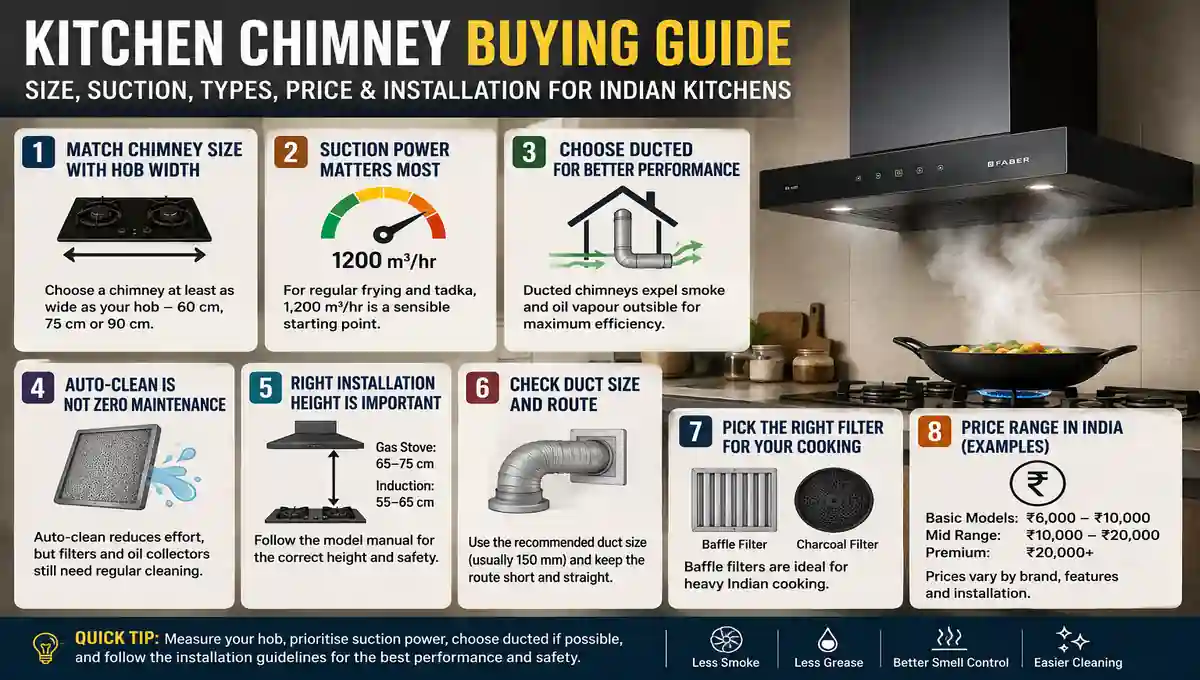
For most Indian homes, choose a kitchen chimney at least as wide as the hob and prefer ducted exhaust when an outside route is practical. For regular frying and tadka, about 1,200 m³/hr is a sensible starting point, not a universal rule.
- Measure the actual hob width first.
- Prioritise suction over smart controls.
- Choose ducted for heavy oily cooking where possible.
- Treat auto-clean as reduced maintenance, not zero maintenance.
- Follow the model manual for installation height and duct size.
Do You Really Need a Chimney in an Indian Kitchen?
A kitchen chimney is most useful when cooking regularly produces smoke, oil vapour and strong odours. Indian frying, roasting, tempering spices and tadka can send grease particles beyond the cooking zone and onto cabinets, walls and ceilings.
A chimney pulls polluted air from directly above the stove before much of it spreads around the room. Manufacturer guidance also specifically connects higher suction needs with frequent frying and spice-heavy Indian cooking.
The main benefits are practical:
- Less smoke around the cooking area
- Reduced grease settling on nearby surfaces
- Better control of strong cooking smells
- Less stuffiness in compact or enclosed kitchens
- Easier cleaning around the stove and upper cabinets
A chimney does not make a kitchen maintenance-free. Grease can still settle outside the capture area, so regular appliance cleaning and surface cleaning remain necessary.
You may not need a costly chimney if you cook very lightly, have excellent cross-ventilation and rarely fry. A strong exhaust fan can also be a cheaper alternative for some kitchens, although it cannot capture fumes as close to the cooktop.
For households using a gas stove, good ventilation remains important even with a chimney. Follow basic kitchen safety tips and never treat a chimney as a replacement for proper fresh-air ventilation.
Which Type of Kitchen Chimney Is Best for Indian Cooking?
For most wall-side Indian cooking areas, a wall-mounted ducted chimney is the simplest starting point. Built-in, inclined and island models make sense when the kitchen layout requires them rather than because one shape is automatically better.
| Chimney type | Best suited to | Main limitation |
|---|---|---|
| Wall-mounted | Stove or hob against a wall | Visible body and duct cover |
| Built-in | Chimney hidden within cabinetry | Cabinet planning must be precise |
| Inclined | Tight headroom or design-led kitchens | Shape alone does not improve suction |
| Island | Hob on a central island | More complex ceiling installation |
Wall-mounted models dominate typical Indian modular kitchens because the hob usually sits against a wall. Island chimneys hang from the ceiling and only make sense when cooking happens on an island. Faber and Crompton both separate wall, island and built-in or shaped models by installation layout.
If you are planning cabinetry around the appliance, chimney dimensions should be settled before you install kitchen cabinets. Cutting finished cabinets later is an avoidable expense.
For a compact renovation, do not assume a mini chimney for kitchen use is automatically the answer. A physically smaller hood that does not cover the hob can capture smoke poorly. Space planning in a small kitchen remodel should account for both chimney width and the route of its duct.
Kitchen chimney design should come after performance. Glass, black finishes, curved hoods and inclined fronts can suit different kitchen design styles, but shape cannot compensate for the wrong width or weak extraction.
What Kitchen Chimney Size Should You Buy?
Choose a kitchen chimney that covers the width of the cooking surface. Measuring the actual hob or gas stove is more reliable than choosing only by burner count.
Indian manufacturers commonly offer 60 cm, 75 cm and 90 cm chimneys. Crompton recommends 60 cm for smaller two-burner cooktops, with wider 75 cm and 90 cm options for larger cooking surfaces. Faber also pairs wider hobs and more burners with larger hood widths.
A useful starting point is:
| Actual cooktop width | Chimney size to consider | What to check |
|---|---|---|
| Up to about 60 cm | 60 cm | Hood covers the whole cooking width |
| Around 60–75 cm | 75 cm or wider | Do not rely only on burner count |
| Wider hob around 75–90 cm | 90 cm | Confirm cabinet and duct clearance |
These are buying guidelines, not installation rules. Check the exact product specifications before ordering.
This matters because three-burner stoves are not all the same width. One may fit beneath 60 cm, while another may extend well beyond it. Real Indian buyers also raise this problem when comparing a 70 cm three-burner cooktop with 60 cm chimney options.
For kitchen chimney size in inches, 60 cm is about 24 inches, 75 cm about 30 inches, and 90 cm about 35 inches. Use the manufacturer’s metric size for ordering because Indian listings usually specify chimney width in centimetres.
How Much Suction Power Is Enough for Indian Cooking?
Regular tadka, frying and oily cooking generally justify stronger suction than light boiling or steaming. Around 1,200 m³/hr is a useful starting point for many Indian homes, while heavier cooking or larger capture areas may justify higher-rated models.
Current Indian manufacturer guidance spans roughly 1,000 to 1,500 m³/hr for many common home-use situations. Crompton suggests 1,000 to 1,500 m³/hr depending on kitchen size and cooking habits, while Faber describes about 1,200 m³/hr as a general fit for many standard homes and higher ratings for heavier cooking.
Current Elica models also show why suction should not be treated as one fixed target. Its India catalogue includes 60 cm and 90 cm models around 1,200, 1,425 and 1,500 m³/hr.
Higher is not automatically better. More airflow can mean more noise, higher cost and no useful gain if the hood is already capturing your normal cooking fumes.
Use four factors together:
- Cooking intensity
- Hob width
- Duct design
- Noise you will tolerate daily
This last point matters more than many buying guides admit. A high-suction chimney that is unpleasantly loud may simply be left off during normal cooking.
Ducted vs Ductless Kitchen Chimney: Which Is Better?
A ducted kitchen chimney is usually the stronger option for frequent Indian frying because it sends extracted air outdoors. A ductless chimney filters the air and returns it to the kitchen, making it useful where an outside duct route is impractical.
A ducted system removes smoke, odour and grease-laden air from the room. It needs a proper outlet through a wall or another approved external route.
A ductless chimney, sometimes searched as a “chimney without pipe”, normally uses an activated carbon filter for odour control. An Elica installation manual notes that adding an activated carbon filter reduces suction performance.
That does not mean ductless models never work. They solve a real problem in flats where drilling an external wall or routing a long pipe is difficult.
The trade-off is more important for heavy Indian cooking. Recent Indian user discussions repeatedly focus on odour retention, oil deposits, filter replacement and whether ductless systems can handle daily tadka. Experiences are mixed, which is a good reason not to treat one homeowner’s result as universal.
If you own the home and can create a short, sensible outside duct route, ducted is usually the better long-term decision. If you cannot alter the exterior wall, compare a ductless chimney with a strong exhaust fan rather than buying one without understanding the compromise.
Baffle, Mesh, Filterless and Auto-Clean: What Do They Mean?
Filterless, ductless and auto-clean describe different things. Confusing them is one of the easiest ways to buy the wrong chimney.
A baffle filter uses shaped metal plates to separate oil droplets from moving air. It can handle greasy cooking well, but the filter still needs washing.
A mesh filter uses multiple fine layers that trap grease. As the mesh fills, airflow can fall, so regular cleaning matters. Faber describes both baffle and mesh systems and notes the higher cleaning requirement of mesh filters.
A filterless chimney removes the traditional grease filter from the main airflow path. It can still be a ducted chimney. Current Elica filterless models, for example, are sold with 60 cm and 90 cm sizes and heat auto-clean features.
A ductless chimney refers to the exhaust route, not the grease-filter design.
Auto-clean also does not mean “never clean the chimney.” Heat auto-clean systems move collected oil toward an oil collector, reducing some manual cleaning. The oil cup, outer surfaces and accessible internal areas still need attention.
If grease repeatedly reaches surrounding cabinetry, check both chimney performance and the condition of nearby cabinet materials. Persistent deposits can be a sign that the hood is undersized, poorly positioned or not being used early enough during cooking.
Kitchen Chimney Price in India: What Should You Budget?
Kitchen chimney price in India varies sharply by width, motor, suction, controls, auto-clean system and seller discounts. There is no single useful “average price” that represents every model.
Live manufacturer and brand listings checked in August 2026 show how wide the spread can be:
| Current example | Width / suction | Listed price |
|---|---|---|
| Köche Enzo | 60 cm / 1,450 m³/hr | ₹14,990 sale |
| Faber Stilux | 60 cm / 1,095 m³/hr | ₹21,004 sale |
| Crompton SensoSmart | 60 cm / 1,367 m³/hr | ₹31,790 MRP |
These are examples, not a market average. Sale prices and MRPs are not directly comparable, and prices can change by seller, city and promotion.
Premium listings can go higher. Crompton currently lists models above ₹40,000 and ₹50,000 MRP, showing why paying more is not automatically evidence of better smoke capture for your kitchen.
Budget separately for installation if it is not included. Before ordering, ask whether the quote includes:
- Wall drilling
- Duct pipe and bends
- External vent cover
- Installation labour
- Electrical socket work
- Cabinet cutting or modification
A cheap chimney with a difficult duct route can cost more to install than expected.
How High Should a Kitchen Chimney Be Installed?
There is no single installation height that should be copied across every kitchen chimney. Use the exact manual for the model you buy.
This point matters because even manuals from one manufacturer can differ. One Elica manual specifies 65–75 cm above the cooktop, while another specifies 70–75 cm.
That is why averaging installation heights is a mistake.
The same applies to duct size. One Elica model manual specifies a 150 mm extraction duct, but that figure should not be assumed for every chimney.
Before installation:
- Confirm hob position and final counter height.
- Check the model’s required hood clearance.
- Verify the duct diameter in its manual.
- Plan the shortest practical outside route for a ducted unit.
- Keep major bends to a minimum where the manufacturer advises it.
- Confirm a properly earthed electrical connection.
Manufacturer instructions also call for qualified installation and adequate ventilation when a chimney is used with gas-burning appliances.
If installation requires a new opening through an exterior wall in an apartment, check the building or housing-society rules before drilling.
Common Kitchen Chimney Mistakes to Avoid
The most expensive chimney mistake is buying from the feature list before checking the kitchen itself. Suction numbers, gesture control and auto-clean cannot fix a hood that is too narrow or a poor duct route.
Avoid these mistakes:
- Buying by burner count without measuring the stove
- Choosing a 60 cm hood over a wider hob
- Assuming filterless means ductless
- Assuming auto-clean means no manual cleaning
- Ignoring noise at the highest usable speed
- Forgetting installation and ducting costs
- Copying another model’s installation height
Another common mistake is focusing on the best kitchen chimney brand in India instead of local service support. Faber, Elica, Crompton, Glen, Hindware, Kutchina and other brands sell multiple product types, and quality can differ between models.
Check service availability in your city before choosing between two otherwise similar products. Recent Indian buyer discussions show after-sales availability can become a deciding issue outside major metro areas.
Which Chimney Is Best for an Indian Kitchen?
The best chimney for an Indian kitchen is the one sized for the actual hob, powerful enough for your cooking, practical to duct and easy enough to maintain that you will use it every day.
For frequent tadka and frying, a well-sized ducted model around 1,200 m³/hr or higher is a sensible shortlist starting point. Then compare noise, filter or filterless design, auto-clean system and service support.
For light cooking, do not automatically pay for maximum suction or every smart feature.
For a kitchen where no outside duct is possible, a ductless model may be the practical compromise. Go into that choice expecting carbon-filter maintenance and weaker odour removal than a properly installed ducted system.
Make the Final Choice
For most Indian kitchens, the safest buying sequence is simple: measure the hob, confirm whether you can vent outdoors, then choose suction and maintenance features. A well-sized ducted kitchen chimney usually suits frequent tadka and frying better than a recirculating setup.
Before ordering, compare the model manual, installation scope, noise rating and service support in your city. That one check prevents most expensive mistakes.