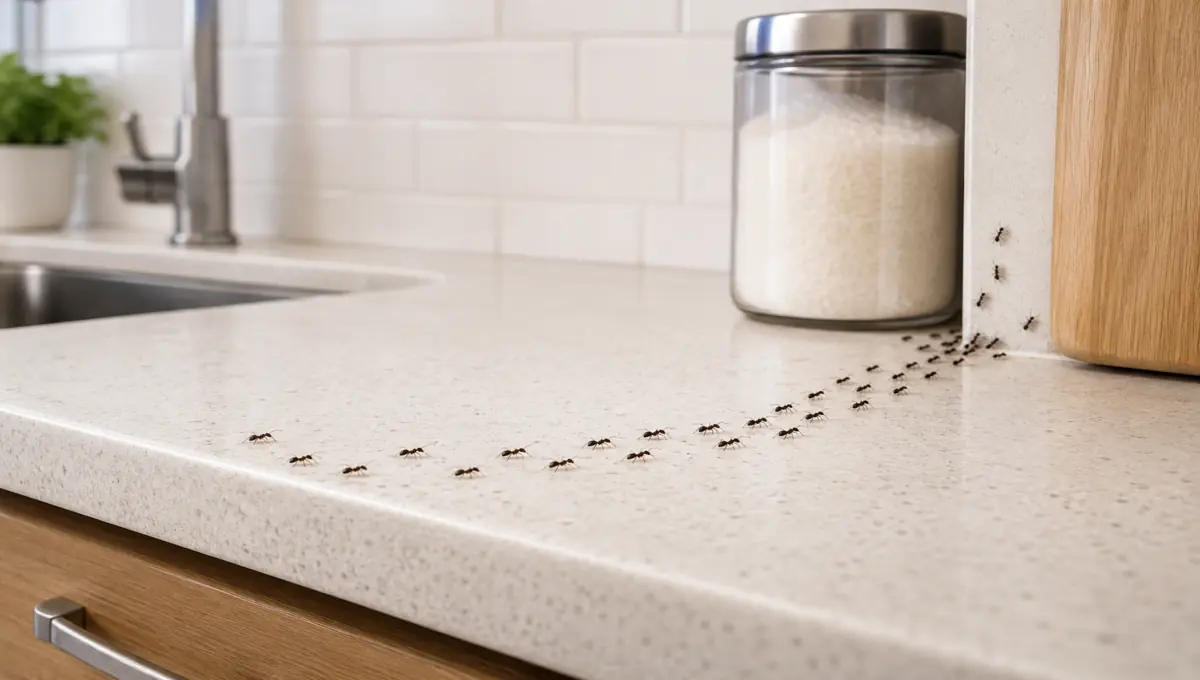
Seeing ants on a kitchen counter does not always mean the room is dirty. Learning how to get rid of ants in the kitchen starts with understanding where they are coming from and what keeps bringing them back. The ants you see are usually worker ants searching for food or water from a larger colony.
Killing those workers can make the kitchen look ant-free for a short time without solving the source. A better approach is to follow their trail, remove competing food and moisture, use the right bait when needed, and seal entry points after activity drops.
Quick Answer
To get rid of ants in the kitchen, follow the active ant trail, remove accessible food and water, and place a slow-acting ant bait near the route if workers keep returning. Avoid spraying ants that are feeding on bait because they need time to carry it back toward the colony.
- Clean crumbs, grease, and sticky spills.
- Find the ants’ entry route.
- Remove easy food and water sources.
- Use bait that the ants will actually eat.
- Seal entry gaps after activity falls.
Why Do Ants Keep Coming Back After I Clean?
Ants can keep returning after you clean because crumbs are only one part of the problem. A nearby colony, reliable water source, or established ant trail can keep workers entering an otherwise clean kitchen.
Ants leave a pheromone trail, which is a chemical scent path other workers can follow. If a worker finds food or water, that route can become busy even after you remove the original attraction.
Look beyond the obvious countertop. Check for:
- Grease beside or beneath appliances
- Sugar or syrup residue
- Pet food and water bowls
- Open trash or recycling
- Damp sponges and dishcloths
- Dripping faucets
- Food inside cabinet corners
A targeted deep kitchen clean is more useful than repeatedly wiping an already-clean counter.
Then watch a few ants before removing them. Their direction may lead to a baseboard gap, cabinet seam, window frame, wall crack, or opening around a plumbing pipe.
If you have been asking, “Why do I have ants in my kitchen when it is clean?” the answer may be water, access, or a nearby colony rather than poor housekeeping.
What Are These Tiny Ants in My Kitchen?
Tiny ants walking across a kitchen counter are normally adult worker ants, not baby ants. Ant larvae remain inside the nest, where workers care for them.
Homeowners may call very small ants sugar ants, little black ants, ghost ants, grease ants, or simply tiny kitchen ants. Those names can be useful descriptions, but size and color alone may not identify the exact species.
If you are trying to figure out how to get rid of tiny ants in the kitchen, watch their behavior before choosing a treatment.
Notice what they are feeding on.
Ants gathering around syrup, fruit, or sugar may accept a sweet bait. Ants feeding around meat, grease, nuts, or oily residue may prefer protein or fat.
This matters because a bait can fail simply because the ants do not want that food source at that time.
The same rule applies if you are searching for how to get rid of sugar ants in the kitchen, small black ants, or little ants. Start with what they are eating and where they are traveling instead of guessing the species from appearance alone.
How to Get Rid of Ants in the Kitchen for Longer-Term Control
The most reliable way to get rid of ants in the kitchen is to handle four separate jobs: find the route, remove competing food and water, target the colony, and close the entry point. A single spray or home remedy rarely does all four.
Follow the Ant Trail
Do not immediately wipe out every worker you see.
Watch where the ants travel. Follow the line toward cabinets, baseboards, windows, plumbing openings, countertop seams, or door frames.
You do not need to locate the actual ant nest before taking action. Finding the active route helps you decide where to clean and where bait may work.
If ants are actively feeding on bait, avoid sealing their entry gap immediately. Letting workers continue using the route for a short period can help them carry slow-acting bait back toward the colony.
Remove Food and Water Competition
Clean the food sources ants can choose instead of your bait.
Store sugar, flour, cereal, snacks, and other pantry food in closed containers. Better kitchen pantry organization also makes leaking packages and forgotten spills easier to notice.
Clean grease from cooking areas and remove crumbs beneath small appliances.
Empty food waste regularly. Rinse containers before leaving them in indoor recycling.
Water matters too. Fix dripping faucets, dry standing water, and avoid leaving wet sponges or cloths around the sink overnight.
Removing these competing resources makes the kitchen less attractive and can make properly placed bait more effective.
Vinegar, Cinnamon, Spray, or Ant Bait: What Actually Works?
These methods are not interchangeable. Some remove trails, some repel ants, some kill visible workers, and some are designed to affect the colony.
| Method | What it does | Best use | Main limitation |
|---|---|---|---|
| Vinegar or soapy cleaning | Removes or disrupts trails | Cleaning ant routes | Usually temporary |
| Cinnamon or scent repellents | Discourages workers | Short-term barrier | Ants may find another route |
| Contact spray | Kills exposed ants | Fast visible reduction | Usually misses the colony |
| Slow-acting bait | Targets the colony | Longer-term control | Requires time and feeding |
Does Vinegar Get Rid of Kitchen Ants?
Vinegar can help clean surfaces and interfere with the scent trail ants follow. That can reduce activity on a particular route.
It should not be confused with colony elimination.
If the nest remains active, workers may return through the same opening or create another trail.
This is why people trying to get rid of ants in the kitchen naturally can see short-term improvement with vinegar without getting a permanent result.
Does Cinnamon Work?
Cinnamon is mainly a repellent. Ants may avoid an area with a strong scent, but avoiding one route does not mean the colony is gone.
If ants simply move to another cabinet edge or wall opening, the problem has been redirected rather than solved.
Should You Spray the Ants?
A contact spray can kill workers quickly, which makes it attractive when ants are moving across a counter.
The limitation is simple: the ants you see may represent only a small part of the colony.
Spraying can also work against your baiting plan. Do not spray repellent insecticide around ants that are feeding from a slow-acting bait station.
What About Borax?
People searching for how to get rid of ants in the kitchen with borax are usually trying to create a colony bait.
A safer approach is to use a labeled indoor ant bait containing an approved active ingredient and follow the product directions. Homemade mixtures can be too strong, too weak, or placed where children, pets, or food can contact them.
Keep bait away from food-preparation surfaces and follow basic kitchen safety tips.
What If the Ants Ignore the Bait?
Ants ignoring bait does not automatically mean baiting does not work. The ants may dislike the bait’s food base, another food source may be competing with it, or the bait may be placed away from the active trail.
Ant food preferences can change.
If ants ignore sweet liquid bait but gather around grease, meat, cheese, nuts, or oily residue, a bait formulated around protein or fat may be more attractive.
This is especially useful when dealing with what homeowners call grease ants.
The opposite can happen too. Ants feeding on sugary residue may strongly prefer sweet liquid bait.
Placement also matters. Put bait beside an active trail rather than in a random corner where ants are not traveling.
Why Are More Ants Coming After I Put Bait Down?
Seeing more ants around bait at first can be normal.
Worker ants have to discover the food and recruit other foragers before enough bait moves toward the colony. Killing those ants while they are feeding can interrupt that process.
Do not keep moving the bait because seeing ants makes you uncomfortable. Monitor whether activity begins to fall instead.
Longer-term colony control can take more time than killing exposed workers.
If ants continue at the same level and repeatedly ignore several suitable baits, correct identification becomes more important than using stronger chemicals.
How to Get Rid of Ants on Kitchen Counters
For ants on kitchen counters, remove grease, sugar, crumbs, and sticky residue first. Then watch the trail to see whether it leads toward a backsplash edge, cabinet joint, countertop seam, window, or wall.
Avoid scattering loose pesticide across a food-preparation surface.
Clean the surface after you have identified the active route. If bait is required, use it only where its label allows and away from food-contact areas.
Repeatedly spraying the center of the counter without finding the entry point treats the visible symptom rather than the route bringing ants inside.
How to Get Rid of Ants Around the Kitchen Sink
Ants around a kitchen sink may be searching for moisture instead of food. Check the faucet, plumbing connections, wet cloths, sink cabinet, and gaps around pipes before assuming ants are coming from the drain.
A proper kitchen sink cleaning removes food residue that may attract workers.
Dry standing water at night and repair leaks.
Look underneath the sink too. Plumbing openings can leave small gaps through a wall or cabinet where ants travel.
Follow the ants themselves. Their route tells you more than their location near the drain.
How to Get Rid of Ants in Kitchen Cabinets
Ants inside kitchen cabinets usually have either a food source or a travel route worth investigating. Remove open food, wipe crumbs and spills, and inspect corners, shelf holes, joints, and gaps along the wall.
A thorough clean of kitchen cabinets can expose spilled flour, sugar, grease, or crumbs hidden around shelf edges.
Move dry foods into sealed containers while the infestation is active.
Do not spray pesticide across shelving that holds food unless the label specifically allows that use. Bait placement should also follow the label and remain inaccessible to children and pets.
How to Stop Ants From Coming Back
Permanent control requires more than killing the ants already inside. Once activity drops, remove the route that allowed the colony to keep sending workers into the kitchen.
Seal confirmed gaps around:
- Baseboards
- Cabinet edges
- Window frames
- Door frames
- Countertop joints
- Plumbing penetrations
- Cracks along walls or floors
Keep food sealed and clean grease or sugary spills quickly.
Fix moisture problems rather than relying on repellents around the sink.
Do not seal random gaps while ignoring the active trail. Find the route first, control the infestation, then close the opening.
That order reduces the chance that workers simply appear somewhere else.
When DIY Ant Control Is the Wrong Choice
Some ant problems should not be treated as a normal sugar-ant infestation.
Very tiny pharaoh ants deserve extra caution because disturbing colonies with the wrong treatment can cause them to form additional nesting groups. Professional identification is a better choice when you suspect this species.
Large ants appearing repeatedly indoors may be carpenter ants. Activity around damp or damaged wood deserves closer inspection.
Winged ants inside the kitchen also need identification because they can indicate a nearby ant colony and may be confused with termites.
Get professional help when:
- Ants sting or bite aggressively.
- Large numbers continue after correct baiting.
- You cannot locate the route.
- Ants appear from several rooms.
- Winged insects keep appearing indoors.
- You suspect carpenter or pharaoh ants.
DIY treatment is usually inexpensive for a small household-ant problem because cleaning and labeled bait may be all you need. Professional pest-control prices vary by location, species, nest access, and treatment scope, so local quotes are more useful than one broad national figure.
What to Do Next
The best way to handle how to get rid of ants in the kitchen is to target the source instead of repeatedly killing workers. Follow the active trail today, remove competing food and moisture, and use suitable bait if ants continue returning.
After activity falls, seal the confirmed entry points and keep food and water sources controlled. If ants remain widespread, have wings, sting, or reject several suitable baits, get the species identified before trying stronger treatment.