
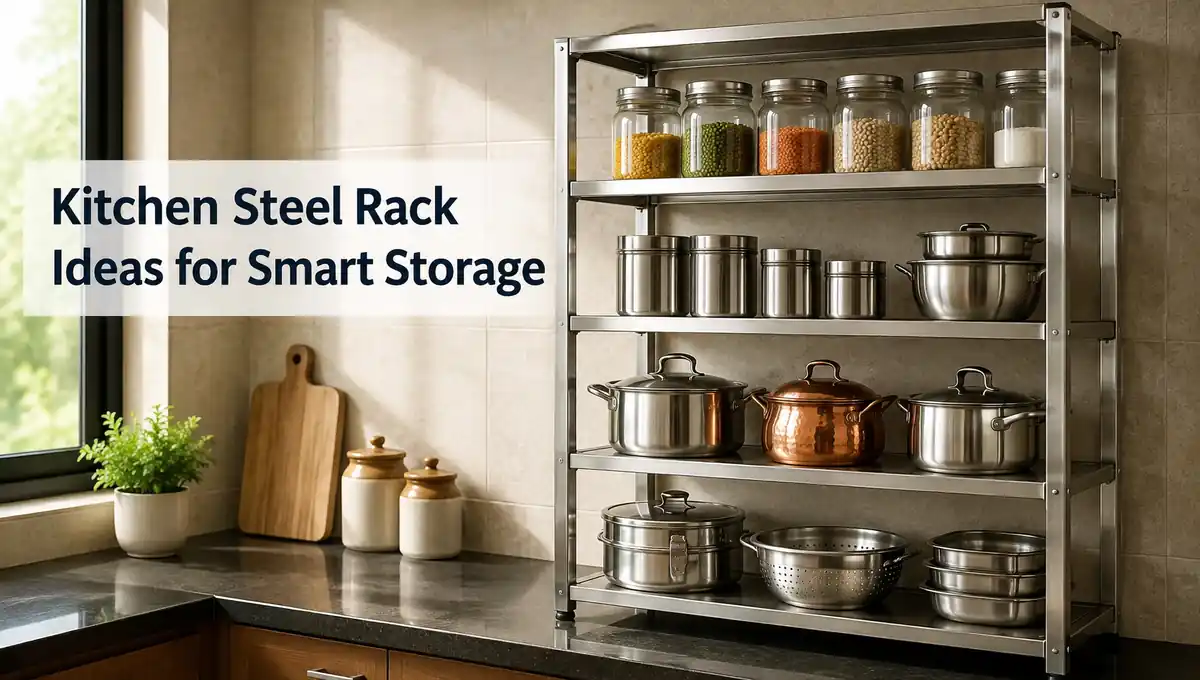
A kitchen steel rack should add usable storage without blocking cabinet shutters, sockets or the walking path. The right design depends on what you plan to store, not simply how many shelves it has. Heavy pressure cookers need a different frame from masala jars, while a wall rack needs safer fixing than a countertop organiser.
Indian kitchens also expose open storage to tadka oil, dust, hard-water marks and monsoon humidity. This guide covers rack types, materials, measurements, load checks, Indian prices and care. You can use it to avoid weak rods, unstable frames, unsuitable mounting and misleading product dimensions.
Quick Answer
The best kitchen steel rack fits its location and has a verified load rating for the stored items. Measure its width, depth, height and door clearance before choosing the design.
- Use countertop racks for spices and light containers.
- Keep heavy bartan on low, reinforced shelves.
- Fix wall racks with suitable anchors.
- Choose lockable wheels on movable units.
- Verify dimensions, material and included parts.
A steel rack for kitchen storage should solve a clear problem without reducing preparation space or making movement unsafe.
Which Rack Design Suits Each Kitchen Area?
Choose the rack design by location, available space and stored items. A spice shelf, corner stand and appliance unit may all use steel, but each needs different dimensions and strength.
| Rack design | Best position | Suitable items | Main limitation |
|---|---|---|---|
| Countertop rack | Kitchen platform | Masala jars and small containers | Reduces preparation space |
| Wall-mounted rack | Clear masonry wall | Tools, jars and light utensils | Needs secure fixing |
| Corner rack | Platform corner | Bottles and small containers | Deep areas become hard to reach |
| Cabinet rack | Inside a cupboard | Plates, packets and dry goods | Must clear hinges and shutters |
| Freestanding rack | Floor or utility area | Pots, groceries and appliances | Occupies walking space |
| Wheeled rack | Flexible storage zone | Vegetables and light supplies | Can move while loading |
Countertop and Corner Racks
A countertop kitchen storage rack keeps frequently used spices within reach. Its feet should remain well inside the kitchen platform, away from the edge and cooking flame.
A corner steel rack for kitchen use can recover an unused corner. However, triangular shelves sometimes offer less storage than their outer dimensions suggest. Measure your widest jar or bottle before choosing one.
For a compact kitchen, one small steel rack for kitchen storage may work better than several separate organisers. Existing kitchen cabinet storage can sometimes solve the problem without reducing slab space.
A steel plate rack for kitchen storage suits dry plates or lids. A rack intended for draining wet dishes needs a tray and belongs to a different product category.
Wall and Cabinet Racks
A kitchen wall rack in steel keeps the platform open but needs a reliable wall connection. Use it for loads covered by the manufacturer’s published rating.
A steel rack for a kitchen cabinet can create a second storage level inside a tall cupboard. Measure the clear opening because hinges and shutters may reduce access even when the internal width looks adequate.
If poor arrangement causes the crowding, organise kitchen cabinets before adding another shelf. Extra hardware cannot correct containers stored in the wrong zones.
Freestanding and Large Racks
A kitchen rack stand works well for bulk groceries, large vessels or appliances. Choose a broad base and keep heavy items low so the unit is less likely to tip.
A big steel rack for kitchen use only makes sense when it leaves a clear passage. A tall stand may offer more shelf area but can become unsafe if its base is narrow.
Wheeled units suit renters and flexible layouts. Choose lockable castors, which are small wheels fixed beneath the frame, and lock them before loading or removing heavy items.
Is Every Silver Rack Stainless Steel?
A silver finish does not prove stainless-steel construction. The rack may use stainless steel, chrome-plated mild steel or another metal beneath a protective coating.
| Material | Main advantage | Main weakness | Suitable use |
|---|---|---|---|
| Stainless steel | Resists corrosion and cleans easily | Quality varies when grade is undisclosed | Regular kitchen use |
| Chrome-plated steel | Bright finish at a lower price | Rust can start where plating chips | Dry countertop storage |
| Powder-coated steel | Protective coloured surface | Scratches can expose the base metal | Appliance and floor racks |
| Mild or carbon steel | Strong frame at a practical cost | Needs an intact protective finish | Large storage units |
Stainless steel contains alloying elements that help it form a protective surface layer. This improves corrosion resistance but does not make every rack immune to staining, rust or weak welds.
A stainless steel kitchen rack shelf should have smooth joints, level supports and finished edges. A stainless steel kitchen wire rack improves airflow, though thin wires may press into packets or allow small containers to tilt.
While comparing Indian retailer specifications, I found some product titles describing stainless steel while the specification field listed a steel-and-iron combination. Check the frame, shelves, screws, hooks and wheels separately.
Chrome-plated steel can perform well in a dry pantry. It is a poor option beside a wet sink once the coating becomes scratched.
Powder-coated steel suits larger floor units if the coating covers welds and cut edges. Avoid steel wool because scratches can weaken a rust-resistant finish.
What Size Steel Rack Do I Need?
The correct size fits the usable space after allowing for shutters, sockets, pipes and movement. Terms such as small, large or free size cannot replace actual measurements.
Follow this process:
- Measure the maximum available width.
- Measure the depth without crossing the platform edge.
- Check the height below cabinets, windows or chimney ducts.
- Open every nearby shutter, trolley and appliance door.
- Mark the proposed footprint with masking tape.
- Measure the tallest and widest stored item.
For a modular kitchen steel rack inside a cabinet, record the internal dimensions and the clear opening. A hinge or thick shutter may reduce the entry width.
On a kitchen platform, retain enough space for chopping, hot vessels and mixer-grinder use. Keep the rack away from gas-pipe joints, water connections and sockets.
Do not move gas, electrical or plumbing services to fit a rack. Use the relevant qualified professional if a connection must change.
In a small kitchen layout, even a shallow floor unit can narrow the working aisle. If the taped outline interrupts movement or a cabinet door, leave that position uncovered.
Indian listings may use centimetres or inches and do not always state dimension order clearly. Confirm which figure represents width, depth and height before ordering.
How Many Tiers Are Actually Useful?
Select the number of tiers from item height, shelf spacing and reach. A two-tier rack can provide more useful storage than a crowded four-tier design.
A multi layer kitchen rack suits short jars, bowls and grocery packets. Tall oil bottles, mixer jars and pressure cookers require more vertical clearance.
Adjustable shelves let you change the spacing for different items. Fixed shelves need closer measurement because removing a structural shelf can weaken the frame.
Store frequently used items between waist and shoulder height. Keep heavier vessels on the lowest approved shelf and lighter items above.
More tiers also collect more oil and dust. Skip an extra shelf if it will remain difficult to reach, load or clean.
Will the Rods Bend Under Heavy Bartan?
A rack can hold heavy utensils safely only when the maker publishes a credible load rating. A shiny finish, large size or “heavy-duty” label does not confirm strength.
Load capacity should specify whether the figure applies to each shelf or the complete unit. It should also say whether the weight must be spread evenly.
Place pressure cookers, cast-iron cookware and stacked steel bartan on lower shelves. This keeps the combined weight closer to the floor and reduces the chance of tipping.
A kitchen utensil rack in stainless steel needs more support than a masala shelf. Look for:
- Reinforced shelf edges
- Firm welded or bolted joints
- Limited side-to-side movement
- Level feet or supports
- Smooth rods without visible bends
Public marketplace reviews repeatedly mention thin material, undersized products and rods bending under heavier loads. These complaints do not apply to every model, but they show why specifications matter.
Do not place a microwave on a steel rack for utensils unless the rack maker approves appliance use. The shelf must support the appliance’s full weight and all its feet.
The microwave maker’s ventilation clearance must remain open. Plan how you will store kitchen appliances before selecting an appliance stand.
Wall-Mounted or Freestanding: Which Is Safer?
A properly fixed wall rack saves floor space, while a stable freestanding rack avoids drilling. Safety depends on the wall, anchors, stored weight, base width and installation.
A wall mount steel rack for kitchen storage needs fixings suited to the actual surface. Masonry, hollow block, tile over masonry and cabinet panels require different anchors.
The screws supplied with a stainless steel kitchen wall rack may not suit your wall. An experienced installer should check the fixing position, especially where concealed wiring, plumbing or gas lines may be present.
Rental agreements, builders and housing societies may restrict drilling. Confirm the applicable rule instead of treating one apartment policy as universal.
Adhesive hooks can hold light tools only within the manufacturer’s stated limit. Do not use adhesive mounting for pressure cookers, glassware or heavy utensils.
A freestanding metal kitchen rack should touch the floor evenly at every support point. Anti-slip feet reduce movement, while adjustable levelling feet can correct small differences in the floor.
Lock castor wheels before loading the unit or operating an appliance. A tall wheeled rack without effective locks is a poor choice for heavy bartan.
A kitchen furniture guide can help you compare a steel stand with a trolley, hutch or closed cupboard. Closed storage often works better in dusty kitchens or close to the hob.
How Much Does a Steel Kitchen Rack Cost in India?
Published prices for compact household racks in India range from about ₹283 to ₹1,813. The midpoint of this published range is ₹1,048, but it is not a national average.
The synthesis uses six India-focused retailer sources and excludes an unavailable-on-request listing. Figures were published as of August 2026.
Prices vary by city, seller, dimensions, tier count, material, delivery and mounting hardware. Small countertop or wall shelves generally appear towards the lower end, while larger utensil racks with holders cost more.
Microwave stands and large floor units cannot be compared fairly with compact racks. Some published listings exceed ₹2,000 because they include larger frames, more shelves or appliance space.
Check whether the price includes screws, wheels, trays, holders, delivery and assembly. Wall installation or upgraded anchors may cost extra.
What Buyers Regret After Delivery
The most common disappointments include incorrect size, thin rods, weak clips, missing accessories and wobbling frames. Inspect every part before loading or mounting your kitchen steel rack.
- Match the delivered dimensions with the listing.
- Confirm every shelf, screw, tray, hook and holder.
- Place the unloaded frame on a level surface.
- Check for rocking, twisting and uneven feet.
- Inspect welds, cut wires and sharp edges.
- Confirm that wheels lock correctly.
- Verify the return window before assembly.
A rack that moves under light hand pressure will not become safer after adding cookware. Tighten only the fasteners identified in the assembly instructions.
Steel rack bending often begins when excessive weight sits at the centre of a thin shelf. Spread the approved load and keep heavy items near supported areas.
Missing assembly parts can affect safety rather than appearance alone. Do not replace load-bearing screws or brackets with random hardware.
An expensive rack can still arrive with poor alignment or inaccurate dimensions. Verified specifications and a usable return policy matter more than decorative finish.
How Do You Clean a Steel Rack and Prevent Rust?
Clean the rack with mild dish soap, clean water and a soft cloth, then dry it fully. Pay close attention to welds, screws, scratches and areas exposed to hard water.
Remove stored containers before cleaning. Tadka mist forms a sticky layer that traps dust, especially near the hob and chimney.
Avoid steel wool, bleach and strong acid cleaners unless the manufacturer permits them. Abrasives can scratch polished steel and protective coatings.
For hard-water marks, follow the product’s care instructions and test any approved cleaner on a hidden section. Do not let water remain around joints.
If rust appears at a weld or scratch, remove the rack from wet use and document the damage. Check the seller’s stated warranty rather than coating the affected area without guidance.
Open shelves need more frequent cleaning than closed cabinets. Suitable kitchen pantry ideas can protect dry food from dust and cooking oil.
Frequently Asked Questions
Can a Steel Rack Hold a Microwave?
A steel rack can hold a microwave only when its published shelf rating exceeds the appliance weight. The shelf must support all appliance feet and provide the maker’s required ventilation clearance.
Keep the socket accessible and avoid loose extension leads. Do not judge appliance suitability from shelf size or appearance alone.
Can a Stainless Steel Kitchen Rack Rust?
Stainless steel can develop corrosion marks when the material quality is poor, the surface becomes contaminated or moisture remains around damaged areas. Salt, harsh cleaners and scratches can increase the risk.
Dry the rack after cleaning. Ask for material details instead of relying only on “rust-proof” advertising.
Can You Install a Wall Rack Without Drilling?
Some lightweight racks use manufacturer-approved adhesive mounts. Their safe limit depends on the surface, adhesive system, preparation and stated load.
Adhesive mounting is unsuitable for heavy cookware or appliances. Renters should choose a stable countertop or freestanding design when safe drilling is not permitted.
Choose the Rack by Load and Location
List the items first, measure the available space and reject any rack without clear dimensions or suitable load information. A compact countertop model suits spices, while reinforced floor storage better supports heavy bartan.
Buy a kitchen steel rack only when it improves storage without blocking shutters, sockets or movement. Mark its footprint with tape, confirm every supplied part and keep the heaviest approved items on the lowest shelf.