
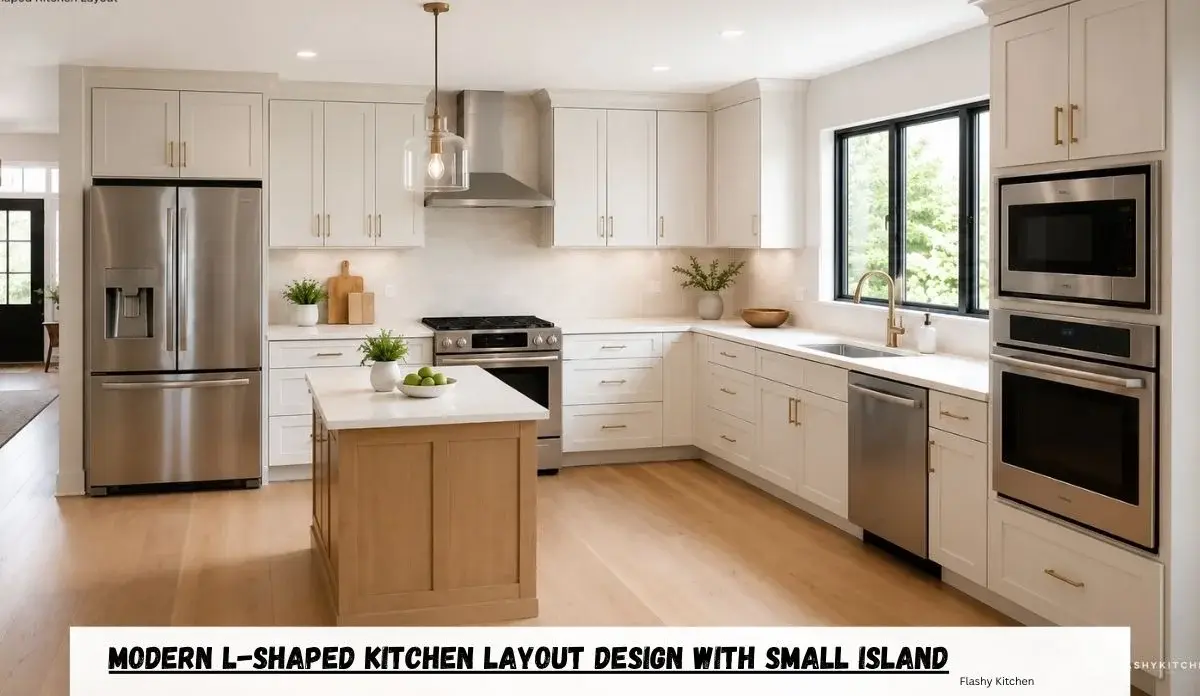
An L-shaped kitchen layout uses two adjoining walls to hold your base cabinets, countertops, and appliances. It is a practical setup that naturally leaves the rest of the room open for better traffic flow or a dining table.
Because it tucks your work zones into a corner, this design works well for both small closed-off rooms and wide open-concept homes. Whether you are building from scratch or planning a kitchen renovation, the secret to making this two-wall design work is getting the dimensions right and placing your fridge, sink, and stove where they are easiest to use.
Quick Answer
An L-shaped floor plan places cabinets and counters along two adjacent walls that meet at a 90-degree angle. This opens up the center of the room, making it easy to move freely or add an eating area.
- Best for: Open-concept rooms, medium spaces, and corner areas.
- Best appliance setup: Fridge on one end, sink centered on a wall, and stove on the adjacent wall.
- Island rule: Only add an island if you have at least 36 to 42 inches of walkway space on all sides.
- Biggest storage issue: The deep corner cabinet where the two walls meet.
- Biggest mistake: Putting the fridge, sink, and stove too close together on the same wall.
What Is an L-Shaped Kitchen Layout?
This floor plan uses two perpendicular walls that form a 90-degree corner. All your base cabinets, wall cabinets, and major appliances sit along these two walls, creating a distinct “L” shape.
The other two sides of the room are left completely open. This makes it a very adaptable design. You can fit it into a small apartment corner or spread it across a large home addition.
Why L-Shaped Kitchens Work So Well
The biggest benefit is better flow. Because all the cooking tasks happen along two walls, family members can walk through the room without bumping into you. It feels open and comfortable.
It also naturally forms a useful work triangle, keeping your main cooking tasks close together. If you have an open-concept home, the two-wall design defines the cooking area without needing a physical wall to separate it from the living room.
Best Appliance Placement in an L-Shaped Kitchen
Where you put your appliances changes how the whole room feels. If you are starting a full kitchen remodel, map out your appliances before looking at cabinets.
Start by putting your fridge at the end of the longest cabinet run. This allows people to grab a drink without walking into your workspace.
Place the sink near the center of one wall, preferably under a window. Put the stove on the opposite wall. Leave plenty of landing space—empty countertop—next to the fridge and oven so you have a place to set down hot pans and groceries. Make sure your primary prep space sits directly between the sink and the stove.
L-Shaped Kitchen Work Triangle
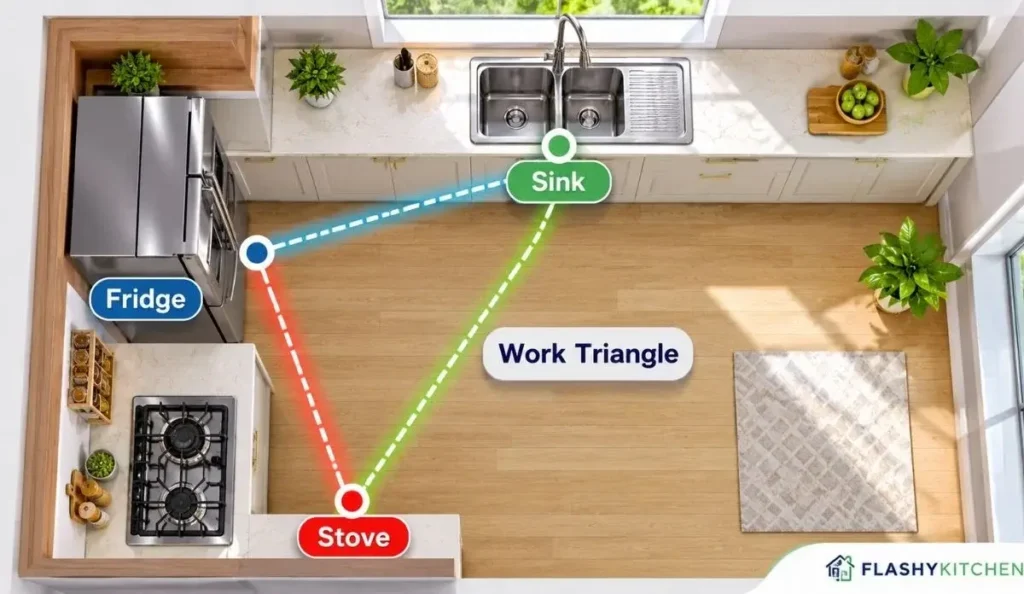
The work triangle is the walking path between your sink, stove, and fridge. In a two-wall kitchen, this triangle forms naturally.
The goal is to keep the steps between these three points short enough to cook comfortably, but not so tight that you cannot open the oven and dishwasher at the same time. Try to keep each leg of the triangle between 4 and 9 feet.
| Appliance | Best Placement | Mistake to Avoid |
|---|---|---|
| Refrigerator | At the outer edge of either wall | Putting it right in the middle of a cabinet run |
| Sink | Centered on one wall | Placing it directly next to the stove |
| Stove / Oven | On the adjacent wall to the sink | Installing it without empty counter space on both sides |
Work Zones in an L-Shaped Kitchen
Beyond the triangle, practical kitchens use work zones. Your prep zone is where you chop and mix. It needs the most continuous counter space, usually located right between the sink and stove.
The cooking zone surrounds your stove and needs deep drawers for pots and pans. Your cleanup zone includes the sink, trash pull-out, and dishwasher.
The storage zone is where your tall pantry and fridge sit. If you add an island or a dining table, that becomes your seating and serving zone.
L-Shaped Kitchen Layout With Dimensions
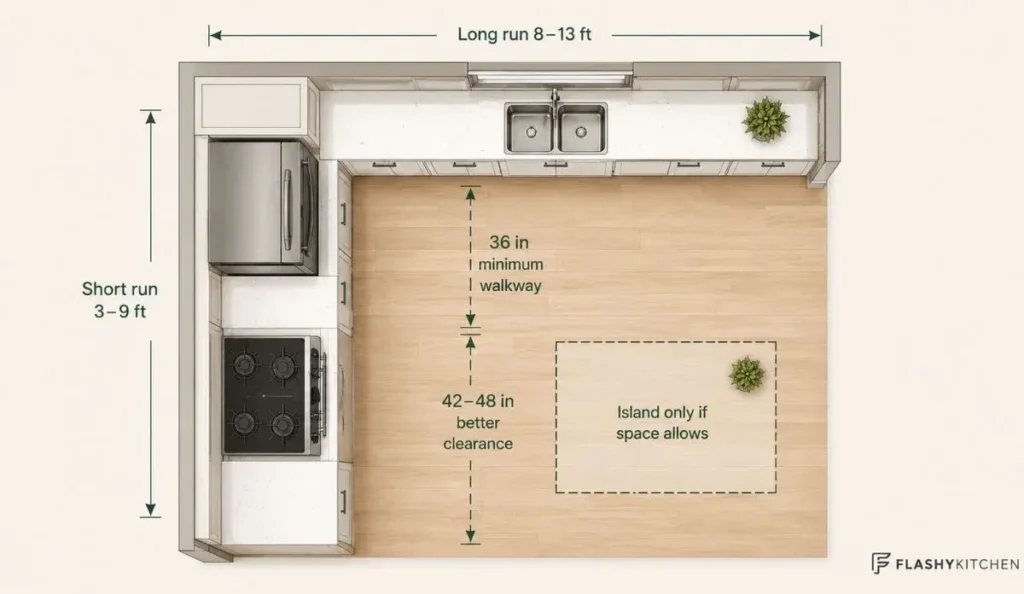
Clearances matter just as much as cabinet space. If your layout is too tight, everyday tasks become harder.
- Minimum front clearance: You need at least 36 inches of walkway space in front of your cabinets.
- Better clearance: For a home with multiple cooks, 42 to 48 inches is a much better target.
- Long wall run: Typically spans 8 to 13 feet.
- Short wall run: Usually measures 3 to 9 feet.
- Island clearance: Never squeeze an island in unless you have 36 to 42 inches of walking room on all four sides.
- Appliance door swings: Always measure how far your oven, fridge, and dishwasher doors open to ensure they do not hit the cabinets on the opposite wall.
L-Shaped Kitchen Layout With Island
An island gives you extra prep space, deep storage drawers, and casual seating. But it only works if your room is wide enough.
If you have a large open room, an island pairs very well with this layout. However, if an island blocks your path to the fridge or stops the dishwasher from opening fully, it will ruin your daily routine.
Peninsula vs Island in an L-Shaped Kitchen
A peninsula attaches to one end of your cabinet run, turning your L-shape into a partial U-shape.
A peninsula offers the same benefits as an island—bar seating and prep space—but it only needs walking clearance on three sides instead of four. For a small kitchen layout remodel, a peninsula is often a much better choice because it fits without crowding the floor.
Small L-Shaped Kitchen Layout Ideas
If you are working with a tight space, run your wall cabinets all the way up to the ceiling to gain extra storage.
Choose slim kitchen appliances like a 24-inch fridge or an 18-inch dishwasher. Keep your cabinet colors light to make the room feel larger.
Use a narrow pantry tower instead of wide, bulky cabinets. For a tight condo kitchen, skip the oversized island. Use a small rolling cart or a small dining table instead to keep the space flexible.
L-Shaped Kitchen Cabinet Layout
Usually, the longer wall holds your sink, dishwasher, and main prep area. The shorter wall handles the stove or a tall pantry.
Keep tall cabinets and the fridge at the outer ends so they do not chop your continuous counter space in half. Use wide drawer bases under the counter for heavier items, and choose between traditional wall cabinets or open shelves based on how much hidden storage you need.
If you are comparing inset vs overlay kitchen cabinets, inset doors can give a clean, flush look, while overlay doors offer slightly more interior space.
Best Corner Cabinet Options
The 90-degree corner is the hardest part of this design. If you just leave standard shelves in there, items will get lost in the dark back corners.
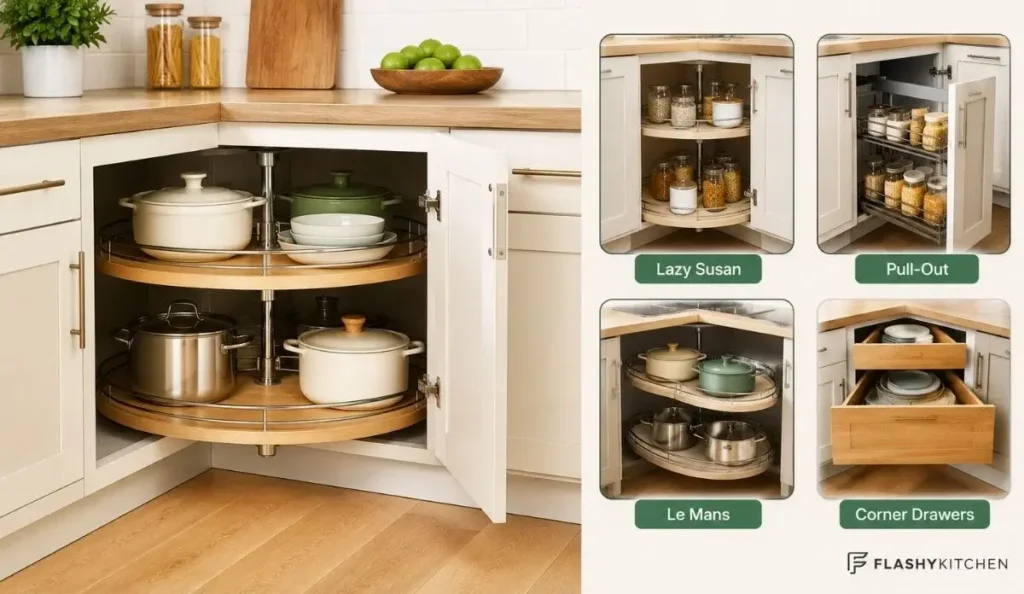
| Corner Solution | Best For | Watch Out For |
|---|---|---|
| Lazy Susan | Budget-friendly daily access | Items falling off the back of the spinning trays |
| Blind-corner pull-out | Maximizing deep, hidden space | Can be expensive and requires careful measuring |
| Le Mans shelf | Smooth, swinging shelf access | Needs specific door width clearance to open fully |
| Corner drawers | Direct access without reaching in | Wastes small triangles of space on the sides |
L-Shaped Kitchen Layout Ideas by Room Size
Your exact room dimensions will guide your best options.
| Room Size | Best Layout Choice | Main Tip |
|---|---|---|
| 8×8 | Compact L-shape | Keep appliances small and skip the island |
| 8×10 | L-shape without island | Protect your primary prep space between sink and stove |
| 10×10 | Standard L-shape | Use corner storage solutions wisely |
| 12×12 | L-shape with small island or table | Check the 42-inch walkway clearance around the island |
| Open plan | L-shape with island or peninsula | Zone the cooking and seating areas clearly |
L-Shaped Kitchen vs Galley Kitchen
A small galley kitchen remodel places cabinets on two parallel walls with a walkway down the middle.
A galley is a good choice for narrow rooms and fast, solitary cooking. The L-shape is a better choice if you want open traffic flow, space for a dining table, or a kitchen that connects directly to your living room.
Advantages of an L-Shaped Layout
- Provides an open, airy feel to the room.
- Creates a practical, easy-to-use work triangle.
- Adapts easily to both small apartments and large homes.
- Leaves floor space open for a dining table or island.
- Keeps walking traffic out of the active cooking zone.
Disadvantages of an L-Shaped Layout
- The deep corner cabinet can waste space if not planned well.
- Offers less wall storage than a U-shaped design.
- In very large rooms, appliances can get spread too far apart.
- Poorly placed appliances can cause frustrating bottlenecks at the ends.
Common Layout Mistakes
- Putting the fridge in the middle of a traffic path.
- Leaving no empty counter space next to the stove or fridge.
- Ignoring the deep corner and losing that storage space.
- Cramming a large island into a room that is too narrow.
- Putting the sink and stove right next to each other.
- Forgetting to check if the dishwasher door blocks a walkway when open.
Final Checklist Before Choosing an L-Shaped Kitchen
- Measure the exact length of both walls.
- Mark windows, doors, and walkways on your sketch.
- Check where your plumbing and gas lines currently sit.
- Plan your specific appliance sizes before buying cabinets.
- Pick a functional pull-out or spinning rack for your corner cabinet.
- Ensure you have a clear prep zone between the sink and stove.
- Verify you have 36 to 42 inches of clearance if you plan to add an island.
- Check that appliance door swings will not hit each other or trap you.
A good two-wall floor plan comes down to smart appliance placement and keeping your walkways clear. Handle the corner storage well and give yourself a strong work triangle. Take the time to measure your clearances, and you will build a practical space that fits your daily routine.
One thought on “L-Shaped Kitchen Layout: Plans, Dimensions and Ideas”