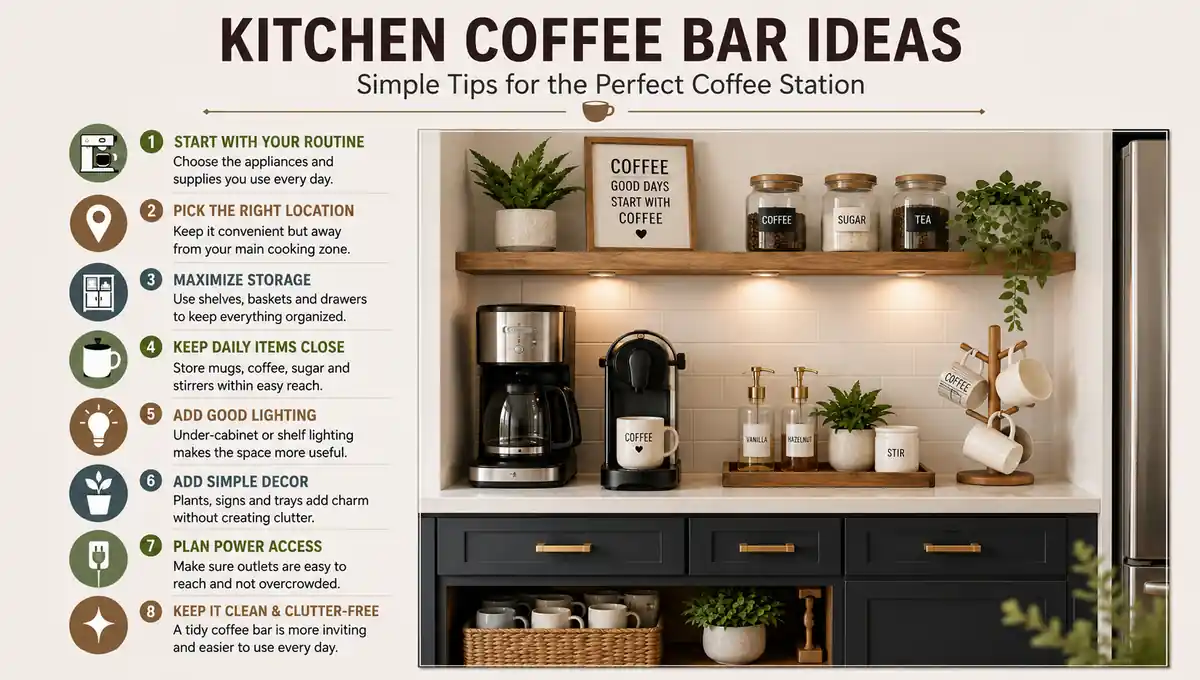
A kitchen coffee bar should make your morning routine easier, not take over valuable prep space. The right setup may be as simple as one coffee maker and a mug drawer, or as involved as a built-in cabinet with storage, lighting, and concealed appliances.
Start with the equipment you actually use. Then decide where you will fill water, grab mugs, store coffee, plug in appliances, and clean up. Only after those basics work should you think about shelves, backsplash, trays, or decor.
By the end, you should know which coffee-bar setup fits your kitchen, how much storage you really need, and which upgrades are worth skipping.
Quick Answer
A kitchen coffee bar needs a brewing appliance, mugs, coffee or pods, convenient power, and enough open counter space to make a drink comfortably. Keep it outside your main food-prep area and store daily supplies closest to the machine.
- Start with the appliances you already own.
- Choose location before cabinets or decor.
- Keep daily coffee supplies within easy reach.
- Use vertical storage when counter space is tight.
- Add plumbing or custom cabinetry only when daily use justifies it.
Start With Your Coffee Routine, Not the Pinterest Look
The best coffee station starts with how you actually make coffee. A drip-machine setup needs different storage than an espresso station with a grinder, tamper, milk pitcher, and cleaning tools.
Walk through your normal routine before choosing a location. Think about where you get water, milk, mugs, beans, filters, spoons, and trash.
You should be able to make a drink without constantly crossing the main cooking zone.
Also separate daily items from occasional ones. Your favorite mugs and beans deserve easy reach; unopened coffee bags and spare cups do not.
This simple exercise often shows that you need less space than expected.
Where Should a Kitchen Coffee Bar Go?
A coffee bar should use space that is convenient but not critical to cooking. An unused counter section, pantry, cabinet niche, breakfast area, or freestanding hutch usually works better than the main prep counter.
A small coffee nook beside a refrigerator can work well because milk stays nearby. A location closer to the sink can make filling the water reservoir and cleaning easier.
A window-side station can also work, but do not block the sill or controls for your kitchen blinds. Leave enough room to open the window treatment and clean around the machine.
Should You Put a Coffee Bar on the Island?
Only if the island has more surface than you regularly need.
An island may already handle:
- chopping and meal prep
- serving
- homework
- seating
- grocery unloading
Putting a permanent espresso machine in the middle of that activity can make the island less useful.
If you keep moving the machine whenever you cook or entertain, the island is the wrong location.
Countertop, Pantry, Built-In, or Hutch?
There is no single best coffee-bar layout. Choose the lowest-commitment setup that gives you enough storage and keeps your daily routine comfortable.
| Setup | Best for | Storage | Main drawback |
|---|---|---|---|
| Countertop station | Simple daily setup | Low to moderate | Uses counter space |
| Pantry station | Crowded main kitchen | Moderate to high | Can be farther from sink |
| Built-in cabinet | Heavy daily coffee use | High | Permanent and more complex |
| Hutch or cart | Flexible setup | Moderate | Uses floor space |
Countertop Coffee Station
This is the easiest option because you already have the work surface.
Choose a section of counter that does not serve as your main prep or appliance landing area. Keep the machine on the counter and move mugs, coffee, and backup supplies into drawers or cabinets.
Good countertop decor ideas can help keep the area visually calm without crowding the machine.
Pantry Coffee Bar
A kitchen pantry coffee bar can remove appliances from the main room and create dedicated storage for beans, mugs, filters, tea, and backup supplies.
It works best when the pantry still has enough room for food.
Before using valuable pantry space, map what currently lives there. Good pantry organization should come before sacrificing shelves to a coffee machine.
A pantry setup can also become inconvenient when it sits far from water or when several people need the pantry during breakfast.
Built-In Coffee Bar
A built-in coffee bar works well when coffee is an important daily routine and the kitchen has cabinet space to spare.
You can add:
- drawers for pods and tools
- shelves for mugs
- doors that conceal equipment
- task lighting
- dedicated storage for beans and supplies
The downside is commitment. Once cabinetry is designed around the station, changing the location later becomes much harder.
Coffee Hutch or Freestanding Cabinet
A kitchen hutch can create a full coffee station without changing existing cabinets.
This is useful for renters, smaller projects, or kitchens where removing cabinet storage would be a bad trade.
A hutch can hold the machine on its main surface, mugs above, and backup supplies in drawers or lower cabinets.
Build the Cabinet Around the Coffee Machine
If you want a kitchen coffee bar cabinet, choose the machine first.
Do not order cabinetry and assume the espresso machine will fit later.
Measure the appliance in its working position. Check how you:
- open the water tank
- lift the lid
- remove the drip tray
- use the steam wand
- insert and remove accessories
- reach the power cord
The manufacturer’s required clearance matters more than an inspiration photo.
Do Not Ignore Steam and Heat
An espresso machine can release heat and steam during use. A cabinet that looks spacious with the machine turned off may become awkward when you need to operate it.
Check the appliance instructions before using it inside an enclosed cabinet.
An appliance garage, which is a cabinet designed to conceal countertop appliances, should provide easy access while the machine is running.
Pocket doors can help because they slide away instead of remaining open in front of the counter.
Add Useful Lighting
Upper cabinets and deep shelves can shade a coffee station.
Simple under-cabinet lighting can make grinding, measuring, filling water, and cleanup easier without taking up counter space.
Lighting is especially useful inside a pantry or concealed coffee cabinet.
How Much Space Does a Coffee Bar Need?
There is no reliable universal minimum because coffee machines vary too much in width, height, depth, and operating clearance.
Instead, size the station around four things:
- the appliance footprint
- the space needed to operate it
- room to set down a mug
- storage for everyday supplies
A station that technically fits the machine but leaves nowhere to place a cup is too small.
Also check vertical clearance. A machine may fit beneath an upper cabinet but still lack space to open its water reservoir.
For an espresso setup, leave usable room for whatever tools your machine requires rather than copying a fixed dimension from another kitchen.
How Do You Store Coffee Supplies Without Creating Clutter?
The easiest method is to organize coffee-bar storage by frequency.
Daily items stay closest to the machine. Backup items go nearby but out of sight. Bulk supplies can live farther away.
Keep Daily Items Close
Prime storage should go to things such as:
- mugs
- beans or pods
- grinder
- filters
- spoons
- everyday tea
- cleaning tools
A drawer often works better than several countertop organizers.
Move Backup Supplies Away
Extra bags of coffee, spare mugs, unopened syrups, boxes of pods, and seasonal drink supplies do not need the best storage location.
Keeping them elsewhere leaves room for the items you actually touch every morning.
Use Open Shelves Carefully
Floating shelves can make a small station useful because they move storage upward.
They also keep every object visible.
One shelf with mugs and a few useful canisters can look organized. Several shelves filled edge to edge can turn the coffee bar into another clutter problem.
Closed cabinets are usually better for packaging, backup stock, and mismatched supplies.
Small Kitchen Coffee Bar Ideas That Save Counter Space
A small kitchen coffee bar works best when storage moves up or away from the counter.
You do not need a large cabinet wall.
Use an Unused Corner
A quiet corner can hold one compact coffee maker and leave the rest of the counter open.
Add a drawer or one shelf for mugs and beans rather than placing everything beside the machine.
Use a Narrow Hutch
A slim hutch or freestanding cabinet can move the entire station away from your kitchen counter.
This can work especially well near a dining area or breakfast nook.
Use Vertical Storage
Instead of spreading mugs, pods, and coffee containers across the countertop, use:
- one floating shelf
- a cabinet above
- a nearby drawer
- a narrow wall-mounted rack
The goal is to keep the machine area clear enough to prepare a drink.
Choose a Compact Appliance
In a small kitchen, the machine itself may be the biggest space decision.
Do not buy a larger espresso setup and then design storage around it unless you genuinely want that brewing routine.
A smaller appliance that you enjoy using can save more space than any organizer.
Does a Kitchen Coffee Bar Need a Sink?
No. Most kitchen coffee bars work perfectly well without a dedicated sink.
A nearby kitchen sink is enough when filling the reservoir and cleaning equipment is easy.
Adding a sink becomes more useful when the station sits far from the main sink or when you make many espresso drinks and clean tools frequently.
But plumbing turns a simple coffee station into a larger project.
Before adding water or drainage, ask whether carrying a reservoir a few feet is actually creating a problem.
For many homeowners, it is cheaper and simpler to keep using the main sink.
Plan Power Before You Build Cabinets
Most coffee makers, grinders, kettles, and frothers need convenient power.
Check outlet access before installing cabinetry or choosing the final appliance position. Avoid designing a setup that depends on cords being stretched across the counter.
If adding or relocating fixed electrical outlets is necessary, check local requirements and use a qualified professional where required.
The same principle applies to plumbing. Do not build expensive finishes first and discover afterward that power or water needs to move.
Reviewing broader kitchen safety tips can also help when several electrical appliances share one small beverage zone.
Open or Hidden Coffee Bar?
An open coffee bar is faster to use. A hidden station creates a cleaner view but adds doors, hardware, and access requirements.
Open Station
Choose open storage when you want:
- immediate access
- fewer moving parts
- easier airflow around appliances
- a lower-cost setup
Keep decor controlled so the station does not become a display shelf.
Hidden Station
A concealed coffee bar can sit behind pocket, folding, or standard cabinet doors.
It works well in an open kitchen where visible appliances bother you.
But the doors still need to remain clear during use, and the appliance needs whatever operating clearance its manufacturer requires.
Hiding an espresso machine is not worth creating an awkward brewing routine.
Should the Coffee Bar Match the Kitchen?
It should relate to the kitchen, but it does not need to match every cabinet and finish exactly.
Repeat one or two visual elements, such as:
- cabinet color
- wood tone
- backsplash material
- hardware finish
- countertop material
A contrasting cabinet color can also work when the station is meant to feel like separate furniture.
Keep accessories restrained. A tray, mugs, one canister, and a small decorative item usually provide enough personality.
The broader kitchen decor ideas can help you connect the coffee zone to the rest of the room without filling every shelf.
Common Coffee Bar Mistakes to Avoid
The most common mistake is designing the station around how it looks rather than how it gets used.
Avoid these problems:
- placing the machine on your best prep counter
- building cabinets before choosing the appliance
- blocking the water reservoir with an upper shelf
- storing every coffee supply on the counter
- putting an island station where it interrupts seating or prep
- adding a sink when the main sink is already convenient
- hiding an appliance without checking steam and clearance
- adding too many shelves, signs, jars, and accessories
A coffee bar should reduce kitchen clutter, not create a concentrated version of it.
Set Up the Routine Before You Style It
A kitchen coffee bar is worth creating when it makes brewing, storage, and cleanup easier without taking away more useful space. Start by grouping your actual machine, mugs, coffee, and tools to see how much room the routine needs.
Then choose the simplest setup that solves the problem. Add custom cabinets, plumbing, specialty doors, or extra appliances only when everyday use justifies the added space, cost, and work.