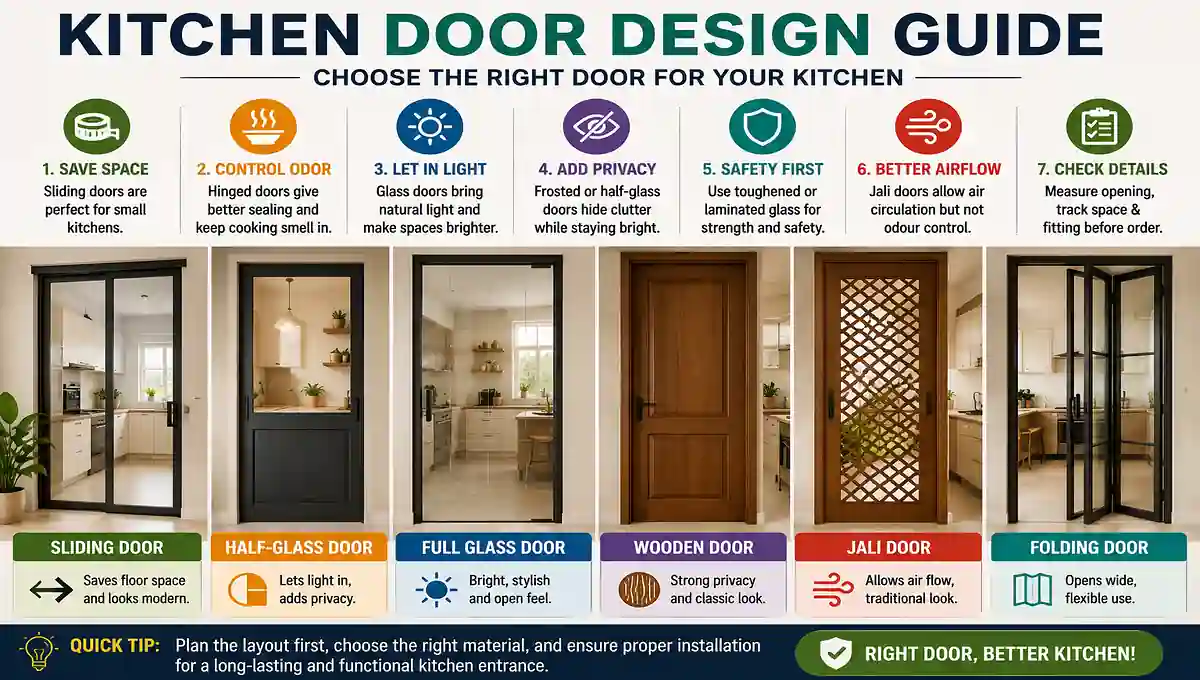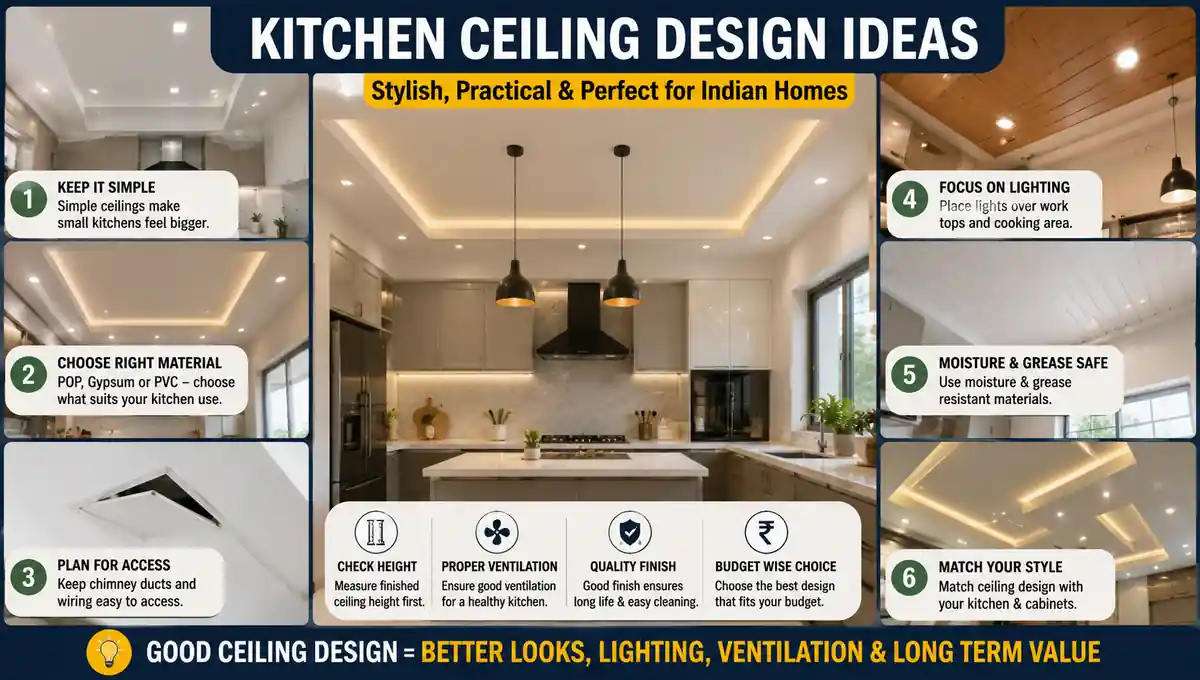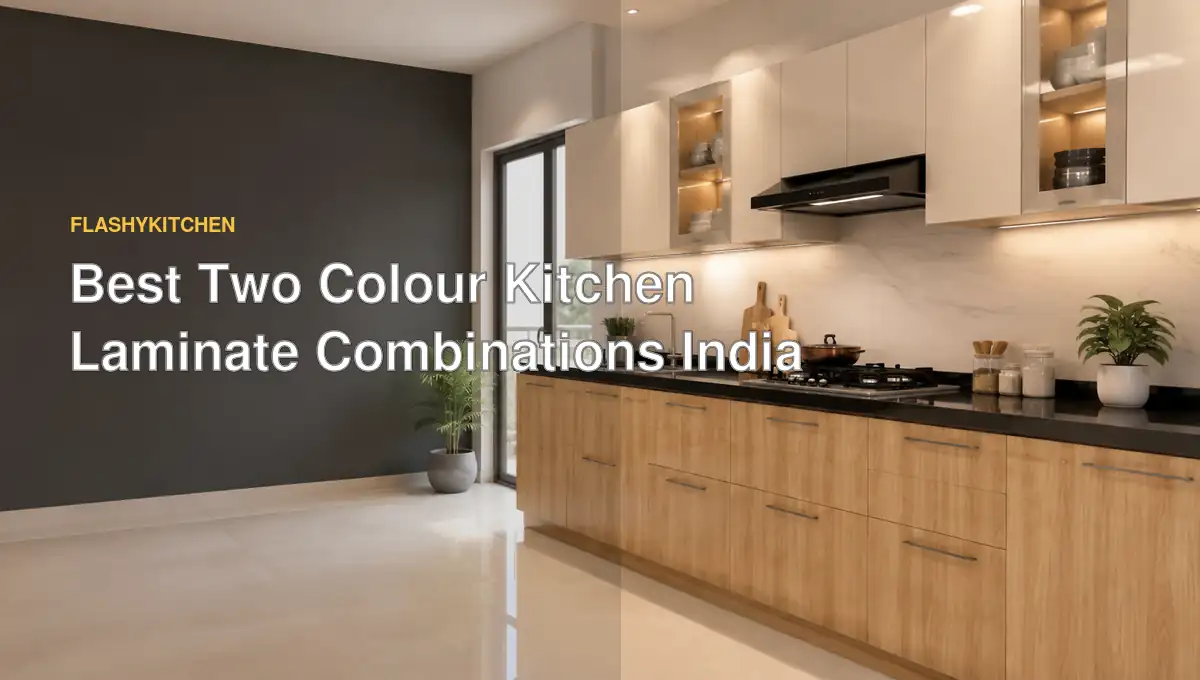
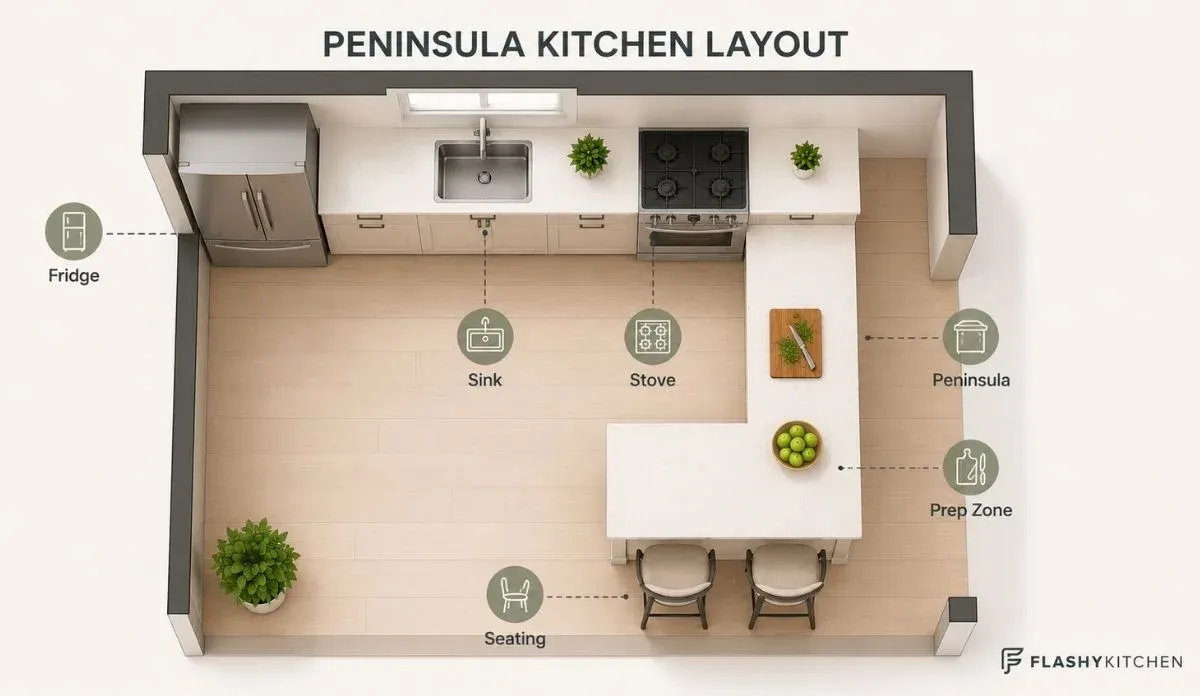
A peninsula kitchen layout uses an attached counter or cabinet run to add valuable prep space, seating, and storage to your home. It acts as a useful room divider, separating your cooking zone from the living or dining area without building a full wall.
If you are planning a kitchen remodel, this design is a practical alternative to an island, especially in small to medium rooms. By anchoring one end to a wall or existing cabinet line, a peninsula provides the benefits of an island while requiring far less floor space.
Quick Answer
A peninsula kitchen layout features a continuous counter attached to a wall or cabinet run on one end, leaving the other three sides open. It provides a smart way to add seating and workspace in rooms that cannot fit a freestanding island.
- Best for: Small to medium kitchens, condos, and open-plan spaces.
- Best layout pairing: L-shaped or U-shaped kitchens needing a room divider.
- Island vs peninsula rule: If you cannot leave 36 inches of walkway on all four sides, choose a peninsula.
- Biggest clearance issue: Placing seating where stools block the main walking path.
- Biggest mistake: Ignoring appliance door swings, causing the dishwasher or oven to hit the opposite cabinets.
What Is a Peninsula Kitchen Layout?
A peninsula is a connected cabinet run that extends out from a wall or existing countertop. It is attached at one end and open on the other sides.
This layout can instantly add seating, prep space, and lower storage. It also creates a natural separation between the kitchen and your dining or living areas. You will often see a peninsula added to L-shaped, U-shaped, G-shaped, galley, and one-wall kitchens to maximize usable counter space.
Why Peninsula Kitchens Work So Well
A peninsula solves multiple design problems at once.
- It adds much-needed counter space for food prep.
- It adds base cabinets to increase your storage.
- It creates an instant breakfast bar for casual dining.
- It separates the kitchen from the living area nicely.
- It works beautifully in spaces where a freestanding island simply does not fit.
- It can redirect foot traffic away from the hot cooking zone.
- It supports open-plan kitchens by defining the room without requiring a solid wall.
Peninsula Kitchen Layout vs Island
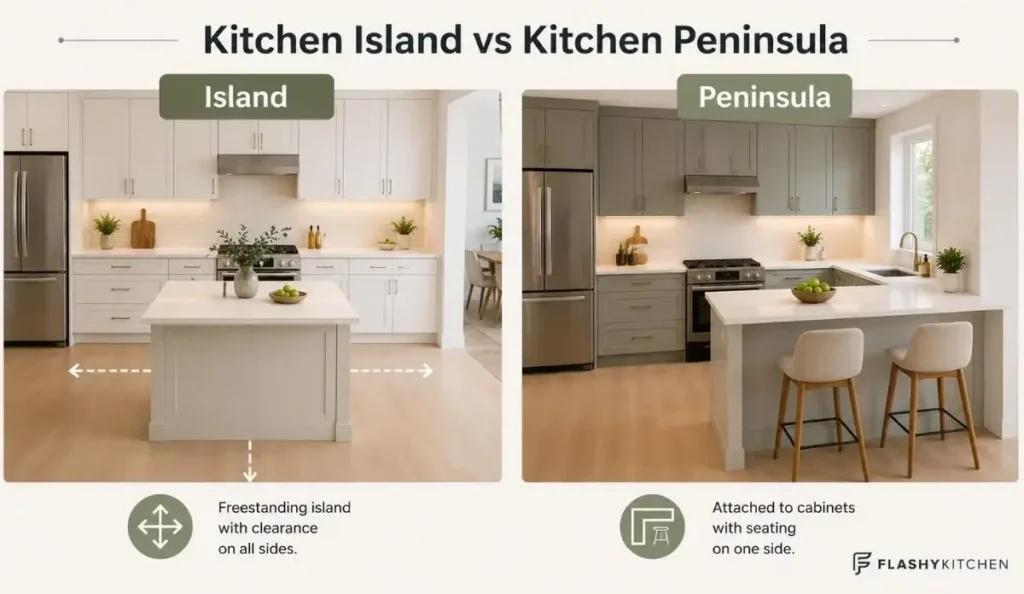
The difference between these two popular features comes down to attachment and clearance.
An island is entirely freestanding. You can walk all the way around it. A peninsula attaches to a wall on one side. Because an island needs wide clearance on all four sides, it demands a larger room. A peninsula only needs clearance on three sides, making it a smarter fit for small and medium rooms. An island can improve traffic flow in a massive kitchen, but a peninsula directs traffic better in a tighter space.
| Feature | Peninsula | Island | Best Choice |
|---|---|---|---|
| Placement | Attached to a wall | Freestanding | Peninsula for small rooms |
| Walkway needed | On 3 sides | On 4 sides | Peninsula saves floor space |
| Traffic flow | Directs traffic around | Allows circular flow | Island for busy, large homes |
| Seating | Usually on one side | Often on two sides | Depends on dining needs |
Peninsula Kitchen Layout With Dimensions
Clearance and spacing dictate whether your peninsula succeeds or fails.
A typical peninsula length runs between 60 and 90 inches, depending on how much room you have. The countertop depth usually follows standard counter depth, around 25 to 26 inches, unless you add a deep seating overhang.
Your minimum passage aisle should not feel tight. A 36-inch aisle can work as a basic minimum in some quiet layouts. However, 42 inches or more is better where people pass by frequently. Always check your appliance doors before finalizing the layout. Measure your seating overhang carefully before ordering your counters.
Use these dimensions as practical planning guidance, not as strict rules. Final clearance depends on your exact room size, traffic path, and local building codes.
| Planning Area | Good Starting Point | Why It Matters |
|---|---|---|
| Peninsula length | 60–90 inches where space allows | Gives room for prep, storage, or seating |
| Counter depth | About 25–26 inches | Matches common counter depth |
| Passage aisle | 36 inches minimum where possible | Keeps basic movement possible |
| Busy walkway | 42 inches or more | Better for shared traffic and stool movement |
| Central work zone | Keep it open and usable | Prevents the cook from feeling trapped |
Seating Overhang and Stool Spacing
When planning a breakfast bar, comfort is critical. Allow enough knee space under the counter—usually 12 to 15 inches of overhang.
Do not crowd too many stools together. Give each person at least 24 inches of width. Leave enough space behind the stools so someone can walk past comfortably while a person is seated. Try to keep seating away from hot cooking zones. Ensure your pendant lights hang high enough so they do not block sight lines across the room.
| Peninsula Seating Plan | Works Best For | Watch Out For |
|---|---|---|
| 2 stools | small kitchens and condos | leave enough room behind seats |
| 3 stools | medium kitchens | avoid crowding elbows |
| 4 stools | larger open kitchens | check walkway behind stools |
| No seating | narrow kitchens | use peninsula for prep and storage instead |
Make sure your seating does not block the main walkway, the dishwasher, the fridge, or the oven doors.
Best Appliance Placement Around a Peninsula
Placing appliances near a peninsula requires careful planning to avoid traffic jams.
Avoid placing the dishwasher where an open door blocks The main kitchen entry. Make sure the fridge door does not open directly into the seating path. A sink can work perfectly on a peninsula if your plumbing allows it. If you put a cooktop on the peninsula, you need serious ventilation and safety planning to protect seated guests from grease. Place your trash pull-out near the prep and cleanup zones. Always keep clear landing space beside the sink, fridge, and stove.
- Dishwasher: Door should not block the only kitchen entrance.
- Fridge: Door should not hit stools or trap someone in the walkway.
- Oven: Door should open without blocking the cooking zone.
- Trash pull-out: Should be close to prep and cleanup, not behind seated guests.
- Sink: Needs landing space and splash control if placed on the peninsula.
Work Zones in a Peninsula Kitchen
A peninsula creates an excellent opportunity to divide your tasks. It easily separates your prep zone from your cleanup zone. You can keep the cooking zone protected on the back wall while using the peninsula as a dedicated serving and seating zone. Families often use the peninsula counter as a homework zone or casual dining spot while dinner cooks nearby.
Small Peninsula Kitchen Layout Ideas
In a tight room, use a peninsula instead of an island. Keep it narrow and highly functional. Use base cabinets to maximize storage. You can add seating for two if space allows, but do not force it if it blocks the walkway.
Use light cabinet colors to make the room feel open. Avoid hanging upper cabinets directly above the peninsula, as this closes off the room visually. Use pendant lighting carefully and always protect your walking clearance.
Peninsula Kitchen Layout Templates
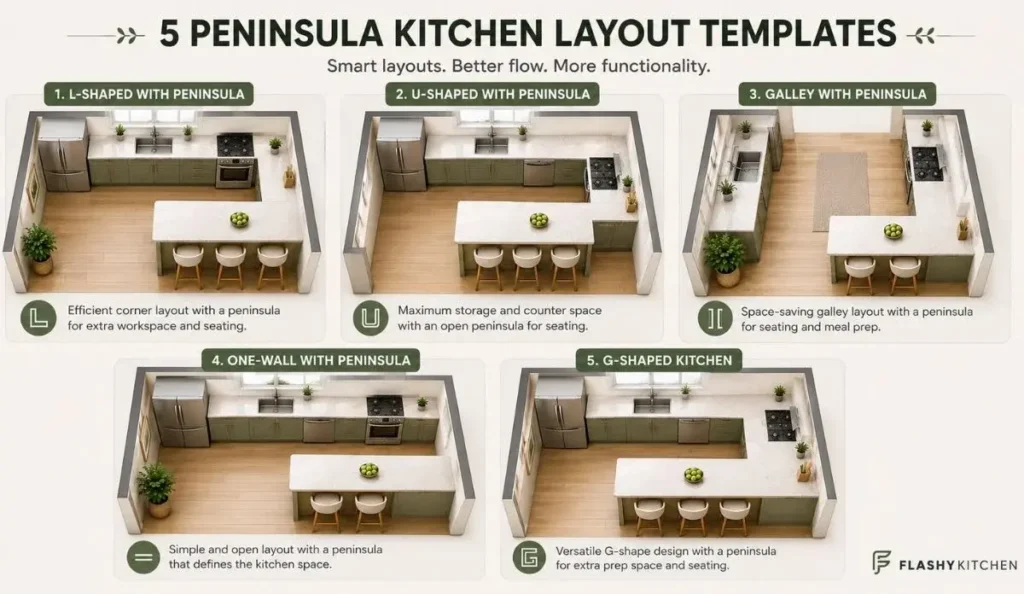
Different room shapes handle peninsulas differently. Here are the most common templates.
| Template | Best For | Main Tip |
|---|---|---|
| L-shaped kitchen with peninsula | open kitchens | use peninsula for seating and prep |
| U-shaped kitchen with peninsula | storage-heavy kitchens | protect the entry path |
| Galley kitchen with peninsula | narrow kitchens | use it as an end cap, not a blockage |
| One-wall kitchen with peninsula | condos and studios | create an L-shape and add prep space |
| G-shaped kitchen | larger kitchens | keep the center zone wide enough |
10×10 Kitchen Layout With Peninsula
A peninsula can work well in a 10×10 kitchen, provided the walkway stays well clear. In this size, a small peninsula is almost always a better choice than a cramped, freestanding island. Keep the seating simple and focus on prep space.
12×12 Kitchen Layout With Peninsula
A 12×12 room gives you far more flexibility. You can add more seating, deeper storage, or a wider peninsula. However, appliance door swings and traffic patterns still matter. Make sure your oven and dishwasher have plenty of room to open fully without hitting the peninsula base.
Peninsula Kitchen Cabinet Layout
When planning your small kitchen layout remodel, focus on smart base cabinets. Use deep drawers for cookware instead of standard doors with shelves. Put your working storage on the kitchen side. If you have the depth, you can add shallow storage on the dining side for plates or seasonal items.
Add a decorative end panel for a finished look. Make sure your countertop overhang has proper structural support panels or hidden brackets. Keep open shelves off the peninsula unless you can keep them perfectly tidy. If local building codes allow it, add electrical outlets on the side of the peninsula to plug in small kitchen appliances or charge phones.
Peninsula Kitchen Lighting Ideas
Pendant lights look great over a peninsula seating area. Keep the lights aligned evenly with the seating below. Avoid oversized pendants that make the area look top-heavy. Ensure the fixtures sit high enough so they do not block sight lines into the dining or living area. You can also use under-counter or toe-kick lighting if it highlights the floor nicely, adding a soft glow at night.
Peninsula Kitchen vs L-Shaped Kitchen
An L-shaped kitchen layout consists of two walls forming an L. Adding a peninsula to the end of the L turns it into a highly functional U-shape or open-ended space. It instantly adds seating, storage, and a room divider that a basic L-shape lacks.
Peninsula Kitchen vs U-Shaped Kitchen
A U-shaped kitchen layout uses three connected walls. Adding a peninsula creates a G-shaped or semi-enclosed layout. It adds more storage and seating, but you must ensure the single entry path does not feel too tight or restrictive.
Peninsula Kitchen vs One-Wall Kitchen
A one-wall kitchen layout places everything on a single wall. Extending a peninsula from the end creates a distinct L-shape. This adds a dedicated prep space and separates the kitchen from the living area, which works well in condos, studios, and open-plan apartments.
Peninsula Kitchen vs Galley Kitchen
Galley kitchens are highly efficient but very narrow. A peninsula can work at the open end of a galley if it does not block the main entry point or any appliance doors. If you are planning a small galley kitchen remodel, a peninsula works best as a simple end-cap for seating or serving.
Advantages of a Peninsula Kitchen Layout
- Adds excellent counter space for cooking.
- Adds base cabinets for heavy storage.
- Creates a casual seating area for guests and family.
- Works well in smaller kitchens where islands fail.
- Easily replaces a bulky island.
- Visually separates the kitchen from dining and living areas.
- Improves traffic flow if placed correctly.
- Supports modern open-plan home design.
Disadvantages of a Peninsula Kitchen Layout
- Can block foot traffic if it sticks out too far.
- Creates a single, one-way entry into the kitchen workspace.
- Can feel crowded if you add too many stools.
- Can trap the cook if the space behind the peninsula is too narrow.
- May block dishwasher, fridge, or oven doors if poorly planned.
- Does not work in extremely small or narrow rooms.
- Bad placement can make the entire kitchen feel awkward.
Common Peninsula Kitchen Layout Mistakes
- Forcing a peninsula where an island or open layout would actually work better.
- Blocking the home’s main walkway with the counter end.
- Adding too many stools for the available width.
- Ignoring seating overhang depth, leaving guests with cramped knees.
- Putting the dishwasher right at the only entrance, blocking anyone from walking in.
- Placing the fridge door in the direct seating path.
- Using oversized pendant lights that block the view.
- Forgetting to wire electrical outlets into the base cabinets.
- Making the peninsula too deep or far too long.
- Not checking how far appliance doors swing open.
- Turning the cooking area into a tight, one-way trap.
Final Checklist Before Choosing a Peninsula Kitchen
- Measure the room accurately.
- Mark all doors, windows, and traffic paths.
- Check your appliance door swings to avoid collisions.
- Decide if a peninsula or an island fits the space better.
- Measure your walkway clearance carefully.
- Plan your seating overhang for comfort.
- Choose base cabinet storage types, like deep drawers.
- Decide if a sink or cooktop truly belongs on the counter.
- Plan your pendant lighting height.
- Keep the main entry path wide and clear.
- Make sure the peninsula solves a real layout problem and does not create a new one.
A highly successful peninsula kitchen layout comes down to proper clearance, smooth traffic flow, and comfortable seating. By balancing your need for storage with the need for an open walkway, you can create a kitchen that looks great and functions well every single day.