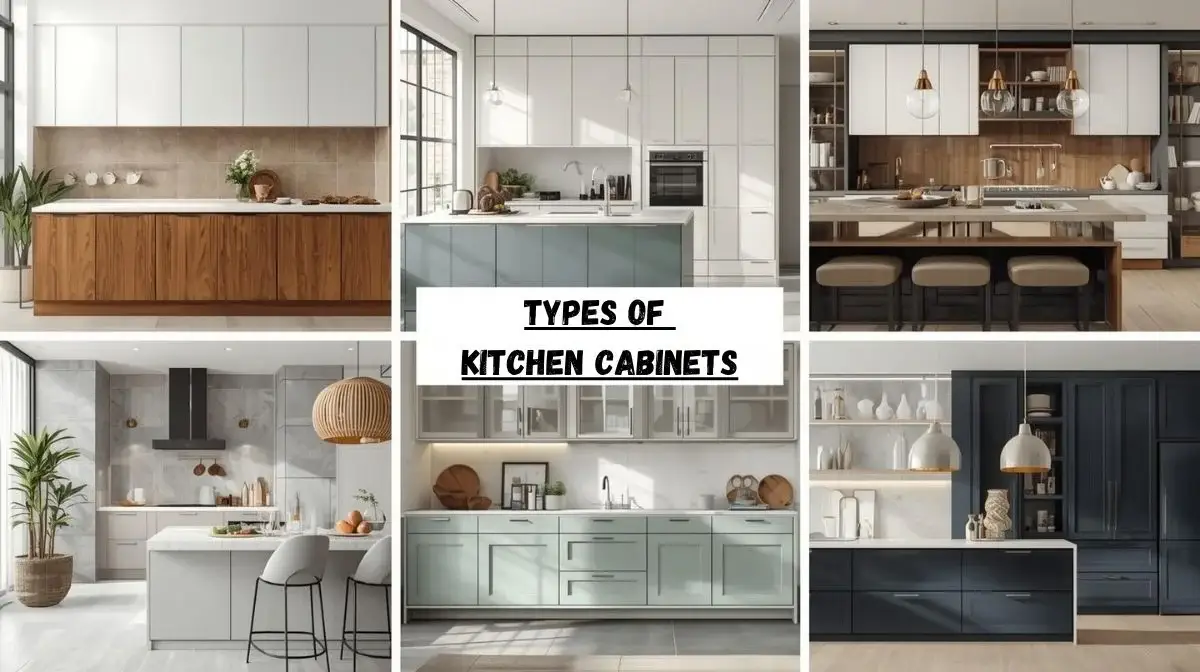
After working on more than 200 kitchen remodels, I’ve noticed that most homeowners make the same mistake: they walk into a showroom, fall in love with a door color, and forget to ask four far more important questions.
The truth is, “type of kitchen cabinet” means four completely different things depending on who you ask. A contractor is asking about construction. A designer is asking about door style. An installer is asking about framing. A layout planner is asking about placement.
Get any of these wrong and your dream kitchen ends up overpriced, impractical, or impossible to install.
This guide fixes that. Below you’ll find every major type of kitchen cabinet in 2026 — organized by the four professional classification methods — with comparison tables, real pros and cons, and honest recommendations at every step.
For a full overview covering materials, colors, sizing, and hardware, see our Complete Kitchen Cabinets Guide 2026.
Quick Answer: What Are the Types of Kitchen Cabinets?
Kitchen cabinets are classified four ways. You’ll pick one option from each category to finalize your complete cabinet specification.
| Classification | Your Options |
|---|---|
| By Construction | Stock, Semi-Custom, Custom, RTA |
| By Door Style | Shaker, Slab, Inset, Raised Panel, Glass-Front |
| By Framing | Framed, Frameless |
| By Placement | Base, Wall, Tall, Island, Floor-to-Ceiling |
For most homeowners remodeling in 2026, the best combination is semi-custom + shaker doors + framed construction at $150–$650 per linear foot installed. That combination delivers quality, resale appeal, and practical storage without the custom price tag.
How Kitchen Cabinets Are Classified (And Why It Matters)
Most homeowners treat cabinet shopping like shopping for furniture — find something that looks right, check the price, buy it. That approach works fine for a sofa. For cabinets it leads to costly mistakes.
Here’s why: the same cabinet can be described four completely different ways at the same time. A semi-custom, frameless, slab-door, base cabinet is one product. Those are four independent decisions about construction, framing, appearance, and placement.
Making these four decisions in the right sequence — construction first, then door style, then framing, then placement — cuts your decision time in half and eliminates confusion at every stage.
Kitchen Cabinets by Construction Type
| Type | Price / Linear Ft | Best For | Durability | Resale Value | Lead Time |
|---|---|---|---|---|---|
| Stock | $60 – $200 | Rentals, flips, tight budgets | Low — 5–10 yrs | Low | Same day – 2 wks |
| Semi-Custom | $150 – $650 | Most remodels — best all-rounder | High — 15–25 yrs | High | 4 – 8 weeks |
| Custom | $500 – $1,500+ | Luxury builds, unusual layouts | Highest — 25–30+ yrs | Highest | 12 – 16 weeks |
| RTA | $50 – $175 | DIY projects, budget builds | Medium — brand-dependent | Low | 1 – 3 weeks |
Construction type determines your price ceiling, your customization options, and your delivery timeline. Decide this before you look at a single door style.
Stock Cabinets
Stock cabinets are manufactured in fixed sizes — typically 3-inch width increments — and kept in warehouse inventory for immediate shipment. No custom orders, no waiting.
They dominate the budget end of the market for good reason. You can walk into Home Depot or Lowe’s today and leave with a full kitchen’s worth of stock cabinets. The price range of $60–$200 per linear foot makes them accessible for rentals, flips, and first-time buyers stretching a tight budget.
The limitations are real though. Most stock cabinet boxes use particleboard, which absorbs moisture quickly and fails near dishwashers and sinks within 5–8 years. Fixed sizes leave gaps in real kitchens that require filler strips. You also have almost zero finish or configuration choices.
I’ve seen many low-cost stock cabinets fail near sinks and dishwashers within 5–7 years because moisture slowly swells particle board boxes.
Best for: Rentals, house flips, standard layouts, budgets under $5,000. Top brands: Hampton Bay, Diamond NOW, IKEA SEKTION.
✅ Pros — Stock Cabinets
- Lowest upfront cost ($60–$200/linear ft)
- Available immediately — no lead time
- Easy to find replacement parts
- Good for temporary or rental kitchens
- Wide availability at big-box stores
❌ Cons — Stock Cabinets
- Particleboard boxes swell near moisture
- Fixed sizes leave gaps in most real kitchens
- Very limited finish and style options
- Lower durability — lifespan 5–10 years
- Poor resale appeal vs semi-custom
Semi-Custom Cabinets
Semi-custom cabinets are factory-built with genuine flexibility. You choose the door style, wood species, interior configuration, finish color, and hardware — within the manufacturer’s range. Sizes adjust in 3-inch increments.
This is the sweet spot for most American homeowners. NKBA trend data shows semi-custom accounts for roughly 80% of all kitchen remodels nationwide. At $150–$650 per linear foot installed, you get plywood box options, dovetail drawer joints, and soft-close hardware without paying the custom premium.
Lead times run 4 to 8 weeks. Plan your installation timeline around that.
Best for: Mid-range remodels, resale-focused projects, homeowners wanting quality without custom pricing.
For a detailed side-by-side, read our Semi-Custom vs Custom Cabinets comparison.
✅ Pros — Semi-Custom Cabinets
- Best value for quality and customization
- Plywood box options available
- Wide style and finish range
- Strong resale value
- Fits irregular spaces with filler strips
❌ Cons — Semi-Custom Cabinets
- 4–8 week lead time (plan ahead)
- Entry-level lines still use particleboard
- Not truly unique — others may have same cabinets
- Premium semi-custom approaches custom pricing
Custom Cabinets
Custom cabinets are built from scratch to your exact specifications. Any dimension, any wood species, any finish, any internal configuration — no catalog limitations.
The premium is steep — $500 to $1,500+ per linear foot installed — and lead time runs 12 to 16 weeks. Custom makes financial sense in a narrow set of situations: genuinely irregular room dimensions, ultra-luxury builds, or forever homes where you’ll recoup the investment over 20+ years.
For a standard 10×10 kitchen, custom rarely justifies its cost. A well-specified semi-custom cabinet delivers 90% of the result at 40–60% of the price.
Best for: Unusual layouts, luxury builds, homeowners staying 15+ years.
✅ Pros — Custom Cabinets
- Any size, shape, or configuration possible
- Highest quality materials and craftsmanship
- Truly unique — one-of-a-kind kitchen
- Best long-term durability (25–30+ years)
- Seamless fit in unusual layouts
❌ Cons — Custom Cabinets
- Highest cost ($500–$1,500+/linear ft)
- 12–16 week lead time minimum
- Poor ROI for standard kitchens
- Errors are expensive and slow to fix
- Requires experienced designer and installer
RTA Cabinets
(RTA) Ready-to-Assemble cabinets ship flat-packed and are assembled on-site. Same fixed sizes as stock, but lower shipping costs since boxes are flatter. Assembly takes 15–30 minutes per cabinet with basic tools.
Quality varies wildly. IKEA SEKTION delivers genuinely good quality — honeycomb-core doors, steel leg levelers, and a 25-year warranty. Unbranded RTA from online marketplaces often fails within 2–3 years.
Best for: DIY projects, budget builds, second kitchens.
✅ Pros — RTA Cabinets
- Lower cost than pre-built stock
- Lower shipping costs (flat-packed)
- Good brands offer solid quality (IKEA)
- Easy to order online and ship anywhere
- DIY-friendly assembly process
❌ Cons — RTA Cabinets
- Assembly time adds to installation labor
- Cheap brands fail quickly (2–3 years)
- Returns are more complicated
- Limited customization options
- Quality very brand-dependent
Kitchen Cabinets by Door Style
| Type | Price vs Baseline | Best For | Durability | Resale Value |
|---|---|---|---|---|
| Shaker | Baseline | Any kitchen — best resale style | High | Highest |
| Slab | Slightly lower | Modern / contemporary kitchens | Medium — scratch-prone | High (modern homes) |
| Inset | +20–30% over overlay | Luxury traditional kitchens | High (kiln-dried wood) | High (niche market) |
| Raised Panel | Similar to Shaker | Colonial / Victorian only | High | Low — dated look |
| Glass-Front | Higher than solid | Accent uppers / display areas | Medium — glass can chip | Medium |
The door style defines your kitchen’s visual personality. Five styles dominate the market in 2026.
Shaker Cabinets
Shaker is the most popular kitchen cabinet style in America and has been for nearly a decade. The design is simple: a flat recessed center panel surrounded by a clean five-piece frame with 90-degree edges.
That simplicity is its superpower. Shaker works in modern, transitional, and traditional kitchens equally well. It takes paint beautifully and never looks dated. Zillow research consistently identifies shaker as the safest style for resale value across all U.S. markets.
Top 2026 color choices include White Dove (OC-17), warm greige, and soft sage green. For a complete breakdown of the latest shades dominating this year, explore our guide on 2026 kitchen cabinet color trends or read about how the trending Jaclyn Smith kitchen cabinet color is inspiring celebrity-style natural kitchens.
Best for: Most homeowners, transitional and modern kitchens, resale-focused remodels.
✅ Pros — Shaker Cabinets
- Timeless — works in any kitchen style
- Highest resale value of any door style
- Takes paint and stain beautifully
- Available in every price tier
- Pairs with virtually any countertop material
❌ Cons — Shaker Cabinets
- Inner grooves collect grease and crumbs
- Slightly higher cost than slab in same tier
- Very common — not visually distinctive
- Inner corners need extra care when painting
Slab Cabinets
Slab doors are completely flat — no frame, no raised center, no detail at all. This is the dominant door style for modern and contemporary kitchens in 2026, especially in new construction.
The benefits are practical as well as visual. Flat surfaces clean faster than shaker because there are no grooves where grease collects. The minimal profile makes small kitchens feel larger. Slab doors pair perfectly with integrated handle channels or push-to-open hardware for a seamless look.
The trade-off: slab doors show every dent, scratch, and fingerprint. High-gloss finishes require near-daily cleaning.
Best for: Modern and contemporary homes, small kitchens, minimalist design preferences.
✅ Pros — Slab Cabinets
- Easiest door style to clean (no grooves)
- Makes small kitchens feel larger
- Works with push-to-open (no hardware needed)
- Clean, modern aesthetic
- Slightly lower cost than shaker (same quality)
❌ Cons — Slab Cabinets
- Shows every scratch, dent, and fingerprint
- Looks cold or sterile in traditional homes
- High-gloss finishes require constant wiping
- Thermofoil versions peel near heat sources
- Less resale appeal in non-modern homes
Inset Cabinets
Inset doors sit flush inside the cabinet face frame, not overlaying it. This creates a seamless, furniture-quality appearance associated with high-end traditional kitchens.
The visual result is stunning when executed well. Inset runs 20–30% more than equivalent overlay cabinets due to tighter manufacturing tolerances. In humid environments, wood expands and inset doors swell, stick, or warp. Only kiln-dried hardwood with proper sealing handles humid climates reliably.
In humid climates, I’ve seen inset cabinet doors expand slightly during summer months, creating uneven gaps and sticking issues if the wood was not properly dried before installation.
Best for: Luxury kitchens, traditional architecture, stable dry climates.
✅ Pros — Inset Cabinets
- Premium furniture-quality appearance
- Shows quality craftsmanship and precision
- Timeless traditional look
- Highly desirable in luxury home market
❌ Cons — Inset Cabinets
- 20–30% more expensive than overlay
- Doors swell and stick in humid climates
- Requires highly skilled installer
- Less interior access due to frame overlap
- Poor fit in modern or contemporary kitchens
For a deeper look into how flush-set doors compare to standard overlay options in price and installation, read our guide on Inset vs Overlay Kitchen Cabinets.
Raised Panel Cabinets
Raised panel doors have a center panel elevated slightly above the surrounding frame — the visual opposite of shaker’s flat recessed panel. This was the dominant American kitchen style from the 1980s through early 2000s.
In 2026, raised panel is in sharp decline. Current design trends overwhelmingly favor shaker’s simplicity. Raised panel now reads as “early 2000s builder kitchen” to most buyers, which hurts resale in modern markets. The exception is genuinely traditional architecture — Colonial homes, Victorian renovations, or formal estate kitchens.
Best for: Colonial, Victorian, or formal estate-style kitchens only.
✅ Pros — Raised Panel Cabinets
- Appropriate for formal traditional architecture
- Adds visual depth and ornate detail
- Pairs well with granite countertops
- Strong in genuine traditional home segments
❌ Cons — Raised Panel Cabinets
- Declining resale appeal in most markets
- Reads as dated in homes built post-2005
- More surface area — harder to clean
- Poor fit in modern or transitional kitchens
- Painting is more complex than shaker
For a closer look at the aesthetic differences and maintenance considerations, read our detailed comparison on Raised Panel vs. Glass-Front Kitchen Cabinets.
Glass-Front Cabinets
Glass-front cabinets work best as accent pieces, not as a whole-kitchen solution. One or two glass-front uppers above a coffee station or flanking a range hood create visual interest without requiring perfectly organized shelves throughout.
Glass types include clear (shows everything), frosted (hides clutter), seeded or reeded (farmhouse/vintage), and leaded glass (formal traditional).
Best for: Accent uppers, display cabinets, open-concept kitchens where visual breaks help.
✅ Pros — Glass-Front Cabinets
- Adds visual depth — breaks up solid cabinet walls
- Showcases beautiful dishware or glassware
- Makes kitchens feel more open and airy
- Interior lighting creates dramatic effect
- Wide variety of glass styles available
❌ Cons — Glass-Front Cabinets
- Clear glass requires perfectly organized shelves
- Higher cost than solid doors
- Glass can crack or chip over time
- Less practical for everyday dish storage
- Needs interior lighting for best visual effect
Kitchen Cabinets by Framing Method
| Type | Interior Storage | Best For | Install Difficulty | Resale Value |
|---|---|---|---|---|
| Framed | ~10% less (face frame) | Traditional kitchens, imperfect walls | Easy — forgiving | High (US market) |
| Frameless | Maximum — full width | Modern kitchens, max storage | Precise walls needed | High (modern homes) |
Every cabinet has either a framed or frameless box structure. This decision affects storage capacity, door options, and how the installation handles imperfect walls.
Framed Cabinets
Framed cabinets attach a solid face frame — typically 1.5 inches wide — to the front of the cabinet box. Doors and drawers attach to this frame rather than directly to the box sides. This is the traditional American construction method and remains dominant in the U.S. market.
The face frame adds rigidity, forgives wall imperfections during installation, and supports inset door applications. The practical trade-off is interior width — the frame consumes roughly half an inch on each side, reducing drawer slide width.
Best for: Traditional kitchens, inset door styles, walls that aren’t perfectly plumb.
✅ Pros — Framed Cabinets
- Forgiving installation — hides imperfect walls
- Supports inset door style
- Traditional American aesthetic
- More rigid box structure
- Wider installer availability
❌ Cons — Framed Cabinets
- ~10% less interior storage than frameless
- Narrower drawer slides and pull-outs
- Face frame visible between doors
- Heavier than frameless equivalent
Frameless Cabinets
Frameless cabinets skip the face frame entirely. Doors attach directly to the cabinet box using concealed European-style hinges with full overlay coverage. This is standard at IKEA and dominates European kitchen design.
Maximum interior storage is the obvious win — full-width drawer slides make every inch usable. The clean modern look is an added benefit. The trade-off is precision: frameless installation demands truly plumb walls and a skilled installer.
Best for: Modern kitchens, new construction, homeowners prioritizing maximum storage.
✅ Pros — Frameless Cabinets
- Maximum interior storage — full box width usable
- Full-width drawer slides and pull-outs
- Clean modern look — no frame between doors
- Lighter construction overall
- European hinge system is very adjustable
❌ Cons — Frameless Cabinets
- Requires plumb walls — imperfections show
- Cannot use inset door style
- Skilled installer required
- Box edges exposed if doors misalign
- Less common in traditional U.S. home markets
Kitchen Cabinets by Placement
| Type | Standard Size | Best For | Resale Impact |
|---|---|---|---|
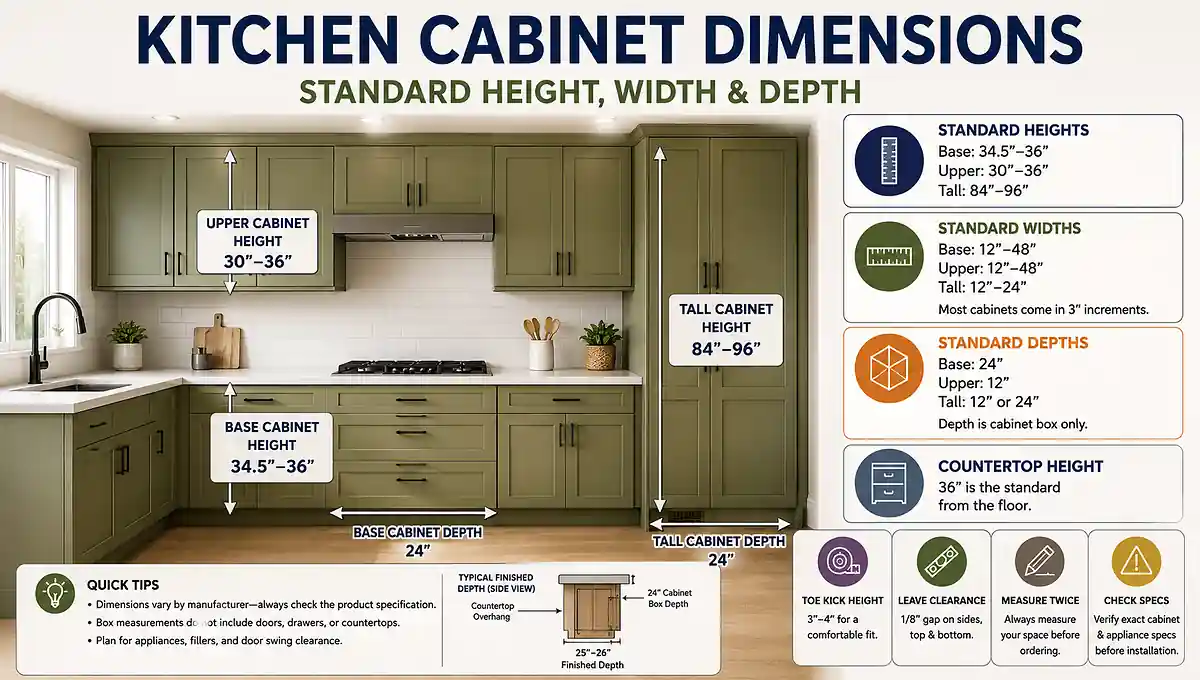
| Base | 34.5″ H × 24″ D | Main storage + countertop support | Neutral — standard |
| Wall | 12–42″ H × 12″ D | Above-counter storage | Neutral — standard |
| Tall / Pantry | 84–96″ H × 24″ D | Food storage, appliance towers | Positive |
| Island | 27–30″ D (custom H) | Extra prep space + specialty storage | Adds value |
| Floor-to-Ceiling | Full wall height | Small kitchens, max vertical storage | High — trending 2026 |
Placement classification describes where each cabinet sits and what function it serves. To understand how these categories work together to form a functional layout, check out our deep dive into Base, Wall, and Tall Kitchen Cabinets.
Base Cabinets
Base cabinets sit on the floor at 34.5 inches tall (36 inches with countertop), 24 inches deep. They carry your countertop, house your sink and dishwasher, and hold the majority of your daily-use storage.
The most important upgrade in modern base cabinet design is switching from shelf-and-door configurations to full-drawer towers. Drawers deliver every item to you — no crouching, no reaching to the back of dark shelves. Every kitchen remodel done right in 2026 converts as many base cabinets to drawers as the budget allows.
Best for: Main daily storage, under countertop, sink and appliance integration.
✅ Pros — Base Cabinets
- Main storage workhorse of any kitchen
- Supports countertop and integrates appliances
- Drawer versions offer best daily accessibility
- Wide range of configurations available
❌ Cons — Base Cabinets
- Door-and-shelf versions waste deep interior space
- Corner base cabinets are notoriously inefficient
- Items stored low require bending to access
Wall Cabinets
Wall cabinets mount above the countertop, typically with the bottom at 54 inches from the floor and 12 inches deep. Heights range from 12 to 42 inches.
The standard mistake is choosing 30-inch wall cabinets and leaving a dusty gap above. For most 9-foot ceilings, 36- or 42-inch wall cabinets with crown molding look intentional and provide significantly more storage.
Best for: Above-counter storage, keeping countertops clear.
✅ Pros — Wall Cabinets
- Keeps countertops clear
- Many height options for different ceilings
- Glass-front option adds decorative accent
- Under-cabinet lighting improves task lighting
❌ Cons — Wall Cabinets
- Top shelves hard to reach for most people
- Can make kitchens feel enclosed or dark
- Require studs for proper mounting
- Removing them later is expensive to reverse
Tall Cabinets
Tall cabinets (pantry cabinets) run from floor to 84, 90, or 96 inches. They function as concentrated vertical storage — housing food staples, cleaning supplies, or built-in ovens and microwave towers.
One well-designed tall pantry cabinet stores as much food as an entire wall of standard wall cabinets while keeping everything at accessible heights.
Best for: Food pantry, broom storage, appliance tower integration.
✅ Pros — Tall Cabinets
- Maximum vertical storage in minimum floor space
- Items stored at accessible heights
- Creates dramatic floor-to-ceiling visual impact
- Integrates appliances cleanly (ovens, microwaves)
❌ Cons — Tall Cabinets
- Very top shelves still out of reach for shorter users
- Large footprint takes wall space from countertop runs
- Heavy — requires solid wall anchoring
- Can make small kitchens feel cramped if poorly placed
Island Cabinets
Island cabinets are modified base cabinets, typically 27–30 inches deep, creating more workspace and storage accessible from multiple sides. The island concentrates your kitchen’s most-used features — trash pull-outs, microwave drawers, prep sinks, and specialty organization.
Islands require minimum 42-inch clearance for one cook, 48 inches for two. Small kitchens almost always benefit more from a peninsula layout than a freestanding island. For a deeper analysis of how these two specific styles impact your workflow and storage, check out our guide on Kitchen Island and Floor-to-Ceiling Cabinets.
Best for: Extra prep space, specialty storage, casual dining overhang.
✅ Pros — Island Cabinets
- Significant additional storage and counter space
- Accessible from multiple sides
- Ideal for specialty features (trash, wine, prep sink)
- Seating overhang adds casual dining space
❌ Cons — Island Cabinets
- Requires 42–48 inch clearance all around
- Poor fit in kitchens under 150 sq ft
- Plumbing/electrical adds significant cost
- Traffic flow awkward if undersized
Floor-to-Ceiling Cabinets
Floor-to-ceiling cabinet runs treat the full wall height as one integrated storage unit, eliminating the gap above standard wall cabinets. This style is growing rapidly in 2026, particularly in smaller kitchens and modern European-influenced designs.
The visual effect is dramatic — the kitchen feels taller and more intentional. Upper sections store items used less frequently while the lower section handles daily-use storage.
Best for: Small kitchens, modern designs, maximum vertical storage.
✅ Pros — Floor-to-Ceiling Cabinets
- Maximum storage — no wasted space above uppers
- No dust-collecting gap above cabinets
- Makes rooms feel taller and more intentional
- Trending strongly in 2026 kitchen design
- Works especially well in small kitchens
❌ Cons — Floor-to-Ceiling Cabinets
- Higher cost (more cabinet height = more linear feet)
- Top section hard to access without step stool
- Requires accurate ceiling height measurement
- Not ideal for ceilings under 8.5 feet
Which Type of Kitchen Cabinet Is Right for You?
| Your Priority | Best Combination | Budget Range |
|---|---|---|
| Lowest cost / rental | Stock RTA + thermofoil slab + frameless | $60–$175/linear ft |
| Best overall value | Semi-custom + shaker + framed | $150–$400/linear ft |
| Modern luxury | Custom + slab + frameless | $700–$1,500+/linear ft |
| Traditional luxury | Custom + inset + framed | $800–$1,500+/linear ft |
| Best resale appeal | Semi-custom + shaker + framed + greige | $150–$400/linear ft |
| Small kitchen max storage | Semi-custom + slab + frameless + floor-to-ceiling | $200–$500/linear ft |
05 Mistakes to Avoid When Choosing Cabinet Types

- Choosing style before measuring your layout. Measure first — then design. A beautiful door style is useless if it doesn’t fit your walls.
- Using inset doors in a humid climate without proper wood. Skip kiln-dried hardwood and your custom cabinets warp within two years.
- Going custom for a standard 10×10 kitchen. Semi-custom delivers 90% of the result at 40–60% of the cost.
- Leaving the frameless/framed decision until you’re choosing hinges. This structural decision affects storage, door options, and installation. Make it early.
- Skipping soft-close hardware. Costs $4–$12 per door. Always include it.
Frequently Asked Questions
01. What is the most popular type of kitchen cabinet in 2026?
Semi-custom framed cabinets with shaker doors — best balance of quality, flexibility, and resale value.
02. What is the difference between framed and frameless cabinets?
Framed has a face frame on the box front (traditional, forgives uneven walls). Frameless attaches doors directly to the box (more storage, modern look, needs precise install).
03. Are inset cabinets worth the extra cost?
Only in stable climates with a skilled installer and a high-end traditional design goal. For most, the 20–30% premium is hard to justify.
04. What is the cheapest type of kitchen cabinet?
RTA or stock at $50–$200/linear ft. IKEA SEKTION offers the best quality at this price.
05. Which type of kitchen cabinet lasts longest?
Semi-custom or custom with plywood boxes, dovetail joints, and soft-close hardware — 25–30 years with normal use.
06. What cabinet works best for small kitchens?
Frameless slab-door cabinets in a light color, floor-to-ceiling — maximizes storage and makes the space feel larger.
07. Are shaker cabinets going out of style?
No. Shaker has dominated for nearly a decade and shows no signs of decline.
08. Can I mix different cabinet types in one kitchen?
Yes — two-tone kitchens (different colors for uppers vs lowers, or perimeter vs island) are trending strongly in 2026.
Final Thoughts
Every kitchen cabinet decision comes down to four questions: how is it built, what does the door look like, is the box framed or frameless, and where does it go? Answer those four and your cabinet specification practically writes itself.
For most homeowners in 2026, the winning combination is semi-custom construction, shaker door style, framed box structure, and a smart mix of base, wall, tall, and island placements. That delivers lasting quality, broad design appeal, and strong resale performance at a reasonable cost.
Put your decision energy where it counts: plywood boxes, soft-close hardware, drawer bases instead of shelf bases, and a door style that fits your home’s overall aesthetic.