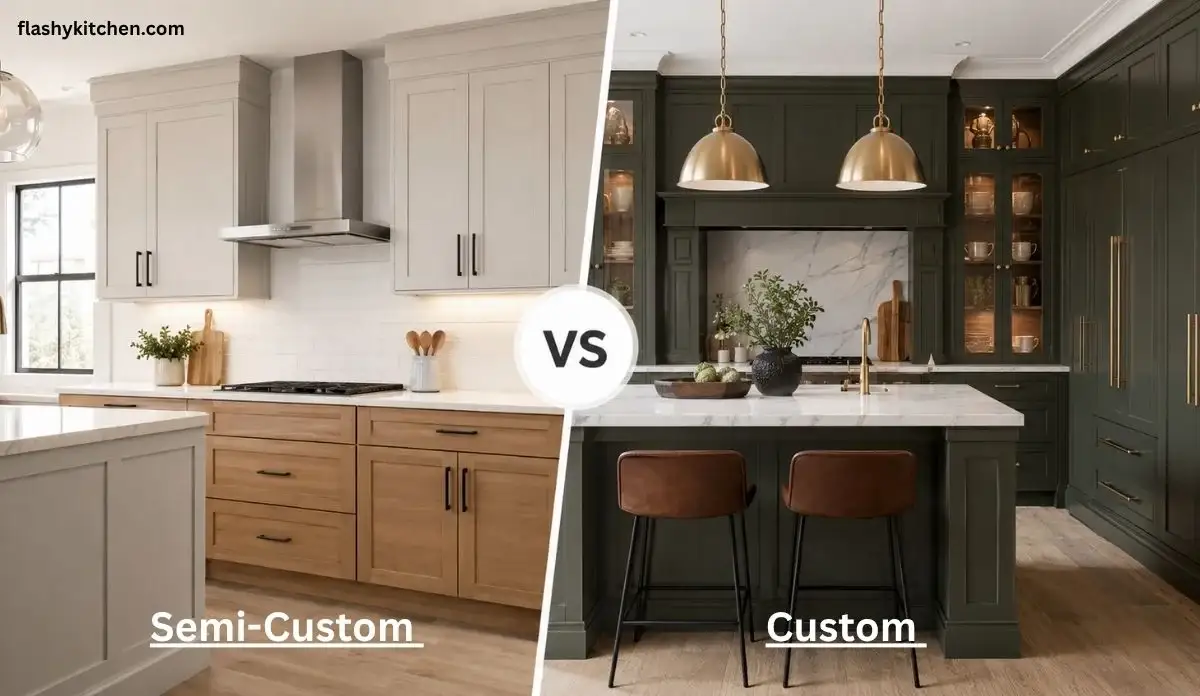
Planning a kitchen remodel? The cabinet decision alone can make or break your budget. Semi-custom and custom cabinets both promise quality — but they serve very different needs, price points, and timelines.
This guide breaks down exactly what separates the two, where your money actually goes, and which option makes sense for your specific project in 2026. If you’re still deciding on the right cabinet type for your kitchen overall, our complete guide to choosing the best kitchen cabinets covers materials, styles, and budget planning from the ground up.
Quick Answer: Semi-Custom vs Custom Cabinets
For most homeowners remodeling a standard kitchen, semi-custom cabinets deliver the best overall value. They offer real design flexibility, solid construction quality, and a predictable budget — typically $150 to $650 per linear foot installed.
Custom cabinets are worth the premium when your kitchen has unusual dimensions, you want floor-to-ceiling built-ins, or you’re executing a high-end luxury remodel where every detail matters. Expect to pay $500 to $1,500+ per linear foot installed.
At a glance:
- Best value: Semi-custom for most homes
- Best for luxury/unique layouts: Custom cabinets
- Best resale ROI: Semi-custom with plywood boxes and soft-close hardware
- Best for irregular kitchens: Custom, where fit precision matters
What Are Semi-Custom Kitchen Cabinets?
How Semi-Custom Cabinets Work
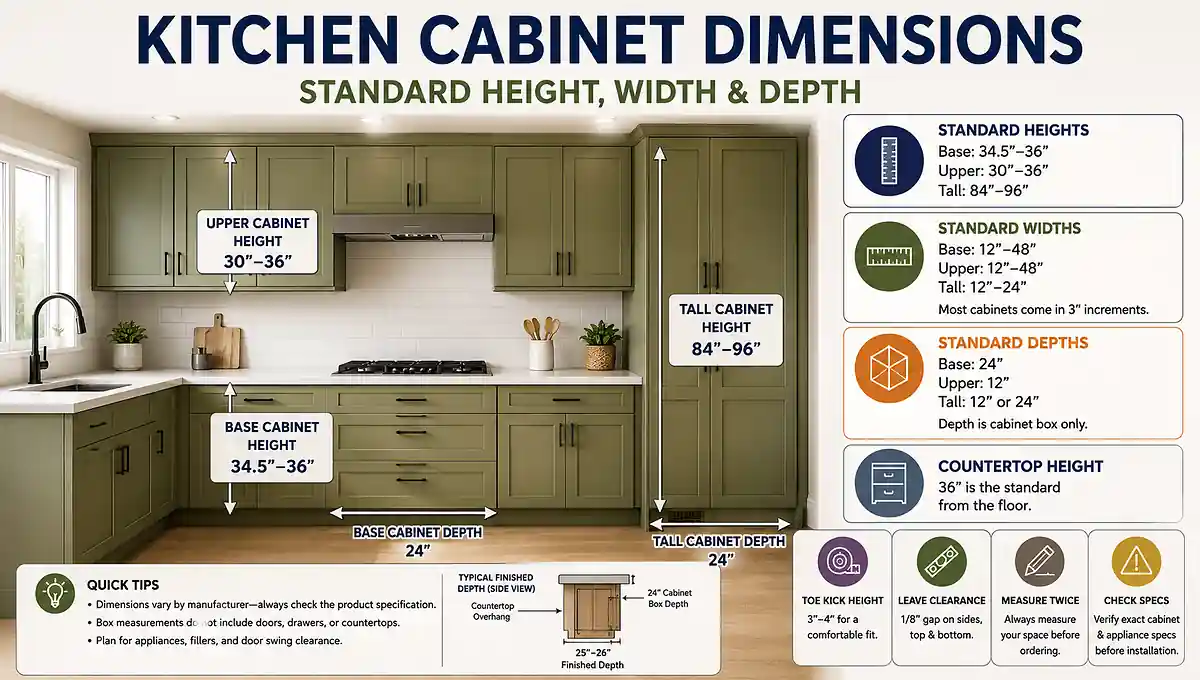
Semi-custom cabinets are factory-built in standardized sizes but offer meaningful choices in door styles, finishes, wood species, and interior storage configurations. Unlike stock cabinets (which come in fixed sizes with limited options), semi-custom allows size adjustments — typically in 3-inch increments — so they fit most kitchen layouts without costly filler strips.
Understanding the full spectrum of kitchen cabinet construction — from stock to semi-custom to fully bespoke — will sharpen your decision. Our kitchen cabinets complete guide for 2026 covers styles, colors, materials, and pricing trends in depth.
Common Features Included
- Door styles: 50 to 100+ options depending on manufacturer
- Wood species: maple, cherry, oak, painted MDF, and more
- Interior upgrades: pull-out shelves, drawer inserts, lazy Susans
- Finish choices: painted, stained, glazed, distressed
- Box material: plywood or particle board (always verify which)
Average Lead Times
Semi-custom cabinets typically ship in 4 to 8 weeks from order. Higher-end semi-custom lines from manufacturers like KraftMaid, Wellborn, or Medallion may run 6 to 10 weeks during peak season.
Who Is Semi-Custom Best For?
- Homeowners with standard rectangular kitchen layouts
- Mid-range remodels with a $15,000 to $40,000 cabinet budget
- Buyers who want design options without custom pricing
- Investors or sellers focused on resale value over personalization
What Are Custom Kitchen Cabinets?
How Custom Cabinets Are Built
Custom cabinets are built from scratch by a cabinetmaker or cabinet shop, sized and designed specifically for your kitchen. Every dimension is measured on-site, every material is chosen by you, and no two kitchens end up with the same result. This process involves more back-and-forth with the maker, longer production timelines, and significantly higher cost.
Unlimited Design Flexibility
With custom cabinets, there are no standard sizes to work around. Heights, depths, widths — all are built to your exact specs. This matters in older homes, kitchens with sloped ceilings, or spaces where standard sizing creates awkward gaps.
Custom Storage Possibilities
Custom shops can build solutions that simply don’t exist in any semi-custom catalog: integrated appliance garages, full-height pantry towers with pull-out shelving on both sides, corner solutions that maximize every inch, and built-in charging stations or wine storage designed around your specific collection.
Who Should Choose Custom Cabinets?
- Luxury remodels with budgets above $50,000 for cabinetry alone
- Historic homes with non-standard ceiling heights or wall angles
- Kitchens with unusual shapes, soffits, or structural obstacles
- Homeowners who want a truly one-of-a-kind, built-in aesthetic
Semi-Custom vs Custom Cabinets: Side-by-Side Comparison
| Feature | Semi-Custom | Custom |
|---|---|---|
| Price per linear ft. | $150–$650 installed | $500–$1,500+ installed |
| Construction quality | Good to excellent (varies) | Excellent — built to exact spec |
| Sizing options | Incremental (3″ steps) | Any dimension, zero compromise |
| Lead time | 4–10 weeks | 8–16 weeks |
| Design flexibility | High — 100+ styles & finishes | Unlimited — fully bespoke |
| Box material | Plywood or particle board | Plywood or solid wood (standard) |
| Finish options | 50–100+ catalog choices | Fully custom — any color/texture |
| Resale ROI | ✓ Strong — wide buyer appeal | Variable — niche taste |
| Installation complexity | Standard | Often higher; longer on-site |
| Best for | Most standard kitchen layouts | Unusual layouts, luxury remodels |
Cost Per Linear Foot — Visual Comparison (2026)
The price gap between cabinet types is real, but it’s not as binary as it seems. Entry-level custom and premium semi-custom often overlap. The chart below maps the full cost spectrum — use it to see exactly where your budget sits.
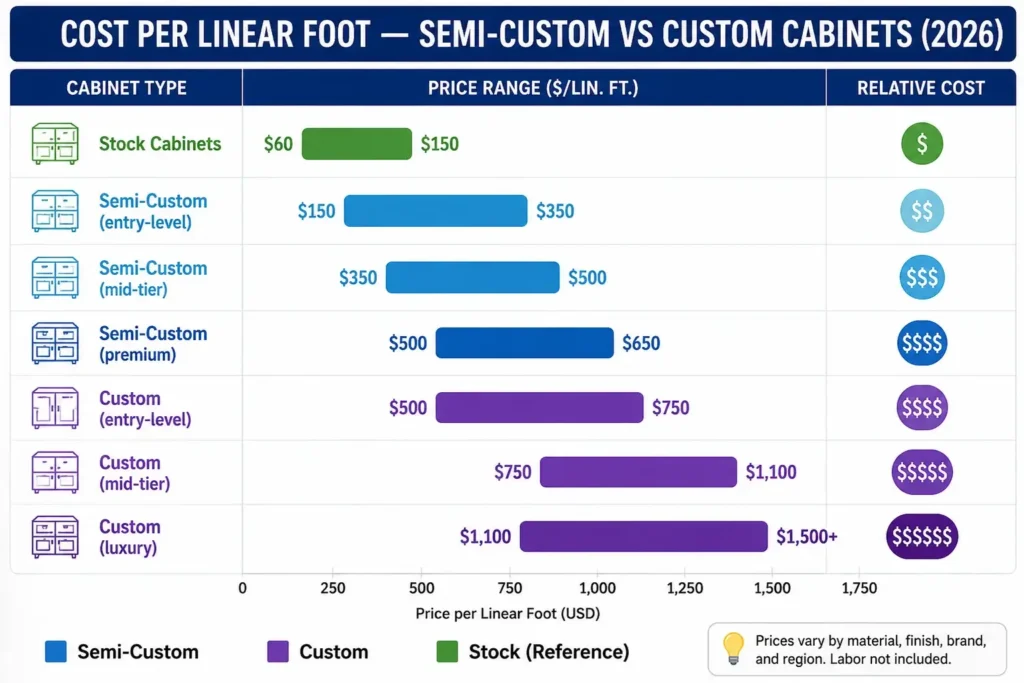
Note: Prices reflect installed cost per linear foot in the U.S. market as of 2026. Regional labor costs vary; metro areas typically run 15–25% higher.
Which Cabinet Type Is Right for You? (Buyer Profile Guide)
Your kitchen’s geometry, your budget ceiling, and your renovation goals each point toward a clear answer. Use this decision table to match your situation to the right cabinet type before you start talking to dealers.
| Your Situation | Best Cabinet Type | Why It Fits |
|---|---|---|
| Standard rectangular kitchen, $15K–$40K budget | Semi-Custom | Full flexibility without overpaying for custom craftsmanship |
| Historic home — sloped ceilings, non-standard dimensions | Custom | Only option that fills every gap without awkward fillers |
| Luxury remodel, $100K+ kitchen budget | Custom | Budget justifies bespoke materials and craftsmanship |
| Investment property / resale-focused remodel | Semi-Custom | Neutral finishes, broad buyer appeal, strong cost-to-value |
| Tight galley or L-shaped kitchen with corner constraints | Custom | Corner solutions and exact sizing prevent wasted space |
| Mid-range home renovation in a competitive market | Semi-Custom (plywood spec) | Plywood box + soft-close hardware matches most custom quality |
Cost Comparison in 2026
Semi-Custom Cabinet Costs
A typical 10×10 kitchen in semi-custom cabinets (the industry standard measurement) runs $3,000 to $8,000 for the cabinets alone before installation. A full kitchen with 20 to 30 linear feet of cabinetry commonly lands between $10,000 and $25,000 including installation for mid-tier semi-custom lines.
Custom Cabinet Costs
Custom cabinetry for the same 20 to 30 linear feet typically starts at $25,000 and commonly reaches $50,000 to $80,000 for full kitchens with premium materials, complex storage systems, and high-end hardware.
Fully bespoke cabinet shops in major metro areas often charge $1,000 to $1,500+ per linear foot all-in.
Hidden Costs Most Homeowners Ignore
- Filler strips and trim: $200 to $800 extra for semi-custom if layout doesn’t align perfectly
- Hardware upgrades: Factory hardware is often basic — budget $500 to $2,000 for quality pulls and knobs
- Interior accessories: Pull-out shelves, drawer organizers, and inserts add $1,000 to $4,000
- Delivery and storage fees: $200 to $600 depending on proximity to manufacturer
- Damage replacements: Custom cabinets have longer lead times for replacement pieces — factor in potential delays
Installation Cost Differences
Semi-custom installation typically runs $70 to $120 per linear foot. Custom installation can reach $150 to $250 per linear foot due to more complex fitting requirements and longer on-site time. For a 25 linear foot kitchen, that gap alone can be $2,000 to $3,500.
Which Cabinet Type Gives Better Value?
Best Value for Mid-Range Homes
For homes valued under $600,000, semi-custom cabinets from a quality manufacturer — built with plywood boxes, dovetail drawers, and soft-close hardware — will meet or exceed the expectations of future buyers while keeping your project on budget.
Spending $15,000 to $30,000 on well-specified semi-custom cabinets consistently outperforms spending $50,000 on custom in terms of cost-per-perceived-quality.
Best Long-Term Investment
The material that matters most is the cabinet box — not the door. Plywood boxes resist moisture, hold screws better over time, and outlast particle board by decades.
Whether you choose semi-custom or custom, specifying plywood construction is the single highest-ROI upgrade you can make.
Best ROI for Resale
Real estate data consistently shows kitchen remodels recoup 60 to 80 percent of their cost at resale. Semi-custom cabinets in neutral finishes (white, gray, natural wood) appeal to the widest buyer pool.
Highly personalized custom cabinets may not transfer well — what you love, future buyers may see as work to redo.
Quality Comparison: Are Custom Cabinets Really Better?
Cabinet Box Construction
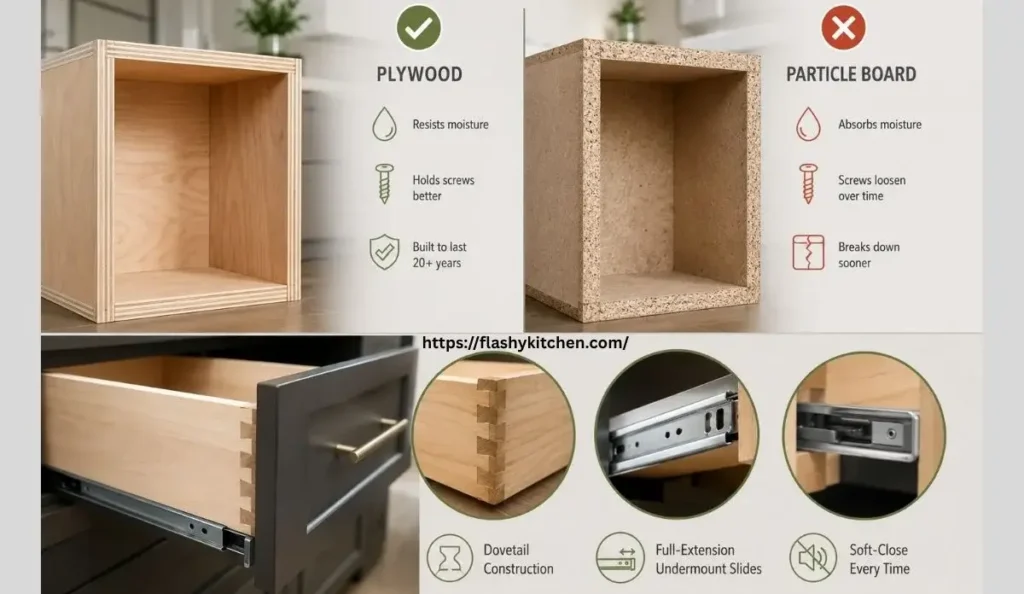
The cabinet box is where quality really lives — not the door. A plywood box with 1/2-inch sides and a full-depth back panel is the benchmark. Many premium semi-custom manufacturers (KraftMaid, Wellborn) offer plywood construction as standard or as an upgrade.
Lower-cost semi-custom lines default to particle board — avoid these for kitchens near sinks or dishwashers where moisture is inevitable.
Plywood vs Particle Board
Plywood holds fasteners better, handles moisture without swelling, and maintains structural integrity for 20+ years. Particle board costs 20 to 30 percent less but degrades significantly faster in humid environments.
Always ask your dealer specifically: ‘Is the box plywood or particle board?’ This question alone separates informed buyers from those who get burned.
Drawer Quality and Hardware
Dovetail drawer boxes with undermount, full-extension, soft-close slides are the standard to insist on — whether in semi-custom or custom.
Cheap drawer slides are one of the first things to fail in any cabinet. Budget an extra $500 to $1,500 to upgrade hardware across a full kitchen if the base spec feels lightweight.
Design Flexibility Comparison
Color, Finish, and Style Options
Semi-custom catalogs typically offer 80 to 150 door styles and 40 to 80 finish options — more than enough for the vast majority of kitchens. If you need a specific color match (a historic paint color, a custom-mixed shade, or a finish not in any manufacturer’s book) then custom is your only path.
Two-tone kitchens, inset doors, beaded-frame options, and mixed materials are all available in premium semi-custom lines. You can also choose between different door styles, though understanding the pros and cons of inset vs overlay kitchen cabinets is essential before making your final selection.
Storage Customization
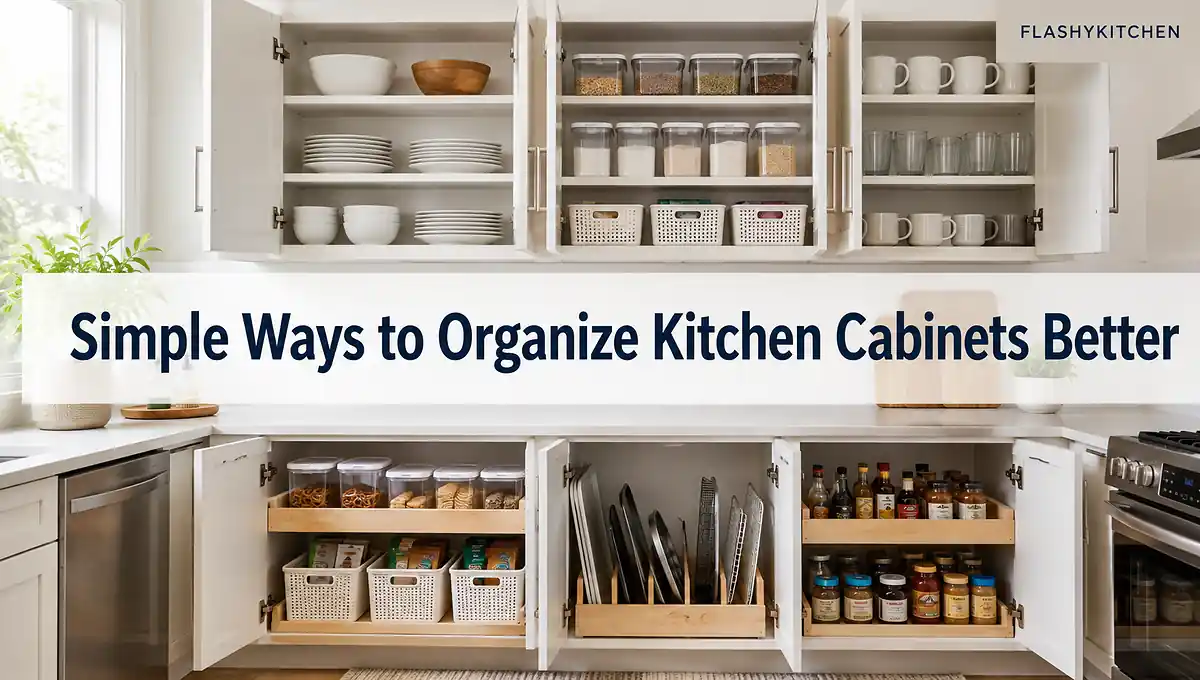
Semi-custom offers meaningful storage upgrades through factory-designed inserts: pull-out trash drawers, spice racks, deep drawer organizers, pegboard drawer inserts, and lazy Susans.
Custom allows you to engineer storage around your exact cookware, appliances, and habits — the difference shows most in corner solutions and deep pantry cabinets.
Unusual Layouts and Appliance Integration
If your kitchen has a 96-inch ceiling in some sections and 84 inches in others, a bump-out wall, or appliances that require non-standard housing dimensions, semi-custom will leave gaps or require filler solutions that look like afterthoughts.
This is the clearest case for custom: when standard sizing genuinely doesn’t fit your space.
Biggest Mistakes Homeowners Make
Paying Custom Prices for Standard Layouts
A common and expensive mistake: hiring a custom cabinet shop for a rectangular kitchen with standard ceiling heights and no unusual features. The result is a beautiful but overpriced kitchen where you paid for flexibility you didn’t need.
If your kitchen fits standard sizing, use semi-custom and redirect the budget savings to countertops, appliances, or lighting.
Ignoring Cabinet Box Material
Choosing cabinets based on door style photos without asking about box construction. Particle board boxes in a high-use kitchen near the sink will swell, delaminate, and fail within 10 to 15 years.
Specify plywood construction — even if it costs $1,500 to $3,000 more upfront, it’s a fraction of the cost of replacing cabinets early.
Choosing Style Before Storage
Falling in love with a door style before thinking through your storage needs. Map out what you store — pots, appliances, dry goods, cleaning supplies — before finalizing any cabinet layout. Adding interior accessories after the fact is always more expensive than specifying them upfront.
Forgetting About Installation Costs
Comparing cabinet prices without factoring in installation. A semi-custom line priced at $400 per linear foot plus $100 installation is often a better deal than a custom line priced at $700 per linear foot plus $200 installation — even if the custom product is marginally better built.
When Custom Cabinets Are Worth the Extra Money
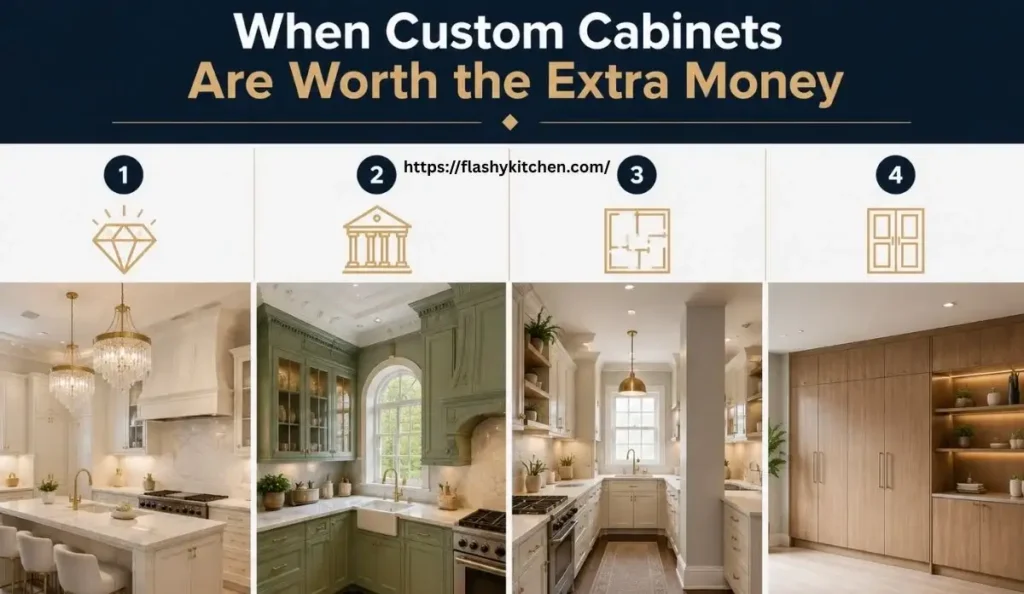
Custom cabinets make financial and practical sense in four specific scenarios:
- Luxury remodels: When your total kitchen budget is $100,000+ and the quality of every detail matters equally
- Historic homes: Where ceiling heights, crown molding profiles, or wall angles make standard sizing impractical
- Small or awkward layouts: Galley kitchens, L-shapes with tight corners, or rooms with structural columns that eat into standard cabinet runs
- Floor-to-ceiling integrated designs: When you want cabinetry, paneling, and built-ins to read as a single architectural element rather than separate furniture
Frequently Asked Questions
Are semi-custom cabinets worth it?
Yes — for most kitchens, semi-custom cabinets offer the best balance of quality, design flexibility, and value. Specify plywood boxes and soft-close hardware, and they will perform and look as good as many custom options at a fraction of the price.
Are custom cabinets higher quality?
Not necessarily. Quality depends on the manufacturer and the specifications you choose. A premium semi-custom cabinet with plywood construction and dovetail drawers often matches or exceeds the quality of a budget custom shop.
Custom becomes a quality advantage when you’re working with an elite craftsman and specifying premium materials throughout.
How long do semi-custom cabinets last?
Plywood semi-custom cabinets from quality manufacturers last 20 to 50 years with normal care. Particle board semi-custom cabinets, especially near moisture, may need replacement in 10 to 20 years. The construction material matters far more than the custom vs semi-custom distinction.
What is the biggest disadvantage of custom cabinets?
Cost and lead time. Custom cabinets typically cost 2 to 4 times more than semi-custom and take 8 to 16 weeks to deliver — compared to 4 to 8 weeks for semi-custom. Any mistakes or changes mid-production are also far more expensive to correct.
Which cabinets increase home value more?
For most markets, semi-custom cabinets in neutral, widely-appealing finishes provide better resale ROI than highly personalized custom work. Real estate professionals consistently advise spending enough to impress buyers without over-improving beyond neighborhood comps.
What cabinet material lasts longest?
Solid wood and plywood construction last longest. For cabinet boxes, 3/4-inch plywood with a finished interior is the gold standard. Solid wood face frames and doors add durability and refinish-ability over time. MDF painted doors are durable if kept away from moisture but cannot be easily repaired if damaged.
Are custom cabinets better than IKEA?
Yes, in almost every measurable way — quality, durability, finish options, and fit. IKEA cabinets are a budget-friendly solution with surprisingly decent flat-pack construction, but they don’t compete with either semi-custom or custom on materials, craftsmanship, or longevity. The comparison only makes sense at the lowest price tiers.
How long do custom cabinets take?
Most custom cabinet shops require 8 to 16 weeks from signed contract to delivery, depending on complexity and current shop workload. High-end craftsmen or shops with backlogs can run 20 to 24 weeks. Factor this into your remodel timeline carefully — cabinet delays are the most common cause of kitchen renovation overruns.
Final Verdict: Which Should You Choose in 2026?
Semi-custom cabinets are the right choice for the majority of kitchen remodels. They deliver real design flexibility, proven construction quality, and a budget that leaves room for the rest of your kitchen — countertops, appliances, lighting, and flooring all matter too.
Custom cabinets earn their price premium in specific situations: unusual layouts, luxury projects, or when you need architectural integration that no catalog can provide. Outside those scenarios, the premium largely buys prestige rather than proportional performance.
Three rules to take into any cabinet decision:
- Always specify plywood construction — this matters more than custom vs semi-custom
- Invest in hardware upgrades (soft-close, full-extension drawer slides) before upgrading to custom
- Don’t overpay for customization your layout doesn’t actually require
In 2026, the best kitchen cabinet investment isn’t the most expensive one — it’s the most intelligently specified one.