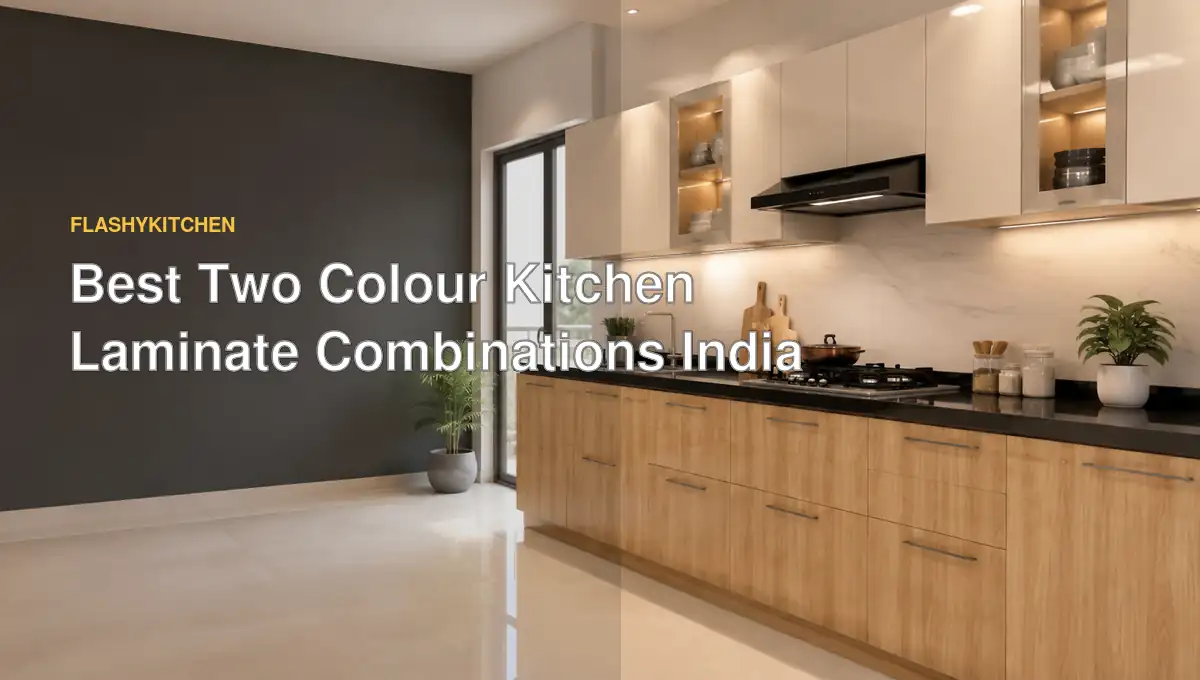
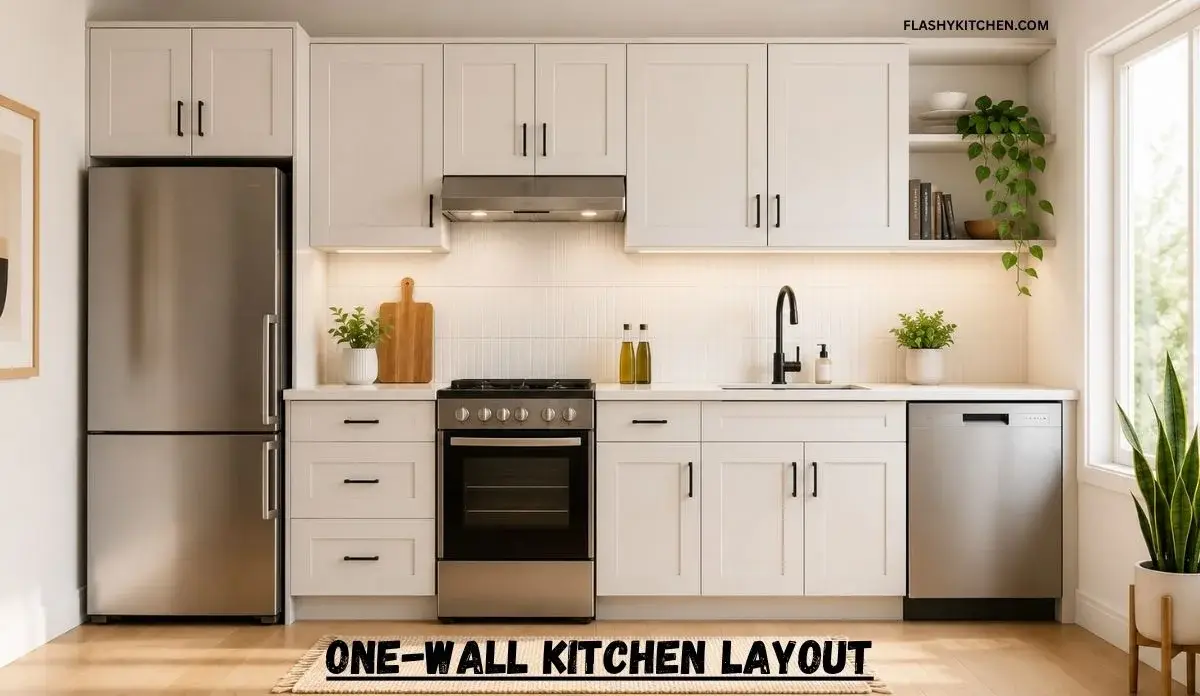
A one-wall kitchen layout places all your cabinets, counters, and appliances along a single wall. It works best for small homes, condos, studios, and open-plan spaces. By keeping your entire cooking space in one straight line, you save floor space and make the room feel larger.
If you are planning a simple kitchen remodel, this layout offers a clean, organized look without a heavy price tag. You avoid expensive corner cabinets and keep your plumbing simple. Let’s look at exactly how to plan your straight-line kitchen.
Quick Answer About One-Wall Kitchen Layout
WHAT IS One-Wall Kitchen Layout?
A one-wall kitchen layout keeps all your cabinets, appliances, and sink on one straight wall to save floor space. It relies on a linear workflow rather than a classic triangle.
- Best for: Studios, apartments, and open-plan living rooms.
- Best appliance setup: Fridge at one end, stove at the other end, sink in the middle.
- Best storage rule: Use ceiling-height cabinets and a tall pantry unit.
- Island or cart rule: Add an island only if you have 36 to 42 inches of empty walkway clearance.
- Biggest mistake: Placing the stove directly next to the sink or fridge without landing space.
What Is a One-Wall Kitchen Layout?
A one-wall kitchen layout organizes your cooking space into one continuous run. People also call it a single-wall, straight-line, or single-line kitchen layout.
It completely avoids corners. This makes it perfect for narrow rooms or open-concept floor plans where you want the kitchen to blend into the living area. Because the design is so simple, it is often a fast and affordable option when you plan a small kitchen layout remodel.
Why One-Wall Kitchen Layout Work So Well
The single-wall design works because it is highly efficient.
- It saves floor space.
- It uses a simple cabinet run without dark corner cabinets.
- It is a great fit for a condo kitchen or a small room.
- It works naturally in open-plan living spaces.
- It uses fewer cabinets and countertops than larger layouts, keeping costs down.
- You can easily pair it with a dining table, island, peninsula, or rolling cart.
Best Appliance Placement in a One-Wall Kitchen
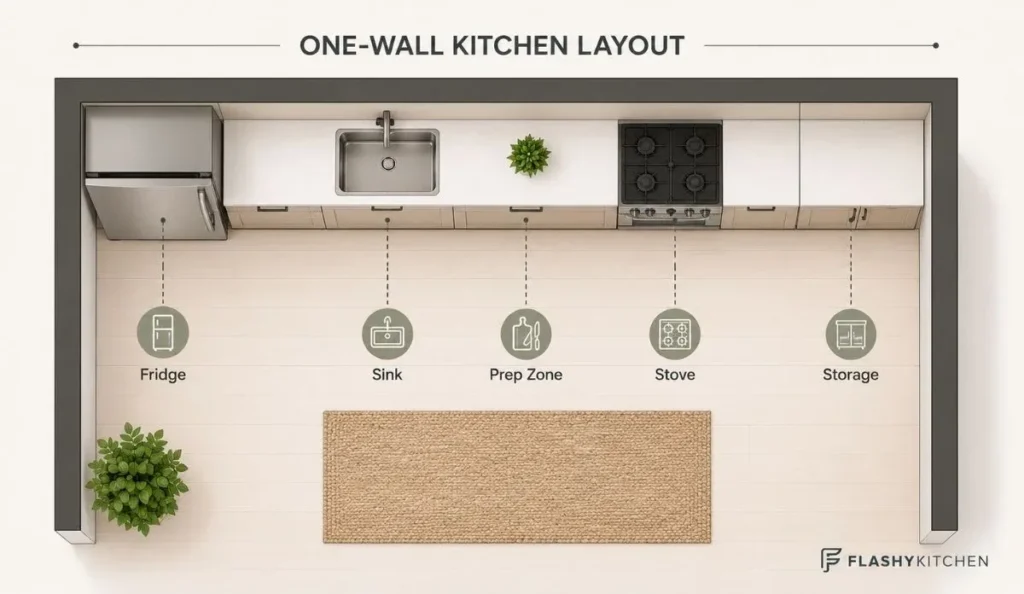
In one-wall kitchen planning, appliance order matters more than the classic triangle. A clear line keeps your work flowing smoothly.
- Fridge: Place it at one end of the cabinet run.
- Sink: Keep it near the middle if your plumbing allows.
- Dishwasher: Tuck it right next to the sink.
- Stove: Place your stove or cooktop on the other side of the sink.
- Trash: Add a pull-out trash can near the cleanup zone.
- Pantry: Put a tall pantry at the opposite end of the fridge to frame the layout.
Avoid placing your stove directly beside the fridge. Always protect your landing space—you need empty counter space near your fridge, sink, and stove.
One-Wall Kitchen Work Triangle Problem
A true work triangle is not possible in a one-wall kitchen because everything sits on one flat line. You cannot walk in a triangle.
Your efficiency comes from the order of your appliances, leaving enough landing space, and keeping a clean work line.
| Station | Best Placement | Mistake to Avoid |
|---|---|---|
| Fridge | Far left or far right end | Placing it in the middle of the counter |
| Sink | Centered between fridge and stove | Placing it right next to the stove |
| Stove | Opposite side of the sink from the fridge | Pushing it flush against a wall or tall cabinet |
One-Wall Kitchen Work Zones
Since the work triangle does not work here, modern kitchen planning relies on work zones instead. Arranging these zones in the correct order creates a smoother workflow and reduces unnecessary walking.
- Food Storage Zone: Your refrigerator and dry pantry. Keep these together at one end.
- Prep Zone: This is your empty counter space between the fridge and sink. You need room to chop and mix here.
- Cooking Zone: Your stove, oven, and the cabinets holding your pots, pans, and spices.
- Cleanup Zone: Your sink, dishwasher, and trash pull-out.
One-Wall Kitchen Layout by Wall Length
Your full wall length matters more than the room width when planning this setup.
| Wall Length | Recommended Layout Strategy |
|---|---|
| 8 ft | Compact setup with slim appliances |
| 10 ft | Standard small kitchen layout |
| 12 ft | Better storage and prep space |
| 14–15 ft | Island or peninsula may fit |
An 8-foot wall is tight. You will need to use a two-burner cooktop and slim appliances to make it work. A 10-foot wall gives you a more workable compact layout. At 12 feet, you gain a strong balance for appliances, a good prep zone, and vertical storage. At 14 or 15 feet, you get excellent storage and enough room to support an island or dining table opposite the cabinets.
Always leave enough walkway space in front of the cabinet run so you can open the oven and dishwasher comfortably.
Small One-Wall Kitchen Layout Ideas
If your space is small, you have to plan carefully. Use ceiling-height cabinets to grab every inch of vertical storage.
Choose compact kitchen appliances. A counter-depth refrigerator stops the fridge from sticking out past the cabinets. A slim 18-inch dishwasher and a two-burner cooktop save massive amounts of counter space.
Use light cabinet colors to keep the wall from looking heavy. Add under-cabinet task lighting to brighten the counters. Use open shelves only where they are actually useful, otherwise they just collect dust.
One-Wall Kitchen With Island
An island works well if your room is wide enough. It gives you extra prep space, seating, and lower storage. An island can even hold your sink or cooktop, creating a better work zone.
Do not force an island if it blocks walking paths. You need at least 36 to 42 inches of walkway clearance between the island and your main cabinet run. If the island blocks your appliance doors or your dining path, skip it.
One-Wall Kitchen With Peninsula
A peninsula often works better than an island in small kitchens. It connects directly to a wall or your main cabinet run, forming an L-shape.
A peninsula provides extra prep space and additional seating benefits. It offers better space efficiency because it only needs walking clearance on fewer sides. Peninsulas are often used when a full island would create circulation problems in the room. Just ensure your clearance remains comfortable for movement.
One-Wall Kitchen With Rolling Cart
A rolling cart is often better than a fixed island in very small kitchens. It adds movable prep space and can hold small appliances like your toaster or blender. You can roll it out of the way when you do not need it. This makes it a smart choice for renters, open apartments, and studio kitchens.
One-Wall Kitchen Cabinet Layout
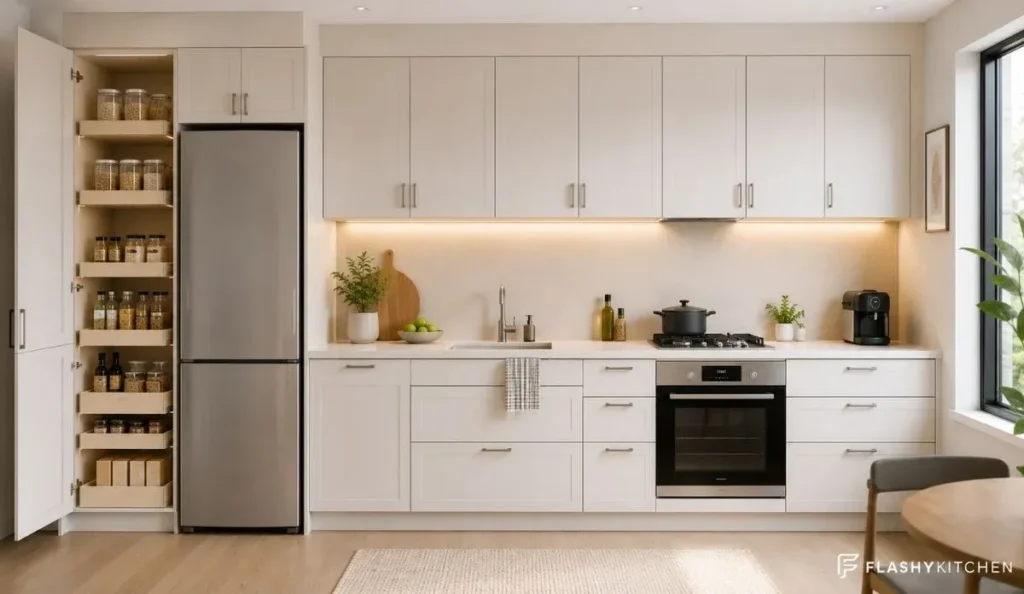
To build a smart storage wall, place a tall pantry at one end and your fridge at the other. Keep your sink and dishwasher together. Give your stove landing space on both sides.
Use deep drawer bases for your cookware. Drawers are much easier to use than standard lower cabinets with doors. Take your wall cabinets all the way to the ceiling. Keep your cabinet finish visually calm so the long wall does not feel heavy or overwhelming.
How to Keep a One-Wall Kitchen From Looking Cluttered
A single-wall kitchen is always fully visible. Hide your small appliances inside a cabinet. Limit open shelves. Use a continuous backsplash to make the wall look unified.
Choose simple cabinet hardware. Keep your colors cohesive and avoid mixing too many finishes. Most importantly, keep your counters clear.
One-Wall Kitchen vs Galley Kitchen
If you are doing a kitchen renovation, you might be debating between a one-wall and a galley layout.
| Feature | One-Wall Kitchen | Galley Kitchen |
|---|---|---|
| Floor Space | More open | More enclosed |
| Storage | Less | More |
| Cooking Efficiency | Good | Excellent |
| Best For | Studios and condos | Dedicated cooking spaces |
The one-wall layout is better when you need open floor space. If you have two parallel walls and prefer high cooking efficiency, a small galley kitchen remodel is the better option.
One-Wall Kitchen vs L-Shaped Kitchen
A one-wall layout is simpler and saves more floor space in a narrow room. However, an L-shaped kitchen layout gives you better corner workflow and more counter options if you have two open walls.
One-Wall Kitchen vs U-Shaped Kitchen
A one-wall layout is best for compact, simple, and open spaces. A U-shaped kitchen layout gives you maximum storage and counter space, but it requires a dedicated, wider room to fit properly.
Advantages of a One-Wall Kitchen Layout
- Saves a lot of space.
- Simple and often more affordable to build.
- Good for condos and studios.
- Works perfectly in open-plan rooms.
- Easy to make visually clean.
- Can pair easily with an island, table, peninsula kitchen layout, or cart.
- Avoids awkward, hard-to-reach corner cabinets.
Disadvantages of a One-Wall Kitchen Layout
- Limited counter space.
- Limited storage.
- No true work triangle.
- Can look cluttered if you use too many uppers or open shelves.
- Appliance spacing can feel tight.
- Not ideal for heavy cooking families unless supported by a large island.
Common One-Wall Kitchen Layout Mistakes
Avoid these practical errors when planning your layout:
- Leaving no prep space between the sink and stove.
- Placing the fridge too close to the cooktop.
- Using bulky standard appliances on an 8-foot wall.
- Forgetting a tall pantry.
- Using weak task lighting.
- Having no landing space near the fridge.
- Having no built-in trash or recycling plan.
- Adding an island without proper walkway clearance.
Is a One-Wall Kitchen Right for You?
Choose a One-Wall Kitchen If:
- You live in a condo or apartment.
- You have limited square footage.
- You want an open-plan room.
- You prefer a simple layout.
Avoid a One-Wall Kitchen If:
- Multiple people cook every day.
- You need maximum cabinet storage.
- You want a traditional work triangle.
- You frequently prepare large meals.
Final Checklist Before Choosing a One-Wall Kitchen
- Measure the full wall length.
- Mark windows, doors, and electrical outlets.
- Check your plumbing location.
- Choose compact or standard appliance sizes based on your wall.
- Plan your fridge, sink, and stove order.
- Keep landing space near main appliances.
- Add vertical storage and tall pantries.
- Decide if an island, cart, or peninsula fits safely.
- Plan under-cabinet lighting.
A successful one-wall layout relies heavily on smart appliance order, vertical storage, ample landing space, and strong clutter control. Measure your wall carefully, follow the work zone rules, and enjoy your open floor plan.