
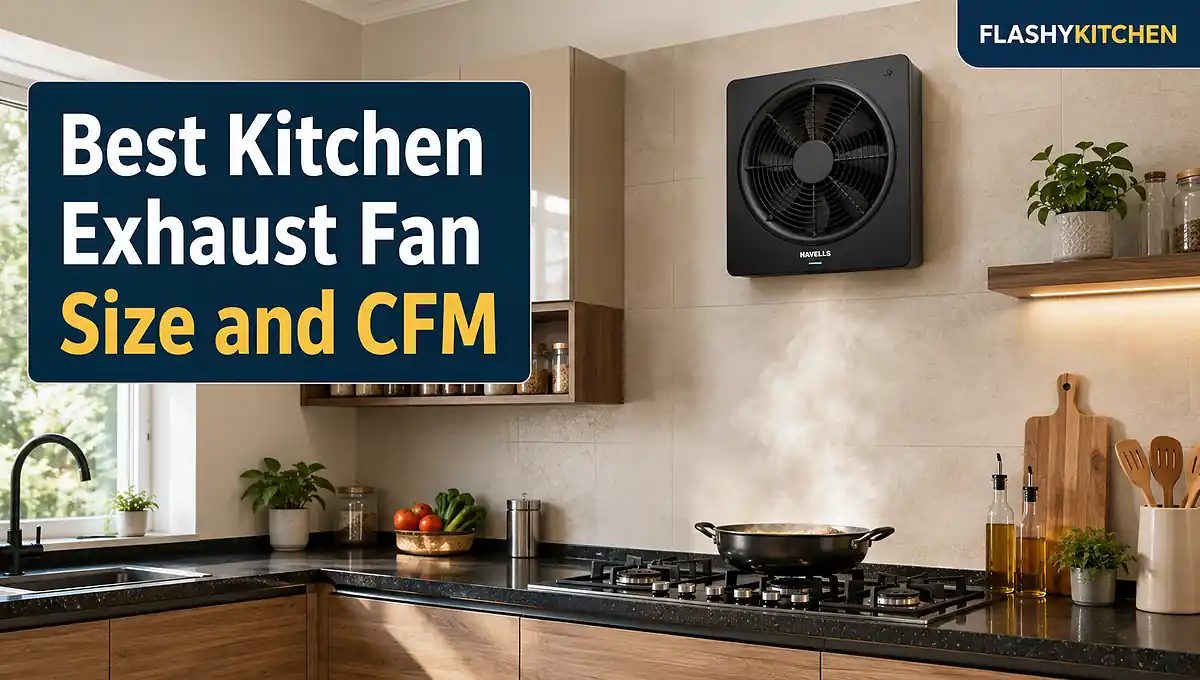
Choosing an exhaust fan for kitchen use in India is mostly a sizing problem, not a brand problem. The fan must move enough air for your room, cooking style, and fitting position without becoming so noisy that you stop using it. Indian buyers commonly see 6, 8, 9, 10, and 12-inch models, but the blade diameter alone does not tell you airflow.
CFM, air delivery, duct resistance, motor type, and placement matter more. By the end of this guide, you will know which size suits your kitchen, how to estimate airflow, when a 12-inch fan makes sense, and when a kitchen chimney is the better choice.
Quick Answer
For most Indian homes, choose the exhaust fan by airflow first and sweep size second. A 6-inch fan suits light-duty ventilation, 8- to 10-inch models cover many small and medium kitchens, and a 12-inch fan is better when the room is larger or cooking creates more heat and smoke. Check the actual CFM or m³/h rating before buying. For frequent frying, grilling, or oily cooking, a ducted kitchen chimney usually captures grease and fumes better because it sits directly above the hob.
What Size Exhaust Fan Does Your Kitchen Need?
The right kitchen exhaust fan size depends on airflow, room volume, cooking load, and mounting position. Do not choose a fan only because the box says 6, 9, or 12 inches.
The inch measurement usually describes the fan’s sweep or blade diameter. It does not guarantee a fixed amount of air movement.
Published Indian-market ventilation data shows why this matters. Example models around 150 mm, 200 mm, 225 mm, 250 mm, and 300 mm can have very different CFM ratings depending on their motor and construction.
| Fan size | Typical use | Published airflow examples | Best for |
|---|---|---|---|
| 150 mm / 6 inch | Light ventilation | Around 165 CFM in one common model | Very small kitchens, light cooking |
| 200 mm / 8 inch | Small kitchen | Around 306 CFM | Moderate heat and odour |
| 225 mm / 9 inch | Small-medium kitchen | Around 424 CFM | Regular home cooking |
| 250 mm / 10 inch | Medium kitchen | Around 506 CFM | More frequent cooking |
| 300 mm / 12 inch | Medium-large kitchen | Roughly 674-1,000+ CFM in published heavy-duty examples | High heat, smoke, larger spaces |
These figures are examples, not universal ratings. Two fans with the same diameter can move very different amounts of air.
Some Indian buying guides simplify sizing to 6 inches for smaller kitchens, 9 inches for medium kitchens, and 12 inches for larger ones. That is useful as a first filter, but CFM should make the final decision.
A stronger fan also helps slow the spread of oily vapour that eventually makes it harder to clean kitchen cabinets. It will not stop grease completely, especially when the fan sits far from the hob.
How Much CFM Should a Kitchen Exhaust Fan Have?
CFM means cubic feet per minute. It tells you how much air the fan can move in one minute.
Indian manufacturers may also publish air delivery in m³/h or CMH. Compare the actual airflow figure instead of assuming that a bigger blade always means stronger ventilation.
One useful room-level calculation is:
Required CFM = kitchen volume × target air changes per hour ÷ 60
Suppose your enclosed kitchen measures:
10 feet × 8 feet × 9 feet
The room volume is 720 cubic feet.
If you use eight air changes per hour as a planning figure:
720 × 8 ÷ 60 = 96 CFM
At 10 air changes per hour, the same room needs about 120 CFM.
Indian exhaust-fan guidance commonly uses roughly 8-10 air changes per hour as a practical kitchen benchmark. Treat this as a sizing starting point rather than a nationwide Indian legal standard.
There is an important catch. Room-volume maths cannot fully account for a large tadka, deep frying, grilling, or smoke rising directly from a hot pan.
That is why a 100-150 CFM calculation does not automatically mean a small fan is ideal. Heavy cooking often benefits from stronger extraction or direct capture above the hob.
An open-concept kitchen layout also changes the decision. Smoke and odour can escape into the living area before a distant wall fan removes them, so source capture becomes more valuable.
Is a 12 Inch Exhaust Fan for Kitchen Use Better?
An exhaust fan for kitchen 12 inch size is useful when you genuinely need its airflow. It is not automatically the best exhaust fan for kitchen use.
Choose a 12-inch model when you have a larger enclosed kitchen, frequent high-heat cooking, noticeable smoke buildup, or an existing opening designed for that size.
Published Indian ventilation listings show an even bigger problem with choosing by diameter. Different 12-inch metal models are listed at roughly 674 CFM, 942 CFM, and more than 1,000 CFM. The physical size is similar, but performance changes substantially.
A powerful exhaust fan can also have disadvantages.
It may cost more, make more noise, create a stronger draft, and need a larger wall or window opening. Strong extraction also works poorly if the room has no reasonable path for replacement air to enter.
For a small enclosed kitchen with light cooking, an 8- or 9-inch fan with adequate airflow can make more sense than an oversized 12-inch unit.
This is where many buyers overspend: they buy the biggest fan rather than the fan whose airflow and fitting suit the room.
Which Type of Kitchen Ventilation Fan Should You Choose?
The best type depends mainly on where the kitchen can discharge air outdoors.
Wall Mount Exhaust Fan
A wall mount exhaust fan for kitchen use is usually the simplest option when an external wall is available.
Mounting the fan high helps remove rising hot air. A short path directly outdoors also avoids much of the resistance created by long ducts.
Check the required wall cut-out before buying. A fan sold as 250 mm does not necessarily require an opening of exactly 250 mm because the frame and mounting dimensions can differ.
Window Exhaust Fan
A window exhaust fan for kitchen use can work where cutting an external wall is difficult.
This option is common in apartments and older kitchens, but the fitting needs proper support. A kitchen window grill may also need modification.
Do not assume any plastic exhaust fan can be fixed directly to glass. Use a model suitable for the intended mounting method.
Duct Exhaust Fan
A duct exhaust fan for kitchen use makes sense when the fan cannot discharge directly through the nearby wall.
The duct carries extracted air outside. Indian suppliers offer kitchen exhaust arrangements using flexible or rigid piping for installations where direct wall discharge is not possible.
Keep the duct route as short and direct as the layout allows. Long runs and repeated bends create resistance and reduce real airflow.
Ceiling Exhaust Fan
A ceiling exhaust fan can remove general hot air, but the extracted air still needs a safe route outdoors.
Never discharge grease-laden kitchen air into a ceiling void or enclosed cavity.
Portable and Mini Exhaust Fans
A portable exhaust fan for kitchen use sounds convenient, but it cannot replace proper outdoor extraction unless it actually discharges outside.
The same warning applies to a mini exhaust fan. Moving smoky air around the room is not the same as exhausting it.
If your kitchen ventilation is being changed during a small kitchen remodel, plan the wall opening, electrical point, duct route, cabinets, and chimney position before finishing the surfaces.
Exhaust Fan vs Chimney: Which Is Better?
For light cooking and general heat removal, an exhaust fan is cheaper and simpler. For frequent oily cooking, a ducted kitchen chimney is usually better because it captures fumes near the hob and can trap grease before it spreads through the room.
| Factor | Exhaust fan | Kitchen chimney |
|---|---|---|
| Heat removal | Good | Good |
| Smoke capture | Depends heavily on placement | Better near the cooking source |
| Grease capture | Limited | Better with suitable filtration |
| Purchase cost | Lower | Higher |
| Installation | Usually simpler | More involved |
| Cleaning | Blades, grill, shutter | Surface, filters or collection system |
| Best fit | Light-moderate cooking | Frequent frying and greasy cooking |
Kitchen chimneys sit directly above the cooktop, which gives them an advantage in capturing cooking fumes before those fumes spread. Exhaust fans normally remove general room air after smoke, heat, or odour has already entered the kitchen.
This matters in Indian homes where tadka, shallow frying, deep frying, or grilling is frequent.
An exhaust fan can still be the smarter choice for a rental, a lightly used kitchen, a limited budget, or a room where chimney ducting is impractical.
You can also use both. A chimney can handle pollutants near the cooktop while a wall fan removes residual heat from the room. The two should be planned properly rather than simply running the largest available fans together.
Whichever system you choose, ventilation works alongside good kitchen safety habits; it does not replace safe cooking practices or proper maintenance.
Where Should an Exhaust Fan Be Fitted?
Place a general exhaust fan high on an outside-facing wall or suitable window where it can discharge directly outdoors. The aim is to create a short exit path for hot, smoky air.
Do not hide the fan behind a tall cabinet, curtain, shelf, or decorative panel. Anything that restricts the intake can reduce airflow.
The fan also needs replacement air. A door gap, window, or other safe air path helps fresh air enter while stale air leaves.
Avoid exhausting kitchen air into:
- a loft or ceiling cavity
- an enclosed shaft not designed for kitchen exhaust
- a neighbouring room
- a garage
- a closed cabinet cavity
Before making a new wall opening, check for electrical wiring, plumbing, structural elements, and building or housing-society restrictions where applicable.
For new hardwiring or changes to the electrical point, use a qualified electrician. Do not improvise mains wiring near greasy or damp kitchen areas.
What Features Matter When Buying an Exhaust Fan?
A good buying decision comes from comparing specifications in the right order.
Start with airflow. Check CFM, CMH, or m³/h rather than choosing only by the fan’s sweep size.
Then check noise. A powerful high speed exhaust fan for kitchen use is not useful if its sound is irritating enough that nobody switches it on.
A “silent exhaust fan for kitchen” or “noiseless exhaust fan” should still be judged by a published noise specification where one is available. Silent is often marketing language rather than literal silence.
Motor design matters too. A BLDC exhaust fan can offer lower power consumption than some conventional motor designs, but do not assume BLDC automatically means better extraction. Airflow still needs to match the kitchen.
For body material, both plastic and metal have a place.
Plastic models are light and resist rust, while heavy duty metal exhaust fans can suit higher-airflow applications. The better option depends on the motor, build, mounting position, heat exposure, and cleaning needs.
Also check:
- actual cut-out dimensions
- shutter or louvre design
- wattage
- motor speed
- warranty terms
- service availability
- ease of removing the grill for cleaning
A decorative fan should not control the decision. Good kitchen design styles can accommodate ventilation without sacrificing access for cleaning and repair.
How Much Does a Kitchen Exhaust Fan Cost in India?
A domestic kitchen exhaust fan can cost roughly ₹1,000 to ₹3,000 for many common models, while larger or heavy-duty designs can cost considerably more. Installation, wall or glass cutting, wiring, grill changes, and ducting can add to the total.
Current Indian listings checked in August 2026 show small 150 mm units around ₹974 to ₹2,264, while manufacturer listings place several mainstream kitchen exhaust fans around ₹2,000 to ₹3,400. Heavy-duty models can rise beyond that range.
Prices vary by retailer, city, model, discount, and installation requirements. Online product prices may include GST but usually do not represent the complete fitted cost.
A kitchen chimney costs more. Current branded Indian listings start around ₹6,599 for some models before considering the exact installation arrangement.
Do not choose between a chimney and exhaust fan based on purchase price alone. Decide whether your main problem is general heat and odour or grease-heavy cooking fumes.
How Do You Keep a Kitchen Exhaust Fan Working Properly?
Grease and dust slowly coat the grill, blades, shutter, and nearby wall. That buildup can restrict airflow and make the fan harder to clean.
Inspect the fan regularly if you fry food often. Clean it when you see sticky residue, dust buildup, slower shutters, or noticeably weaker extraction.
Switch off and isolate electrical power before removing a cover or cleaning accessible parts.
Follow the manufacturer’s instructions for washable components. Never soak the motor or electrical housing.
This maintenance can fit into the same routine you use to clean kitchen appliances. Heavy grease around the fan is also a sign that the room may need more effective source capture.
An exhaust fan will reduce airborne residue, but it cannot replace a periodic deep-clean kitchen routine.
Which Exhaust Fan Should You Choose?
Choose an exhaust fan for kitchen use by airflow, placement, and cooking load, not by inches alone. For many Indian kitchens, an 8-, 9-, or 10-inch model is enough when its published air delivery matches the room. Move to 12 inches when the kitchen is larger or smoke is heavier. If grease capture is the main problem, choose a ducted chimney instead. Measure the opening, check airflow and noise, then confirm the fitting before you buy.