
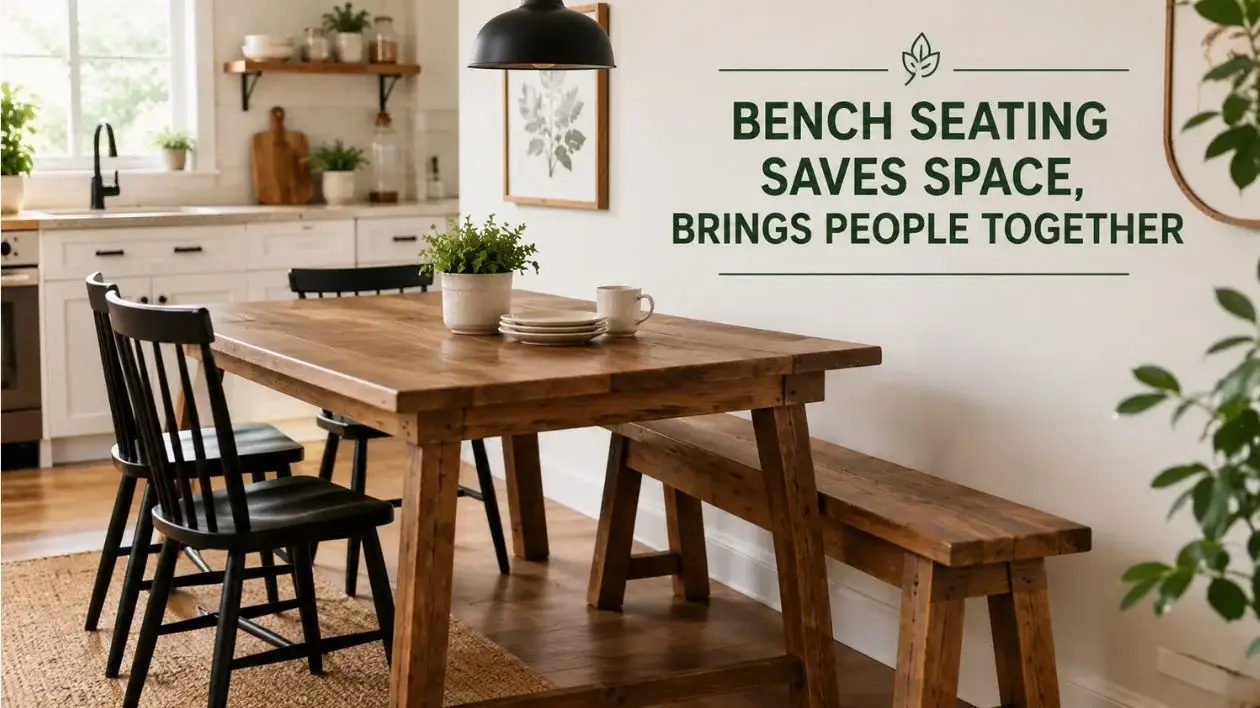
A kitchen table with bench sounds like an easy space saver, until you pick the wrong size, block a walkway, or find out nobody wants to sit on a backless plank through a full dinner. The setup works well in some kitchens and badly in others, and the difference comes down to layout, sizing, and who actually eats at your table.
This guide covers four bench-and-table layouts matched to real kitchen shapes, the dimensions that make bench seating comfortable, honest cost tiers, and the trade-offs. By the end you will know which setup fits your kitchen, or whether chairs are the better call.
Quick answer
A kitchen table with bench saves space when the bench tucks under the table or sits flush against a wall. Expect an 18-inch seat height and 17 inches of seat depth.
- A wall-side bench frees up to 36 inches of walkway versus chairs
- Size the bench 12 inches shorter than the table so it tucks under
- Four layouts: one side, both sides, L-shaped corner, or mixed with chairs
- Backless benches get uncomfortable after about 30 minutes
- Sets run $60 to $1,000 depending on material
What is a kitchen table with bench setup?
A dining table with bench replaces some or all of the chairs with one long shared seat. The bench can be freestanding and movable, built into a corner as an L-shaped unit, or fitted with storage: either a hinged lid that lifts open or an open shelf below the seat.
Most sets pair a single bench with two or three chairs on the opposite side. Corner breakfast nook sets use an L-shaped bench wrapping two walls, with a small table and sometimes a chair on the open side.
A storage bench holds table linens, kids’ games, or a spare tablecloth. It will not replace proper dish storage, though. If displaying and storing dishware is the real goal, a freestanding kitchen hutch does that job far better than seven inches of space under a seat cushion.
What separates a bench from chairs is simple: no armrests, no divided seats, and usually no back. That makes it slimmer and easier to push flat against a wall. It also changes the comfort math, which most product listings skip past.
Bench vs chairs: what you gain and what you give up
A bench seats more people across less width and clears out of the way after meals. Chairs give each person a back, arms, and their own space. Neither wins outright, and the right answer depends on your kitchen size and who sits at the table daily.
Does a bench actually save space in a kitchen?
A bench saves floor space only when it sits flush against a wall or slides fully under the table. Behind a dining chair you need about 36 inches of clear floor so someone can push back and stand up. A bench against the wall needs almost none, because diners slide in from the end.
That recovered floor, up to 36 inches on one side, is real in a tight kitchen. A bench parked in the middle of the room takes the same depth as chairs and gains you nothing.
While comparing product listings across several retailers, one pattern kept showing up. Plenty of budget benches sit too tall to clear the table apron, the rail that runs under the tabletop. If the bench will not slide under, the space-saving claim on that listing does not apply to your setup.
Comfort, back support, and mixing the two
The real cost of a bench is comfort. A backless bench gives zero lower-back support. Most adults start shifting after about 30 minutes, which is fine for a weekday breakfast and poor for a long dinner with guests.
An upholstered bench with a low back solves the support problem. It also usually cannot tuck under the table, so the space savings disappear. That is the central trade-off nobody advertises.
Mixing a bench and chairs is where most households land, and it is worth treating as the default. Put the bench against the wall where nobody needs frequent in-and-out access. Keep chairs on the open side so adults can stand and move without asking two people to shift.
Older adults and anyone with joint or mobility limits should have chairs with arms. Rising from an 18-inch backless seat takes leg strength and something to push against, and a bench gives neither.
Four layout options and which kitchen fits each
Four arrangements cover almost every kitchen: bench on one side with chairs opposite, benches on both sides, an L-shaped corner bench, or a mix of bench, chairs, and stools. Which one works depends on how many walls sit behind your table and how much walkway you can spare.
Bench on one side, chairs opposite
The most common arrangement, and the safest starting point. Push the bench flush to the wall behind the table and set two or three chairs across from it. Works well in narrow galley kitchens and eat-in kitchens where the aisle on one side has to stay clear all day.
Benches on both sides
Two matching benches, no chairs. This seats the most people for a given table length and suits a long farmhouse dining table with a trestle base. It needs a wide open room, since both sides require slide-in room. A small kitchen cannot support it.
L-shaped corner bench and breakfast nook
A corner bench wraps two perpendicular walls with the table pushed into the corner, turning dead space into seating for four to six people. This is the banquette layout, and it delivers the biggest seating gain per square foot of any option here.
Breakfast nooks are not outdated. Several design publications covering 2026 kitchen trends describe them as a genuine comeback, now planned as built-in architecture rather than a leftover corner filled with furniture.
Mixed bench, chairs, and stools
Bench on one side, chairs on another, a stool at one end for overflow. This flexes with group size and suits open-plan kitchens where the table bridges the cooking and living areas. It is also the easiest layout to change later without buying a whole new set.
What size bench fits your table
A dining bench should have a seat height of 17 to 19 inches to work with a standard 28- to 30-inch table. That cluster comes from published measurements across eight retailer and manufacturer sources, with 18 inches sitting at the midpoint. Below 17 inches, shorter adults’ feet dangle. Above 19 inches, knees press into the table apron.
Published sources disagree slightly on seat height, and cushions are the reason. Some list the bare frame height, others the finished height with a cushion in place. A 16-inch frame under a 3-inch cushion sits at roughly 19 inches once compressed, which puts you at the top of the comfortable range rather than the bottom.
Seat depth should run 17 to 20 inches, measured from the front edge back to the seat back or backrest base. Shallower than 17 inches and you feel perched on a ledge. Deeper than 20 and shorter people cannot reach the back at all.
| Measurement | Range | Why it matters |
|---|---|---|
| Seat height | 17–19 in. | Below 17: feet dangle. Above 19: knees hit table apron |
| Seat depth | 17–20 in. | Below 17: perching. Above 20: back is out of reach |
| Bench length | Table length minus 12 in. | Clears table legs so the bench tucks under |
| Walkway behind chairs | 36 in. minimum | Room to push back and stand |
| Walkway behind wall bench | 0–12 in. | Bench sits flush or near-flush |
| Width per seated adult | 24 in. min, 30 in. ideal | Shoulder room without elbow contact |
The 12-inch rule is the one most people miss. A bench matching or exceeding the table length will not fit between the table legs and cannot tuck underneath. An 84-inch table pairs with a 72-inch bench; a 48-inch table pairs with a 36-inch bench. Measure the inside gap between table legs at floor level to confirm before ordering.
Figures published as of August 2026, compiled across retailer and manufacturer sources.
How much does a table and bench set cost?
Table-and-bench sets fall into three tiers. Prices pulled from 12 published retailer listings as of August 2026 and vary by region, and by whether delivery or assembly is included.
Budget sets run $60 to $200. These use engineered wood or MDF with metal frames, seat four, and assemble in about an hour. Weight capacity and finish durability are the weak points; expect visible scratches within a year of daily use.
Mid-range sets run $200 to $600. Solid pine or rubberwood frames, upholstered seats, wider tables seating six. Better joinery means noticeably less wobble after a few months.
Premium sets run $600 to $1,000 and up. Solid hardwood, wider benches with backs, heavier construction. Custom and Amish-made pieces start at the top of that band and climb. Lead times on custom orders run 8 to 20 weeks, so order well ahead if you need it by a date.
Two numbers to check before you buy, since listings rarely lead with them: weight capacity per bench, and whether the bench clears your table apron.
When a bench is the wrong choice
Bench seating is a poor fit in four situations, and it is worth ruling yourself out before spending money:
- Older adults or anyone with joint or mobility limits will struggle with a backless bench. Standing up from an 18-inch seat with nothing to grip is genuinely hard. Chairs with arms are safer.
- Long dinners where people sit for an hour or more expose the comfort gap fast. A bench handles a 20-minute breakfast well and a three-course dinner badly.
- A galley kitchen where the bench cannot tuck under the table gains nothing. If the bench sits in the aisle, it blocks the same floor a chair would.
- An L-shaped corner bench traps whoever sits in the innermost seat. If that person gets up often, give them the chair on the open side instead.
Common questions about bench seating
Can I use a bench with a round table?
A curved bench follows the arc of a round table and seats three where two chairs would fit. The bench radius has to match the table closely, or a gap opens at both ends. Curved benches are harder to find and cost more, so check whether round table shapes actually suit your room first.
How do I stop a bench from sliding on a hard floor?
Stick adhesive rubber pads or non-slip grippers under each leg. For heavier benches on hardwood or tile, silicone furniture cups grip the floor and protect the finish at the same time. Skip felt pads here: they prevent scratches but slide more, which is the opposite of what you need.
Is a bench with a back worth the extra cost?
A low back, 30 to 36 inches from the floor, adds lower-back support and makes longer meals workable. The trade-off is that a bench with a back rarely tucks under the table, so the space savings go away. Worth paying for if the bench stays against a wall permanently.
Making the call
A kitchen table with bench works when you have a wall to push it against, a table sized so the bench tucks under, and a household where most meals run short. Measure three things before shopping: the wall length, the inside gap between table legs, and the clearance on the open side. For how tables, seating, and storage pieces fit together across a whole room, the kitchen furniture guide covers the wider picture.



One thought on “Kitchen Table with Bench: Space-Saving Layouts & Seating Ideas”