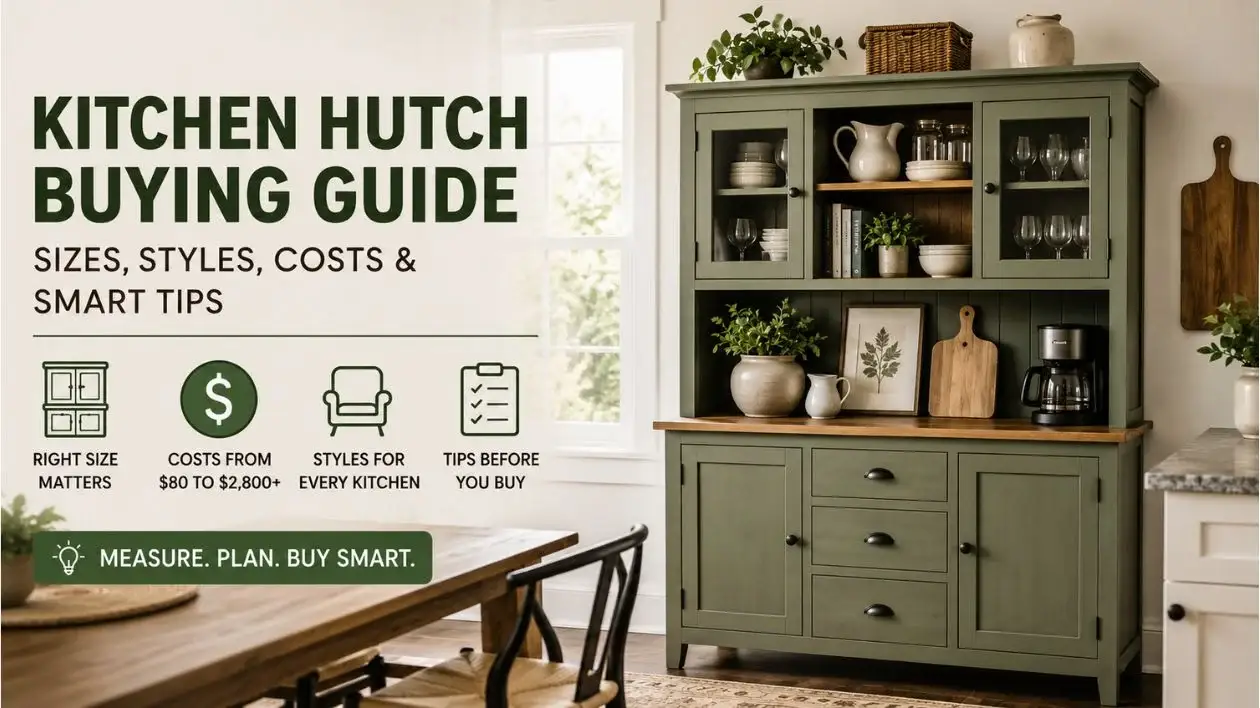
A kitchen hutch gives you freestanding storage and display space without ripping out a single cabinet. But it only works if you pick the right size, spend the right amount, and have the floor space. Get it wrong and you have a heavy piece of furniture blocking a walkway or collecting dust.
This guide covers what a kitchen hutch actually is, the styles and standard dimensions available, realistic costs across four quality tiers, and the honest trade-offs most guides skip. By the end you will know whether a hutch fits your kitchen — or whether you should pass entirely.
Quick answer
A kitchen hutch is a two-part freestanding cabinet: an open or glass-front display section on top, a closed base with drawers and doors on the bottom, and a counter in between. Most stand 72 to 80 inches tall and 30 to 66 inches wide.
- Hutches differ from china cabinets, buffets, and sideboards in structure and formality
- Standard height runs 72 to 80 inches; upper depth is 12 to 16 inches
- Budget models start around $80; premium solid wood runs $1,200 to $2,800
- Farmhouse, modern, corner, and mid-century are the most common styles today
- Skip the hutch if your kitchen lacks 30 inches of clear walkway in front of the wall
What is a kitchen hutch?
A kitchen hutch is a freestanding piece of kitchen furniture built in two stacked sections. The upper cabinet holds shelves — open, glass-front, or a mix — for displaying dishes, glasses, or cookbooks. The lower base works like a buffet: closed doors, drawers, and sometimes a plate rack behind a panel.
Between the two sits a countertop, usually 32 inches from the floor. That counter is where most people land a coffee maker, a toaster, or a serving tray. The word “hutch” comes from a French storage chest, though today it means the full two-part unit.
Construction varies by price. Budget models use particleboard and cam-lock assembly. Mid-range pieces use solid pine or oak with dovetail drawer boxes — a joint where two pieces of wood interlock at the corners for strength. Premium and Amish-made hutches use kiln-dried hardwood with mortise-and-tenon joinery throughout.
Kitchen hutch vs china cabinet, buffet, and sideboard
People mix these four up constantly. While comparing spec sheets across retailer listings, the naming turned out to be inconsistent even among sellers — one site’s “buffet hutch” is another site’s “china cabinet.” The table below shows what each piece actually is.
| Piece | Structure | Storage type | Best for |
|---|---|---|---|
| Kitchen hutch | Two-part: upper display + lower base with counter | Mix of open and closed | Everyday kitchen or dining room storage |
| China cabinet | One-piece enclosed unit, usually all glass front | Display behind glass doors | Formal dining room, protecting fine china |
| Buffet | Low, wide base cabinet, no upper section | Closed drawers and doors only | Serving surface during meals |
| Sideboard | Similar to a buffet, sometimes narrower and taller | Closed storage, sometimes with wine rack | Dining room or hallway, minimal footprint |
A hutch gives you both — the display of a china cabinet and the closed storage of a buffet — in one freestanding piece. That flexibility is why hutches work in kitchens where a formal china cabinet would feel stiff.
Is a kitchen hutch outdated in 2026?
A kitchen hutch is not outdated — it is one of the pieces driving the “unfitted kitchen” trend in 2026. Unfitted cabinetry means mixing built-in cabinets with freestanding furniture so the room feels collected over time rather than installed all at once.
The NKBA’s KBIS 2026 Kitchen Trends Report, cited by multiple design publications, names maximizing storage and wellness as top priorities for kitchen designers this year. A hutch fits both: it adds storage without construction and breaks the monotony of wall-to-wall cabinetry. Several design publications have called the hutch “one of the biggest storage trends” of 2026.
That said, a hutch looks dated fast if it clashes with the room. A dark oak traditional hutch in a white modern kitchen reads like a leftover, not a style choice. Match the finish and proportions to what is already in the room.
Kitchen hutch styles you will find today
Farmhouse. Beadboard panels, distressed paint finishes, open shelving up top. Pairs well with a farmhouse kitchen table and warm wood tones. Most affordable in ready-to-assemble versions.
Modern. Clean lines, flat-panel doors, minimal hardware. Glass front doors with thin metal frames. Works in kitchens with slab-front cabinets and simple hardware.
Transitional. Splits the difference — Shaker-style doors with simple pulls, usually in white, gray, or natural wood. The safest style if you are unsure, because it fits most kitchens without fighting the existing cabinets.
Mid-century. Tapered legs, angled lines, walnut or teak tones. Looks sharp in open-plan spaces but the thinner legs mean lower weight capacity — check the specs.
Corner. Built to fit a 90-degree corner, usually narrower (under 48 inches) and shallower. Good for small dining areas where a full-width hutch would block traffic.
Antique and vintage. Reclaimed pine, original hardware, hand-painted finishes. These pieces carry character but often need leveling, refinishing, or replacement hardware. Dimensions are rarely standard.
Standard kitchen hutch sizes and dimensions
Most kitchen hutches stand between 72 and 80 inches tall. That range comes from published measurements across eight retailer and manufacturer sources — the tightest cluster sits around 75 inches. One outlier reaches 88 inches, designed for rooms with 10-foot or higher ceilings.
Upper cabinet depth on a hutch typically runs 12 to 16 inches. That is close to standard wall-cabinet depth (12 inches) used across the kitchen industry. The upper section stays shallow on purpose — a deeper top would look top-heavy and make the piece hard to reach behind.
Lower base depth runs 15 to 19 inches. Most retailer listings quote the exterior measurement, which is what matters for walkway clearance. Worth noting: a hutch base is shallower than a standard kitchen base cabinet (24 inches), so the counter feels narrower than your main countertop. Plan around that if you intend to prep food on it.
Width varies the most. Narrow and corner hutches run 29 to 48 inches. Standard kitchen-use hutches run 54 to 66 inches. Anything wider than 66 inches is a large dining-room piece.
Small kitchen and galley fit
A hutch can work in a smaller kitchen if two conditions hold: the piece is under 48 inches wide, and you have at least 30 inches of clear floor between the hutch face and any counter, island, or wall behind you. Below 30 inches, the walkway feels cramped and you will bump into the hutch every time you pass. Measure the wall space and the opposite clearance before you shop, not after.
How much does a kitchen hutch cost?
Kitchen hutch prices split into four tiers based on material, construction, and origin. The table below pulls from published prices across 10 retailer and marketplace listings. Figures published as of August 2026 and vary by region.
| Tier | Typical price range | What you get | Trade-off |
|---|---|---|---|
| Budget / RTA | $80 to $350 | Particleboard or MDF, cam-lock assembly, shipped flat | Wobble over time, limited weight capacity, hard to refinish |
| Mid-tier assembled | $350 to $1,200 | Solid pine or oak frame, pre-assembled or semi-assembled, dovetail drawers | Heavier, longer lead time, fewer color options |
| Premium solid wood | $1,200 to $2,800 | Kiln-dried hardwood, mortise-and-tenon joints, custom finish options | Expensive, 8 to 20 weeks lead time, needs floor protection |
| Antique / custom | $500 to $95,000 (marketplace median around $3,200) | Original hardware, hand-built, one-of-a-kind character | Unpredictable condition, nonstandard sizing, may need restoration |
The wide spread in the antique tier reflects the difference between a painted pine farmhouse piece and a museum-grade 18th-century breakfront. Most shoppers land in the budget or mid range.
Hidden costs most listings skip: delivery ($50 to $200 for white-glove), in-home assembly if the piece ships flat ($75 to $150), anti-tip wall anchoring hardware ($10 to $25), and felt pads for hardwood floors ($5 to $15).
What to check before you buy
Weight capacity. One product listing showed shelf limits of 70 to 100 pounds per shelf and 320 pounds for the countertop. Not every listing publishes these numbers. If the spec sheet does not mention weight capacity, email the seller before loading heavy stoneware or a stand mixer on it.
Anti-tip anchor. A loaded hutch is top-heavy. Most mid-tier and premium hutches include a wall-anchor bracket. Budget models sometimes skip it. If yours does not include one, buy an L-bracket kit and fasten it to a stud — especially with children or pets in the home.
Depth against walkway. Add the hutch depth (15 to 19 inches for the base) to any door swing and check that you still have 30 inches of clear passage. Pull out a drawer or open a door while someone walks behind you — that is the real test.
Floor levelness. Freestanding furniture on an uneven kitchen floor rocks and stresses joints. Check with a level before placing the hutch. Adjustable feet or furniture shims fix minor gaps.
Assembly time. Budget RTA models take 60 to 90 minutes with two people. Premium assembled pieces arrive ready but need two people to carry and position. Plan for both.
When a kitchen hutch is the wrong choice
Not every kitchen should have one. A hutch is the wrong move in four cases.
A narrow galley kitchen without 30 inches of clear walkway after placing the hutch will feel cramped immediately. No amount of styling fixes a blocked path. A wall-mounted shelf or a shallow rolling cart is a better use of that wall.
Renters who cannot anchor furniture to the wall face a tipping risk, especially with young children or large pets. If your lease does not allow wall anchors, a low buffet or sideboard without a tall upper section is safer.
A hutch with open upper shelving in a kitchen near the stove or a high-traffic cooking area collects grease and dust fast. If you cook often and do not want to wipe shelves weekly, pick a hutch with glass-front doors or skip the piece entirely.
If your main goal is protecting heirloom china or formal serving pieces, a fully enclosed china cabinet does that job better. A hutch is casual by design — open shelves and a working counter mean fingerprints, crumbs, and everyday wear.
Kitchen hutch FAQs
Can I refinish or paint an old kitchen hutch?
Solid wood hutches take paint and stain well. Sand the surface, prime with a bonding primer, and apply two coats of cabinet-grade paint. MDF or particleboard hutches do not sand evenly and often swell at the edges once the factory finish is broken. Check the material before you start — a solid wood piece is worth refinishing, a particleboard one usually is not.
How long does a kitchen hutch take to arrive?
Budget RTA hutches from major retailers ship in one to two weeks. Mid-tier assembled pieces take four to eight weeks. Amish-made or custom-built hutches run 12 to 20 weeks depending on wood species, finish, and the builder’s backlog. If you need the piece by a specific date, order early and confirm the lead time in writing.
Can I separate the top and use just the base as a buffet?
Most two-part hutches are designed to separate. The upper cabinet lifts off the base, which then works as a standalone buffet or sideboard. Check whether the base has a finished top surface — some are raw or unfinished underneath the upper section. If it is unfinished, a piece of cut-to-fit plywood under a table runner hides it.
A kitchen hutch earns its place when you have the wall space, the walkway clearance, and a real storage need it solves. Measure the wall plus 30 inches of clearance in front of it before you start browsing — that single step prevents the most common regret. For a broader look at how hutches, islands, carts, and shelving fit together, the kitchen furniture guide covers the full picture. And if you are pulling together a farmhouse dining area, matching chair cushions tie the room together faster than any single large piece.