A farmhouse kitchen table should suit your room in real life, not just your mood board. The right table leaves space for chairs, keeps walkways clear, seats your household without crowding, and handles daily meals. Base shape, tabletop width, finish, and extension design all change how a table works.
It must also fit the wider kitchen layout. By the end, you will know how to compare styles, measure the room, check real seating capacity, choose a practical surface, and avoid common problems before a large, hard-to-return piece reaches your home.
Quick Answer: How to Choose a Farmhouse Kitchen Table
Choose a farmhouse kitchen table by measuring the room first, then checking usable seating instead of trusting the listed capacity. Match the shape, base, wood, and finish to how your household eats and moves through the space. Test the full footprint with your own chairs before comparing colors or decorative details.
- Leave room for chairs and walking paths.
- Measure chairs and base supports carefully.
- Match the shape to the room.
- Choose an easy-care surface.
- Compare sets, benches, and extension leaves.
What Makes a Kitchen Table Farmhouse Style?
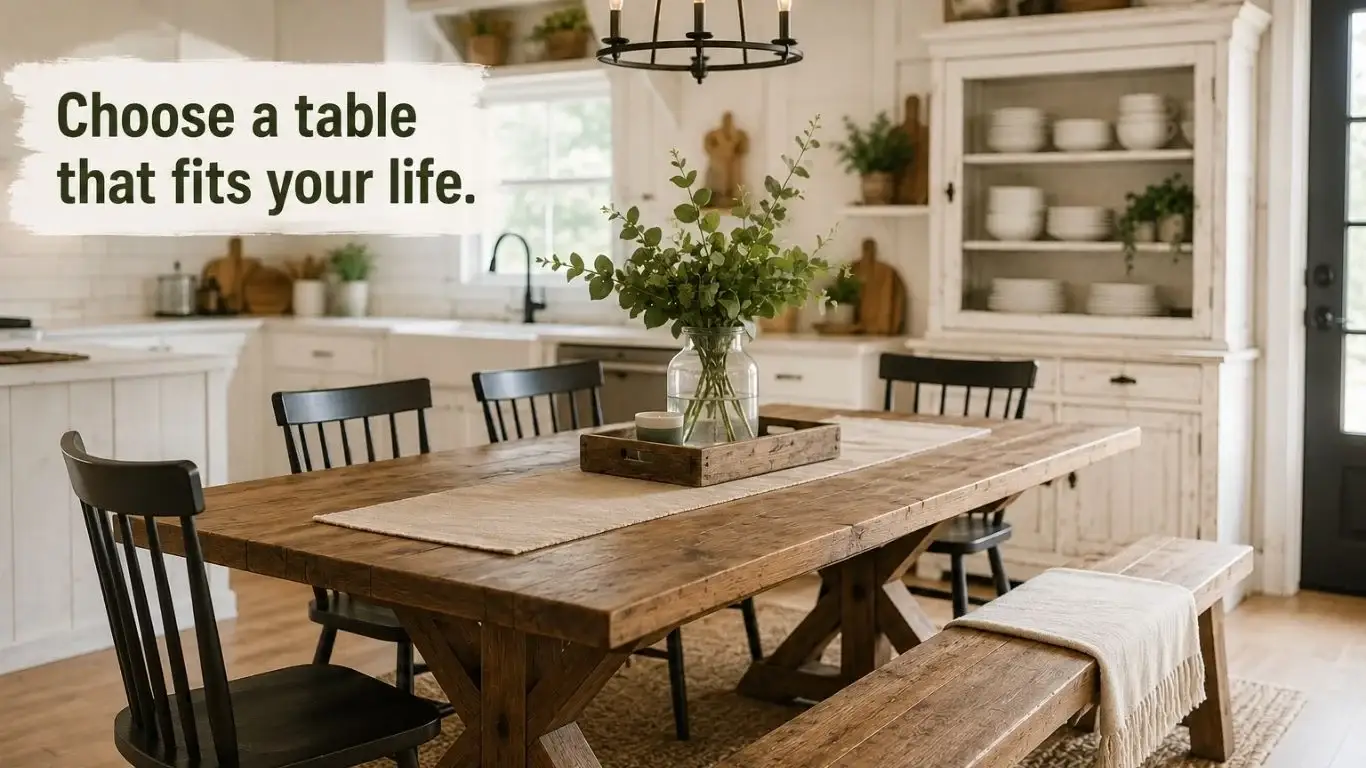
A farmhouse kitchen table pairs a practical shape with visible wood, sturdy construction, and simple country details. Common features include a plank top, trestle base, X-leg supports, painted base, and natural or distressed finish. A good design feels useful, not overloaded with fake wear.
Traditional, Rustic, and Modern Farmhouse Styles
Traditional farmhouse tables use thick tops, turned legs, trestle bases, and painted lower sections. A rustic kitchen table adds rough grain, dark stain, reclaimed boards, and visible wear.
Modern farmhouse tables keep the sturdy forms but use cleaner lines and smoother tops. The style remains sold in 2026, though restrained finishes age better than artificial distressing.
Rustic is broader; farmhouse pairs country character with practical dining.
Farmhouse Details That Affect More Than Appearance
Deep plank gaps may trap crumbs. Breadboard ends are crosspieces that may help manage wood movement, while a live edge keeps the tree’s natural outline.
A thick apron, the frame below the tabletop, can block thighs or stop chairs sliding underneath.
What Size Farmhouse Table Fits Your Room and Seats Everyone?
The right size depends on the full footprint, chair movement, and traffic around seated diners. Do not choose by table length alone. Measure the room, the open table, your chairs, and the clear space between base supports before ordering it.
Measure the Room, Not Just the Table
Measure from walls, islands, doorways, and nearby furniture in both table positions.
Across three published sources, clearance guidance ranges from 27 to 48 inches, with a midpoint of 37.5 inches. Figures published as of August 2026 differ because the low end covers chair pullout, while the high end allows walking behind seated diners. About 36 inches is a useful starting point.
| Source type | Clearance | Meaning | Use |
|---|---|---|---|
| Manufacturer guide | 27–30 in | Basic chair movement | Tight for traffic |
| Editorial guide | 36 in | General planning | Starting point |
| Manufacturer guide | 36–48 in | Chair use and walking | Better for busy paths |
Tape both footprints on the floor, add the chairs, and test each walkway.
Check Actual Seating, Not the Advertised Capacity
While comparing retailer listings, capacity labels rarely showed the usable span between supports. One furniture sizing guide uses 24 inches of edge per adult as a starting point, but verify chair width and support spacing.
Check apron depth, knee room, and end seats. A stretcher, the horizontal bar joining the base, can crowd feet. Confirm every chair slides under the top.
Separate daily capacity from holiday capacity. Eight may fit for one meal while six is the comfortable daily limit. A kitchen furniture guide can help balance the table with nearby pieces.
Width and Extension Size Matter as Much as Length
A narrow top may leave little space for plates, glasses, and serving dishes. Width matters most when diners sit on both long sides.
For an extension table, check its open size, leaf weight, and storage. Butterfly and self-storing leaves stay with the table. Removable leaves need storage, while drop leaves may reduce knee room.
Which Shape and Base Give the Best Fit?
Table shape should follow the room, while base style should follow the seating plan. Rectangular tops suit long spaces and larger groups. Round tops suit square rooms, but a wide diameter or bulky base can make them less practical than they appear.
Round, Rectangular, or Square Farmhouse Table?
A rectangular farmhouse dining table suits long rooms, benches, and extension leaves. Its ends can block tight walkways.
A round table suits conversation and breakfast spaces, especially with a pedestal. Large tops can be hard to reach across.
A square table works for two to four people. Larger tops place opposite diners too far apart.
Will the Supports Get in the Way?
Base supports affect knees, feet, chair placement, and cleaning. A trestle table often frees the corners for chairs or a kitchen table with bench, but its center stretcher and end supports may bother diners.
| Base | Seating | Main drawback | Best use |
|---|---|---|---|
| Trestle | Flexible on sides | End supports block knees | Long tables and benches |
| X-leg | Open corners | Angled supports hit legs | Fewer end seats |
| Pedestal | Easy chair placement | Large base crowds feet | Round tables |
| Four-leg | Stable and familiar | Corner legs limit spacing | Small fixed tables |
X-legs may push end chairs outward. Pedestals can feel heavy, while four-leg tables set firm chair limits.
Which Wood, Top, and Finish Work for Daily Use?
Choose the surface by expected wear, not the wood label alone. Hardwoods resist dents better, pine marks faster, reclaimed boards need inspection, and smooth sealed finishes clean more easily than deep distressing or open plank gaps for years of use.
Hardwood, Pine, Reclaimed Wood, or Veneer?
Hardwoods resist dents better than pine but add weight and cost. A pine tabletop develops marks faster, which suits an aged look but frustrates anyone who wants a crisp surface.
Check reclaimed wood for splinters, wide gaps, hidden repairs, and uneven boards. “Reclaimed” describes the material’s source; it does not guarantee strength.
Veneer places real wood over a stable core and may reduce movement. Price rises with table size, hardwood species, thicker tops, extension hardware, custom finishes, and delivery. Compare like-for-like specifications rather than price tags alone.
Choose a Finish You Can Clean and Repair
A smooth matte polyurethane finish resists common spills and keeps glare low. Use trivets, wipe spills quickly, and follow care directions.
A weathered oak look can come from stain rather than old wood. A distressed finish hides scratches but may collect food in grooves. White shows chips; black shows dust and pale scratches.
A sticky surface may come from coating damage or cleaner buildup. Confirm the finish before using strong solvents.
Should You Buy a Table Alone, a Matching Set, or a Bench?
Buy a matching set for convenience, a table alone for greater chair choice, or a bench for flexible short-term seating. The right option depends on chair quality, comfort, access, and the clear space beneath the tabletop for adults each day.
Table Alone Versus a Matching Chair Set
A set matches color and seat height, but check chair width, apron clearance, and quality. A seven-piece label counts pieces; it does not prove that six adults will sit comfortably.
A table alone gives more control over comfort, replacement options, and visual weight.
When Bench Seating Works—and When It Does Not
Bench seating may tuck away and fit children flexibly. It works best with access from both ends.
A wall-side bench makes diners climb past one another. It is a poor fit for anyone who needs easy access, firm back support, or a personal seat.
Drawers and Other Special Features
Small drawers hold flatware but may reduce thigh room and block end seating.
Which Farmhouse Table Is Wrong for Your Space?
The wrong table usually fails because of size, support placement, surface care, or delivery limits. Reject a design that blocks walkways, crowds knees, traps food, or cannot reach the room safely. A beautiful finish cannot fix a table that is uncomfortable every day.
Avoid an oversized table in a narrow kitchen and a bulky trestle where every inch matters. Skip a wide round table if the center is hard to reach. Deep grooves are also poor for quick cleaning.
Check chair clearance, knee contact, and wobble. Confirm leaf storage, leveling feet, assembly steps, total weight, and whether the top separates from the base.
Measure doors, halls, stairs, and turns before delivery. For custom work, confirm dimensions, finish, lead time, return limits, and warranty terms in writing.
Final Recommendation
Choose a farmhouse kitchen table by usable space and real seating before color or style. Tape the closed and extended footprint on the floor, place your chairs around it, and test the walking path. Then compare the base, finish, and weight with daily needs.
Use a kitchen hutch beside the dining area only if it leaves enough clear circulation