A round kitchen table is the easy answer for a small or awkward eating area. Choosing the diameter is the hard part. Every round dining table size chart is built on 42, 48, 54, and 60 inches, while the tables actually on sale measure 41 3/8 or 47 1/4.
By the end of this page you will know which diameter seats your household, how much floor space each size needs, whether a pedestal base suits your room, and what an extension leaf costs you in practice. If your eating area is long and narrow rather than square, a rectangle usually wastes less floor.
Quick Answer: What Size Round Table to Buy
Buy a 48-inch round kitchen table for four people and a 54-to-60-inch table for six. Across published figures from five sources, 54 to 60 inches is the standard six-person range.
- Leave 36 inches of clearance between the table edge and any wall.
- Add 6 feet to the diameter to get the minimum room size.
- Multiply diameter by 3.14, divide by 24, to get the seating capacity.
- Pedestal bases suit small rounds; heavy tops need a wide, weighted base.
- A 42-inch table seats four, not six, whatever the listing says.
Round Kitchen Table Sizes and How Many Each Seats
For six people, published guidance from five sources puts the right diameter at 54 to 60 inches, with 54 the most common recommendation. Four people fit comfortably at 48 inches. Two to four people suit anything from 36 to 42 inches.
| Diameter | Seats comfortably | Seats at a squeeze | Sources |
|---|---|---|---|
| 36″ to 42″ | 2 to 4 | 5 | 3 |
| 48″ | 4 | 6 | 8 |
| 54″ | 5 to 6 | 6 | 7 |
| 60″ | 6 | 8 | 7 |
| 72″ | 8 | 10 | 3 |
Why a 48-inch round is called both a four-seater and a six-seater
Eight published sources give a capacity for a 48-inch round, and their answers run from four to six. That is a 50 percent swing on the same table, and the cause is spacing.
Sources that allow 24 inches of table edge per person arrive at six. Sources that allow 30 inches, the figure used for formal place settings, arrive at four. Almost none of them say which they used, which is why two charts can both be correct and still contradict each other.
Pick your own number. Everyday family meals work at 24 inches per person. Dinner parties with serving dishes need closer to 30.
Working out the seat count for any diameter
Comparing retail listings against the published size charts turns up an odd mismatch. Stores sell 33 1/2, 41 3/8, 45 1/4, and 57 1/8-inch rounds, and every chart covers 42, 48, 54, 60, and 72. Your table is often not on the chart at all.
The arithmetic fixes that. Multiply the diameter by 3.14 to get the edge length, then divide by 24. A 47 1/4-inch table gives about 148 inches of edge, which works out to six at casual spacing and four at formal.
Run it on the exact table you are looking at, not the nearest chart size.
How Much Room a Round Table Needs
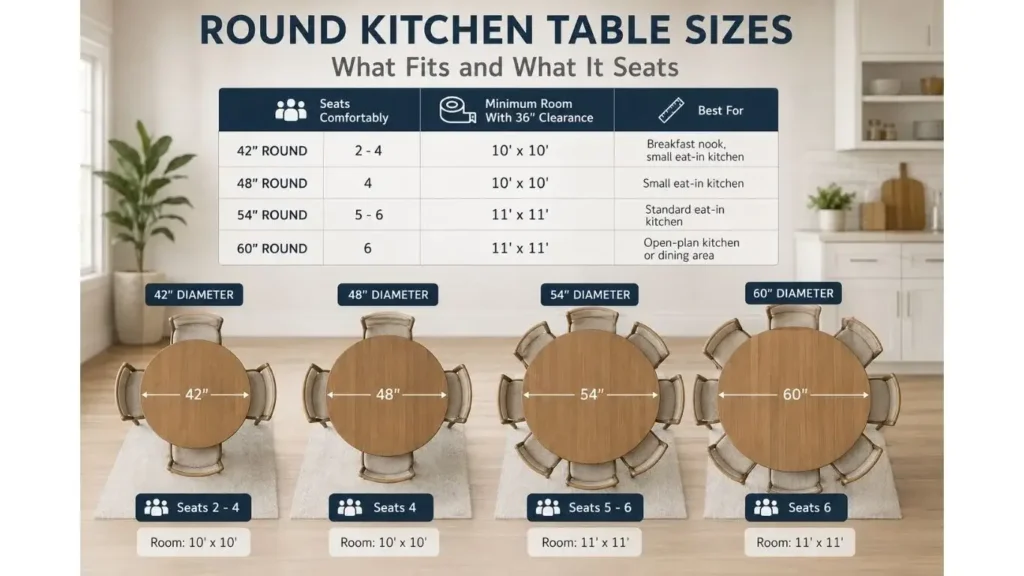
Leave at least 36 inches between the table edge and the nearest wall, cabinet, or appliance. Four published sources agree on that figure, with one allowing 30 inches on a single tight side. Add 3 feet on each side to the table diameter and you have the minimum room.
| Diameter | Table plus clearance | Minimum room | Works in |
|---|---|---|---|
| 42″ | 114″ | 10 x 10 ft | Breakfast nook, small eat-in kitchen |
| 48″ | 120″ | 10 x 10 ft | Small eat-in kitchen |
| 54″ | 126″ | 11 x 11 ft | Standard eat-in kitchen |
| 60″ | 132″ | 11 x 11 ft | Open-plan kitchen or dining area |
Figures calculated from the 36-inch clearance minimum, published as of August 2026.
Published room sizes often run a foot tighter or looser than this arithmetic. Some guides quote 9 by 9 feet for a 48-inch round, and others quote 12 by 12 for a 60-inch. The gap appears because those figures assume full clearance on some sides and a tighter squeeze on others, so treat the calculated number as the safe version.
Measuring your own kitchen before you buy
Measure the eating area only, not the whole kitchen. Subtract 6 feet from the length and 6 feet from the width. The smaller of those two numbers is your maximum diameter.
If that leaves you under 42 inches, the table is not where you should be adding capacity. A shallow kitchen hutch against the wall takes less floor than a bigger table and gives you the storage the room is actually short of.
Pedestal or Legs: Which Base Actually Fits
A pedestal base suits most round tables under 54 inches, because a single central support lets chairs slide in anywhere around the edge. Four corner legs create dead zones where a chair cannot sit. That is the real advantage, and it is about chair placement rather than legroom in general.
Two trade-offs get skipped almost everywhere. A pedestal cannot use an apron, the wooden frame that runs under a tabletop and stiffens it, so a wide or heavy top on a slim column can develop a wobble you feel when you lean on the edge.
The second is stranger and rarely mentioned. At larger diameters the column itself occupies the floor under the middle of the table, so diners sit further back to clear their knees. A wide, weighted foot or a cross base solves the wobble without making that worse.
Four legs remain the safer pick for a 60-inch or larger top, especially in solid wood or stone.
Chairs and Sets for a Round Table
Count chairs by width, not by how many will physically fit. Side chairs measure 18 to 20 inches across, and armchairs measure 22 to 24. A round table that seats six side chairs seats four armchairs, and the table has not changed.
Round tables tolerate an extra chair better than rectangles do, because there are no corners and no head of the table. Slide everyone around a few inches and one more fits.
Buying the table and chairs as a set costs less than buying separately, and it fixes your chair width permanently. If your seat count is tight, choose the chairs first and the table second. The same trade-off applies across most kitchen furniture decisions.
Extendable and Drop-Leaf Round Tables
An extension leaf adds roughly 14 to 20 inches, based on retail listings read for this page, which turns a four-seater into a six-seater. Drop leaf versions fold two side flaps down instead, usually adding 9 inches each. Both let a small kitchen host occasionally without living with a large table.
Leaves come in three types. A separate leaf stores elsewhere, a self-storing leaf folds inside the table, and a butterfly leaf hinges in half and tucks under the top.
Two problems show up in owner reviews and rarely in buying guides. A separate leaf stored somewhere damp swells and stops fitting back in, and somewhere too dry it shrinks and sits loose. Extension mechanisms also wear, and a table that opened smoothly for two years can develop a wobble in the extended position that tightening does not fully cure.
Simpler mechanisms fail less. A leaf that slides on metal tracks and locks at each end outlasts a geared multi-position system.
Tabletop Materials That Survive a Kitchen
Solid wood lasts longest and sands back when it marks. Veneer is a thin real-wood layer over a board core, and it looks identical until the edge lifts, which happens first near a dishwasher where steam gets under the edge banding.
Tempered glass shows every fingerprint and needs wiping daily in a kitchen. It also makes a small room feel more open, which is why it keeps selling despite the maintenance.
Marble is porous and stains from oil, wine, and lemon unless it is sealed and resealed. It is also heavy enough that the base has to be rated for it.
Painted tops chip at the edge where chairs knock, and touch-up paint rarely matches. A farmhouse kitchen table in solid oak or ash gives you a surface that improves with marks rather than one that records them.
Mistakes People Make With Round Tables
Over-seating a small diameter tops the list. Six chairs will physically fit around a 42-inch round, and nobody at it can cut anything. The listing counts chairs; the table counts elbows.
Measuring the table and not the chairs is next. A 48-inch top needs a 10-foot room because the chairs pull out into space that has to already exist.
Buying a wide top on a slim pedestal is the third. Check the base width and the table weight before you order, not after the wobble starts.
Two more worth naming. Storing a separate leaf in a damp basement guarantees it will not fit next Thanksgiving. And a 54-inch solid-wood or stone round often passes 150 pounds, so measure your doorway diagonally and check the crate size before delivery day.
Frequently Asked Questions
Can six chairs fit around a 42-inch round table?
Six chairs will not work at 42 inches. That table gives about 132 inches of edge, which is 22 inches per person before anyone puts a plate down. Chair arms collide and there is no room for serving dishes. Four is the honest number, with a fifth possible for a short meal.
Do you need a rug under a round kitchen table?
A rug is optional, but if you use one it must extend at least 24 inches past the table edge on every side. Chair legs need to stay on the rug when pulled out, or they catch the edge every time someone stands. For a 48-inch table, that means a 96-inch round.
How heavy is a round table and will it fit through my door?
Solid wood and stone rounds over 54 inches often weigh more than 150 pounds and need two people. Measure your doorway diagonally rather than straight across, since a tabletop tilts through. Ask for the crate dimensions before ordering, because the packed size is larger than the table.
What to Do Next
For most kitchens, a 48-inch round on a pedestal base handles four people and fits a 10-foot room. Step up to 54 or 60 inches only if you seat six regularly and the floor space is there.
Before ordering any round kitchen table, mark the diameter on your floor with painter’s tape and set your existing chairs around it. Live with it for a day. That test catches more bad purchases than any chart.