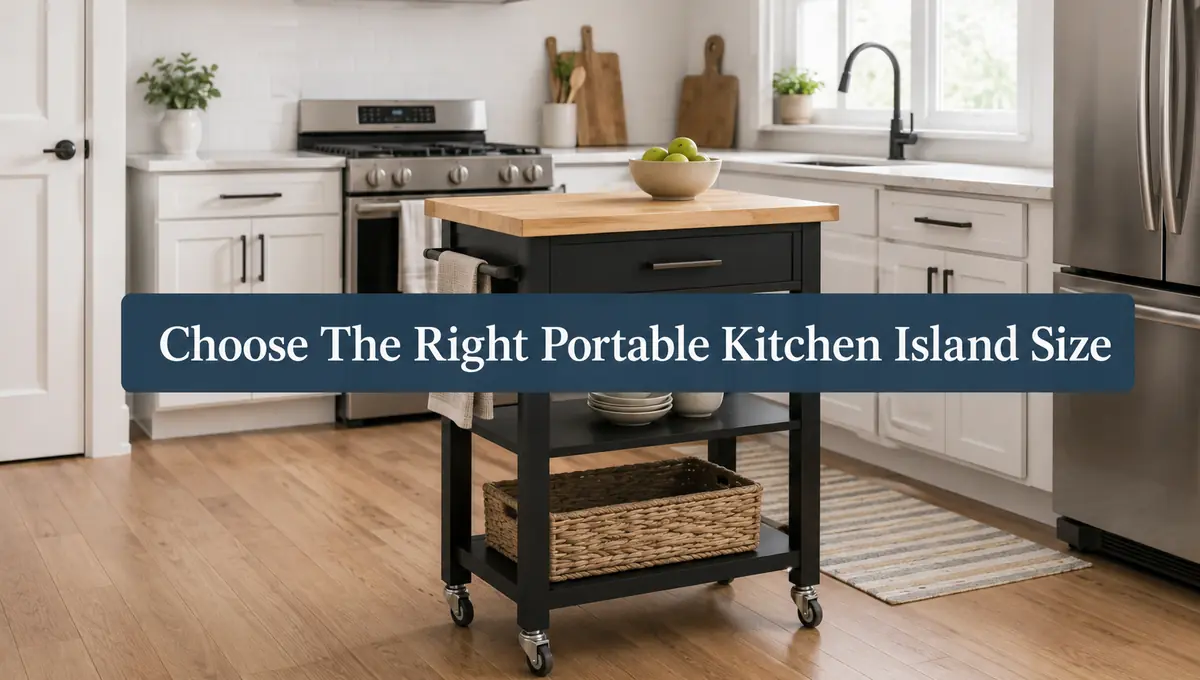
A portable kitchen island is a freestanding prep-and-storage unit that can be repositioned instead of built permanently into the floor. It may sit on wheels or furniture-style legs, but the right one must fit when parked, stay stable while you work, and leave appliances and walkways usable. Start with floor space, then compare the closed size, working size, storage, wheels, and seating needs. The broader kitchen island sizing rules help set the clearance baseline. By the end, you should know which setup fits your room, which features earn their space, what current prices look like, and when a cart is the wrong answer.
Quick Answer
A portable kitchen island works best when it solves one clear problem without creating a new traffic problem. For most small kitchens, a slim rolling cart with secure wheel locks is the safest starting point.
- Choose a narrow cart when floor space is tight.
- Measure a drop leaf both closed and fully open.
- Check appliance doors before deciding where the cart will park.
- Favor storage over stools when seating blocks the aisle.
- Verify shelf size, weight limits, assembly, and caster locks before ordering.
Do I Have Enough Space for a Portable Island?
A portable island fits only if the kitchen still works while the cart is parked and in use. Measure the working footprint, not just the cabinet box listed by the seller.
General island guidance uses 36 inches as a minimum clearance and 42 to 48 inches as a more comfortable working range. Use that as a planning baseline, then increase space where stools or appliance doors occupy the same aisle.
Measure five things before choosing a small portable island: the body, handles or towel bars, the leaf when open, occupied stool depth, and the route used to roll the unit away. A small kitchen layout can fail even when the cart itself fits because the refrigerator handle or dishwasher door becomes the real obstruction.
While comparing current U.S. retailer listings for this article, I found that labels such as “small” are unreliable. One narrow wood cart measures about 39 3/8 inches long, 16 7/8 inches deep, and 35 3/8 inches high. Larger drop-leaf carts are commonly around 50 inches wide or more.
Mark both the closed and open footprint on the floor with painter’s tape. Then open every nearby appliance and stand where you would actually prep food. That test is more useful than choosing by room square footage alone.
5 Portable Kitchen Island Types for Small Kitchens
The best portable island is the configuration that solves your main problem with the smallest practical footprint. For most tight kitchens, start with a slim rolling cart unless you specifically need seating, deeper storage, or an expandable surface.
| Type | Best use | Main limitation |
|---|---|---|
| Slim rolling cart | Extra prep space in a tight kitchen | Limited deep storage |
| Storage-first cart | Cookware and small-appliance overflow | Gets heavy when loaded |
| Drop-leaf island | Extra surface only when needed | Open leaf consumes aisle space |
| Seating island | Breakfast or casual meals | Stools reduce circulation |
| Work-table style | Open prep area and easy access | Little hidden storage |
A slim kitchen cart is usually the easiest option to live with because it can park against a wall. A rolling island with a drop leaf gives more temporary surface, but only buy that feature if the leaf can open without blocking the route through the room.
A storage-first portable island for kitchen use makes sense when drawers, shelves, or cabinets solve pantry overflow. A table-style portable island suits households that need eating space more than closed storage.
Retailers often use portable, rolling, mobile, and kitchen cart for overlapping products. Treat those words as labels and inspect the construction: wheels, locking casters, fixed legs, drop leaf, and actual dimensions tell you what the unit can really do. Current mobile island options deserve separate attention when frequent movement is the main goal.
Will It Stay Put While You Cook?
A rolling island should move when you push it and stay still while you chop, mix, or set down hot cookware. It is more likely to stay steady when the caster locks work well and heavy items sit low.
Locking wheels, also called locking casters, matter more than the word “portable” in the product title. Current retailer categories specifically distinguish carts with locking casters, and current drop-leaf examples use four or five wheels.
A narrow cart becomes less steady when heavy items sit high. Put dense cookware and appliances on lower shelves where possible, and check whether the stated weight capacity applies to the whole unit or to individual shelves and the countertop.
Floor type changes mobility too. Small hard casters roll differently across grout lines, uneven tile, soft vinyl, and transitions between rooms. If you plan to move the island every day, check wheel size, lock type, total cart weight, and the loaded route rather than assuming any wheeled unit will glide easily.
A large portable island can stop being meaningfully portable after you fill it. If you expect it to stay in one place almost all year, a freestanding island without wheels may be the simpler design.
How Much Storage and Seating Do You Really Get?
A storage-focused portable island is useful only when the drawers, shelves, and cabinets fit the things you need to store. Measure your tallest and widest appliance before treating “ample storage” as a useful specification.
Open shelves suit bowls, cookware, and items you grab often. Doors hide clutter, while adjustable shelves help with appliance storage. A towel rack or spice rack can be useful, but remember that side-mounted accessories also increase the cart’s real width.
A portable island with seating creates a harder trade-off. Stools need knee room under the countertop and floor space behind the seated person, so a compact island can fit physically yet feel crowded once someone sits down.
For small kitchens, do not force seating into the design just because it is available. A storage-focused cart paired with better cabinet storage ideas can be more useful than two stools blocking the only clear aisle.
A portable island with seating and storage works best in a wider room. Seating for four usually pushes the unit into a much larger footprint, which weakens the small-space advantage that made the cart attractive in the first place.
Which Countertop and Extra Features Are Worth It?
Choose the countertop and extras by the way you will use the cart. Butcher block suits a furniture-style prep surface, stainless steel favors easy cleanup, and a granite top adds weight that can make frequent moving less convenient.
A drop-leaf countertop earns its space when you need a larger prep surface only part of the day. Check the leaf support hardware and the open depth, because the extension must carry weight without turning the cart into an aisle blocker.
Current U.S. listings also include rolling islands with built-in power stations and drop leaves. These models still depend on a power cord, so plugging one in limits where it can move and can create a trip hazard if the cord crosses a walkway.
Assembly is another buying factor. Drawers, cabinet doors, leaves, side racks, and casters add alignment steps. Before ordering, check the assembly instructions, package weight, return policy, finished dimensions, and any separate weight limits for shelves or the top.
What Does a Portable Island Cost in 2026?
Portable kitchen island prices vary by size and features. Current U.S. retail examples checked August 11, 2026 run from about $180 for a narrow wood cart to roughly $300 to $400 for larger drop-leaf storage carts. Sale prices can fall below those levels, so treat this as a current shopping snapshot rather than a national average.
Prices vary by retailer, region, shipping, material, storage, and promotions. Stone tops, power outlets, stools, larger cabinets, and more complex hardware can raise the price, but paying more does not fix a poor fit.
A DIY portable island can make sense if you already have a sturdy cabinet or work table. Do not simply screw casters onto furniture that was not designed for rolling loads; the base and fasteners need to support the unit while it moves.
When Should You Skip a Portable Island?
Skip a portable island when the kitchen only works after you keep moving the cart out of someone’s way. Mobility should solve the space problem, not create a daily parking problem.
A fixed island is better when you have enough room and want permanent cabinetry or built-in appliances. A peninsula layout can add counter and storage space without requiring a walkway on all four sides.
Watch for five warning signs:
- The refrigerator or dishwasher cannot open comfortably.
- The drop leaf blocks the main walkway.
- Seated stools leave no passing room.
- A loaded cart is too heavy to move easily.
- You have nowhere sensible to park it.
In those cases, a slim work table, wall-mounted drop leaf, or open floor space may perform better than another piece of furniture.
What Should You Choose?
Choose a portable kitchen island by solving one problem first: prep space, storage, seating, or mobility. For most small kitchens, a slim rolling cart with reliable locking casters is the lowest-risk starting point.
Tape the closed and fully open footprint on the floor, open nearby appliance doors, and test the walking path. If the kitchen still works around that outline, you have a size worth comparing.