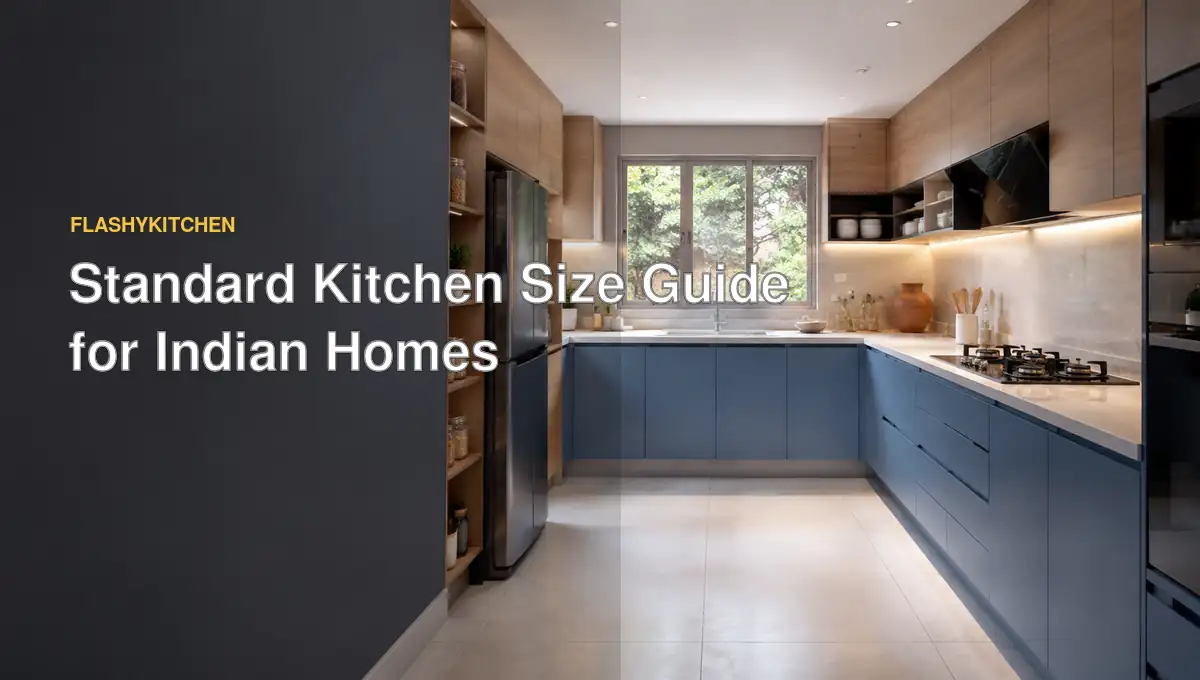
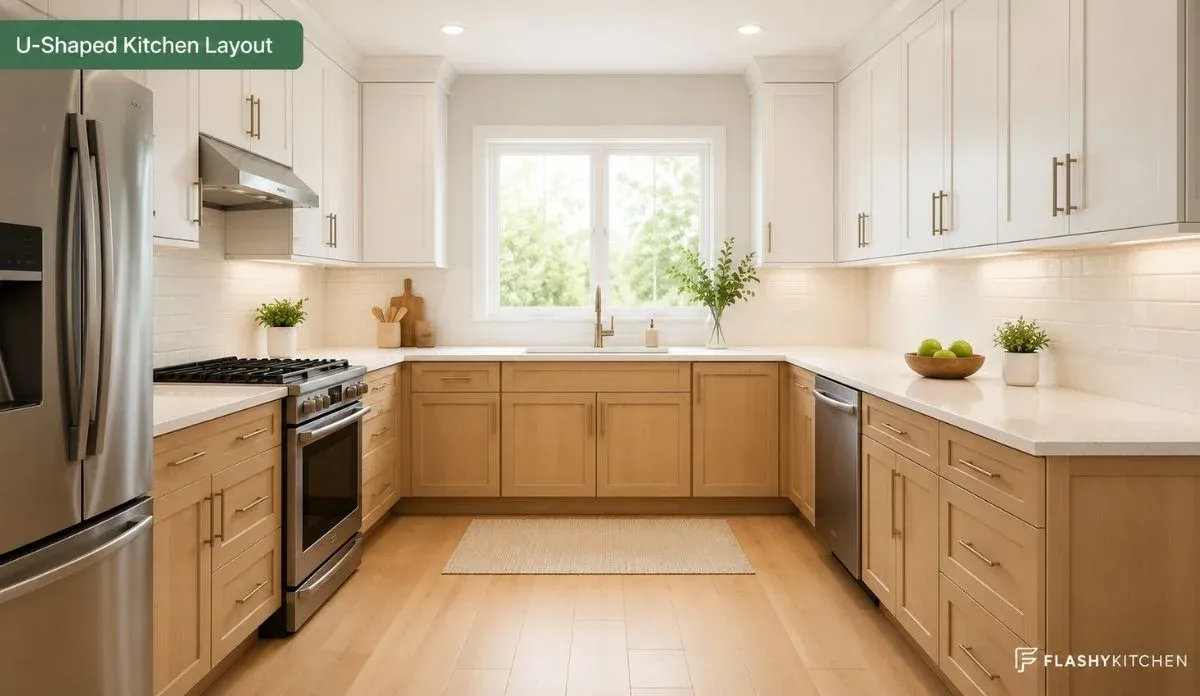
A U-shaped kitchen layout uses three connected cabinet runs to form a continuous workspace. This design works well when you want maximum storage, strong counter space, and a clear cooking zone away from foot traffic.
By wrapping the cabinets around three walls, you get a natural layout for your sink, fridge, and stove. Whether you are planning a tight enclosed space or a large open-plan room, a U-shape gives you a highly organized layout.
We will look at exactly how to plan the dimensions, where to place your appliances, and how to handle the two tricky corner cabinets without wasting space.
Quick Answer
A U-shaped kitchen layout features cabinets along three walls, creating a highly efficient workspace with maximum storage. It provides a natural work triangle that keeps cooking, cleaning, and prep zones completely separate.
- Best for: Homeowners who want maximum counter space and closed-off cooking zones.
- Best appliance setup: Sink on the center wall, stove on one side, fridge on the opposite side.
- Island rule: Only add an island if you have at least 5 feet of central clearance remaining.
- Biggest storage issue: Wasting the two deep corner base cabinets.
- Biggest mistake: Placing the dishwasher and oven where their doors collide when open.
What Is a U-Shaped Kitchen Layout?
A U-shaped kitchen layout places cabinets and counters along three adjoining walls. Some designers also call this a horseshoe kitchen.
This shape creates a clear physical boundary. It keeps guests and foot traffic out of the main cooking area.
You can build this layout in small closed kitchens, medium rooms, and large open-plan homes. When you plan the center clearance correctly, it offers the highest amount of storage per square foot.
Why U-Shaped Kitchens Work So Well
- This design gives you three connected work surfaces. You never have to walk far to reach a counter.
- It provides strong storage capacity because you have three walls for base and upper cabinets.
- A U-shape creates a natural work triangle. You get clear separation between your cooking, cleaning, and prep zones.
- It works great for one or two cooks, provided the center clearance is wide enough. If the room is large, the layout easily supports a peninsula, breakfast bar, or island.
Is a U-Shaped Kitchen Right for You?
If you are currently deciding on your floor plan, use this checklist to see if the U-shape matches your needs:
Choose a U-shaped kitchen if:
- You want maximum storage capacity.
- You cook frequently and need dedicated zones.
- You want ample counter space for appliances.
- You prefer a clear, organized cooking workflow.
Avoid a U-shaped kitchen if:
- The room is extremely narrow.
- You need to allow for heavy through-traffic.
- You want a large dining table located inside the kitchen area.
Best Appliance Placement in a U-Shaped Kitchen
Good appliance placement stops you from bumping into things while cooking.
Place the sink on the center wall. If you have a window, center the sink under it. Put the dishwasher directly next to the sink.
Place the fridge at the open end of a cabinet run. This allows family members to grab a drink without crossing into your cooking zone.
Put the stove or range on a separate wall. Avoid placing the fridge in the middle of the main traffic path.
Always protect landing space. You need clear counter space right next to the fridge, oven, and sink so you can set down hot pans or heavy groceries. If you are planning a kitchen renovation, moving your heavy appliances first will dictate the rest of your layout.
U-Shaped Kitchen Work Triangle
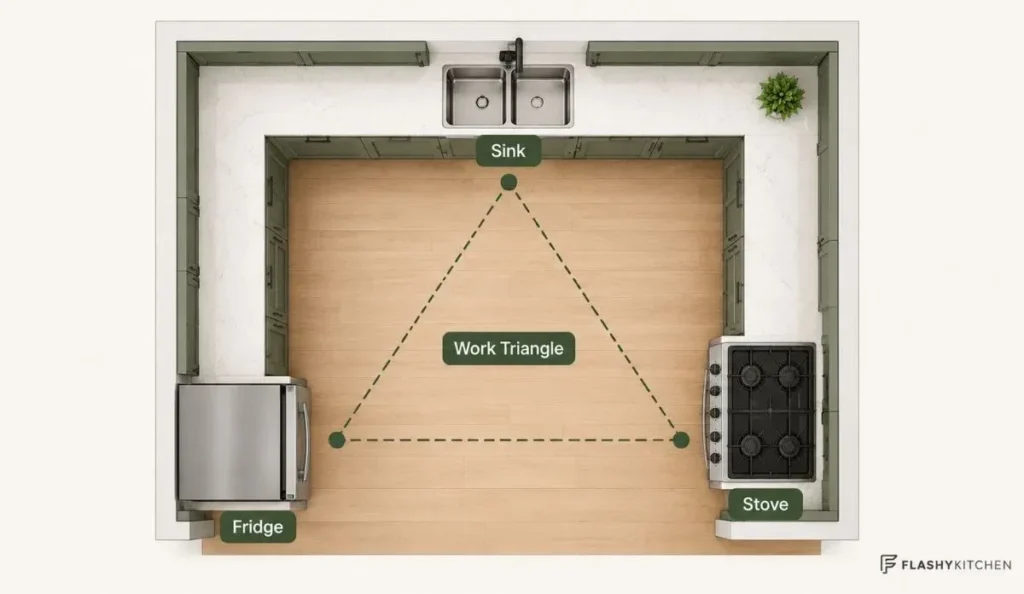
The kitchen work triangle connects the sink, stove, and fridge.
A U-shaped kitchen creates a strong, highly efficient triangle. Each major appliance can sit on a different wall. This means you just turn around to move from the sink to the stove.
| Appliance | Best Placement | Mistake to Avoid |
|---|---|---|
| Sink | Center wall, often under a window | Placing it too far from the stove |
| Stove | A side wall with dedicated counter space | Forcing it into a corner |
| Fridge | At the entry point of the kitchen | Trapping it deep inside the U-shape |
Work Zones in a U-Shaped Kitchen
- Modern kitchen planning goes beyond just the triangle. You must think about work zones.
- A U-shape easily holds four main zones.
- Your prep zone needs a large, clear counter, usually near the sink.
- Your cooking zone centers around the stove with pots and pans stored below.
- Your cleanup zone holds the sink, dishwasher, and trash pull-out.
- Your storage zone includes the fridge and tall pantry cabinets at the far end.
- If your layout includes a peninsula, you also get a serving or seating zone.
U-Shaped Kitchen Layout With Dimensions
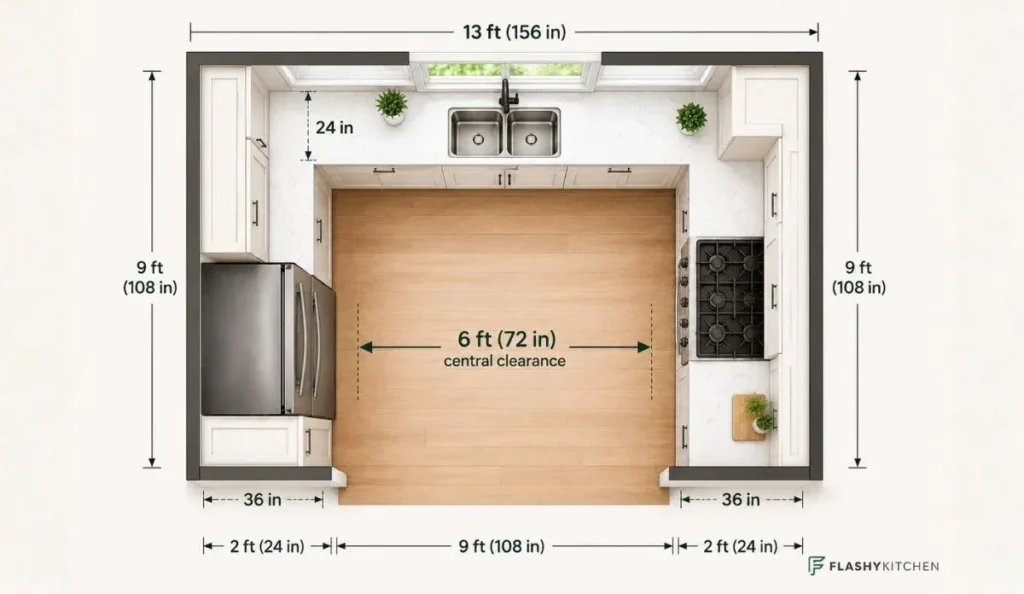
Clearance is the most important measurement in this design.
You need a minimum central clearance of 5 feet between opposite cabinets. A better central clearance is 6 to 8 feet. This allows two people to walk past each other.
A common width for this room shape is 9 to 12 feet. A standard example is around 107 square feet.
Only plan an island if the room is wide enough. Always measure your dishwasher, oven, and fridge door swings. You do not want opposing doors to hit each other when fully open.
Small U-Shaped Kitchen Layout Ideas
When working with a tight room, keep the space feeling open.
Use light cabinet colors to reflect light. Avoid placing heavy upper cabinets on every single wall, as this makes the room feel like a cave.
Choose compact appliances and slim dishwashers. If you are comparing different floor plans, a small kitchen layout remodel often relies on ceiling-height cabinets to maximize storage without eating floor space.
Add bright under-cabinet lighting. Use glass-front cabinets or open shelves only where useful. Keep the center walkway completely open, and avoid forcing an island into the middle.
U-Shaped Kitchen Layout With Island
An island works beautifully, but only in large, open rooms.
It provides extra prep space, extra storage, and casual seating. You can place a sink or cooktop in the island, but only if your plumbing and electrical budget allows for it.
The island must not block cabinet doors, dishwasher doors, or regular traffic flow.
Do not force an island into a U-shaped kitchen if the center clearance becomes tight. In many medium kitchens, a simple table or peninsula works much better.
Peninsula or Breakfast Bar in a U-Shaped Kitchen
Instead of an island, one side of the U can become a peninsula or breakfast bar.
This is much better for small and medium kitchens. It creates casual seating without needing clearance on all four sides.
A peninsula naturally separates the kitchen from the living or dining area. It replaces an island perfectly in a tighter room while still giving you a place to eat and prep.
U-Shaped Kitchen Cabinet Layout
Cabinet planning requires dividing the walls by function.
Use one wall for the sink and cleanup. Use the second wall for cooking. Use the third wall for storage, placing a tall pantry at the end of the run.
Use deep drawer bases for pots, pans, and heavy dishes. Choose between upper cabinets for hidden storage or open shelves for a lighter feel.
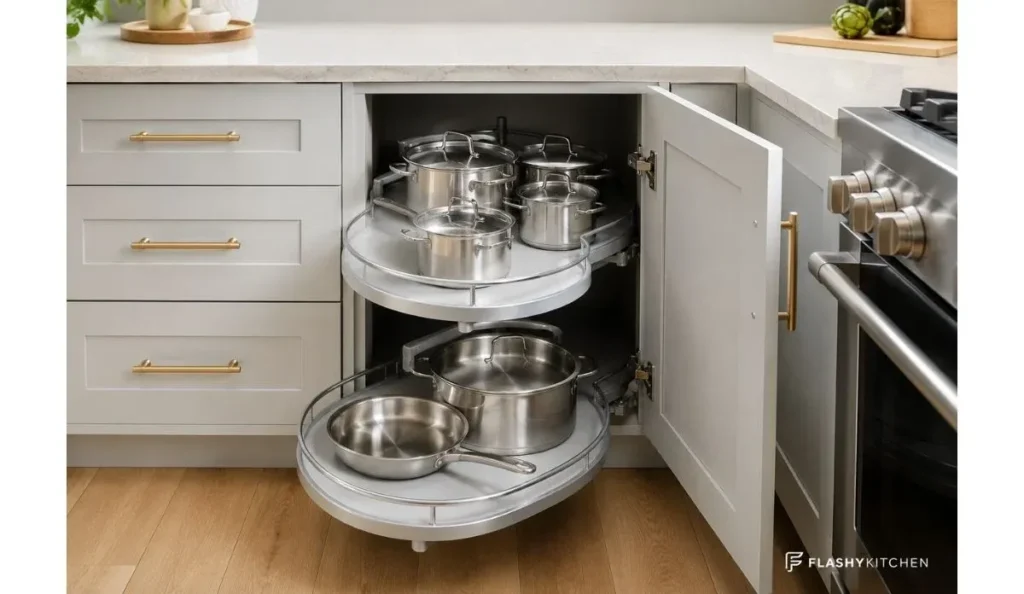
Because of the shape, you will have two corners. Two corner cabinets need special planning so things do not get lost in the back.
Best Corner Cabinet Options
You have a few ways to handle the blind corners.
A lazy Susan spins so you can reach items easily. A blind-corner pull-out slides shelves completely out into the room. A Le Mans shelf uses peanut-shaped trays that swing out smoothly. Corner drawers pull straight out diagonally.
| Corner Solution | Best For | Watch Out For |
|---|---|---|
| Lazy Susan | Small appliances and dry goods | Items falling off the back edges |
| Blind-Corner Pull-Out | Heavy pots and mixing bowls | Needs precise door clearance to pull out |
| Le Mans Shelf | Smooth, premium access | Higher cost than standard shelves |
| Corner Drawers | Quick access to utensils | Wastes some triangular space behind them |
U-Shaped Kitchen Layout Ideas by Room Size
The size of your room changes how you design the space. If you plan a full kitchen remodel, measuring the exact footprint comes first.
| Room Size | Best Layout Choice | Main Tip |
|---|---|---|
| 8×8 | Compact U-shape | Keep appliances small and avoid an island |
| 8×10 | Narrow U-shape | Protect the center walkway from door swings |
| 10×10 | Standard U-shape | Use both corners wisely with pull-outs |
| 12×12 | U-shape with small island or table | Check central clearance first |
| Open plan | U-shape with peninsula or island | Zone the cooking away from the seating |
U-Shaped Kitchen vs L-Shaped Kitchen
A U-shaped layout is better for maximum storage and counter space. It surrounds the cook with surfaces.
An L-shaped layout is better for open traffic and flexible dining. Because it only uses two walls, the L-shape naturally leaves the center of the room wide open for a large dining table.
U-Shaped Kitchen vs Galley Kitchen
A U-shaped layout gives you more counters and storage because it connects the two sides with a third wall.
A Galley layout is better for narrow rooms. It uses two parallel runs of cabinets but leaves both ends open for foot traffic to pass completely through the space.
Advantages of a U-Shaped Kitchen Layout
This layout gives you high storage capacity and lots of counter space.
It provides a strong work triangle and clear work zones. It is incredibly good for serious cooking because foot traffic stays out of the chef’s way.
It can work perfectly in both open-plan or closed kitchens. In the right room, it strongly supports a peninsula, breakfast bar, or island.
Disadvantages of a U-Shaped Kitchen Layout
This floor plan can feel closed-in if the room is too small.
The two corners can waste storage if you do not buy special pull-out hardware. In average homes, an island often does not fit.
Opposing appliance doors can collide if the walkway is narrow. Adding too many upper cabinets can make the space feel heavy. Traffic can get blocked if the entry path is narrow. It can also cost more because it uses more cabinets and countertops than other layouts.
Common U-Shaped Kitchen Layout Mistakes
Homeowners often make specific planning errors with this shape.
- The biggest error is adding an island without enough center clearance. Another common mistake is ignoring the dishwasher door swing, which traps you against the opposite counter.
- Do not place the fridge in the wrong traffic path. Do not waste both corner cabinets with basic fixed shelves.
- Avoid making all three walls feel too heavy with dark upper cabinets reaching the ceiling. Never forget to leave landing space beside the oven or sink.
- Do not rely on a single ceiling light; poor lighting in the corners makes prep work difficult. Do not use bulky, oversized appliances in a small U-shaped kitchen. Finally, do not forget to plan a dedicated spot for your trash and recycling pull-out.
Final Checklist Before Choosing a U-Shaped Kitchen
Review these steps before finalizing your plans:
- Measure all three walls exactly.
- Mark the locations of windows and doors.
- Check where the plumbing and electrical lines sit.
- Choose your specific appliance sizes early.
- Measure the center clearance to guarantee 5 feet minimum.
- Check fridge, oven, and dishwasher door swings against each other.
- Plan specific hardware for both corner cabinets.
- Decide carefully if an island, peninsula, or table fits best.
- Plan under-cabinet lighting for all three sides.
- Keep one large, clear prep zone next to the sink.
Conclusion
A highly functional U-shaped kitchen layout depends on protecting your center clearance, smart appliance placement, and solving your corner storage early. By keeping the work triangle tight and avoiding heavy upper cabinets in small spaces, you can build a room that handles serious cooking while staying highly organized.