
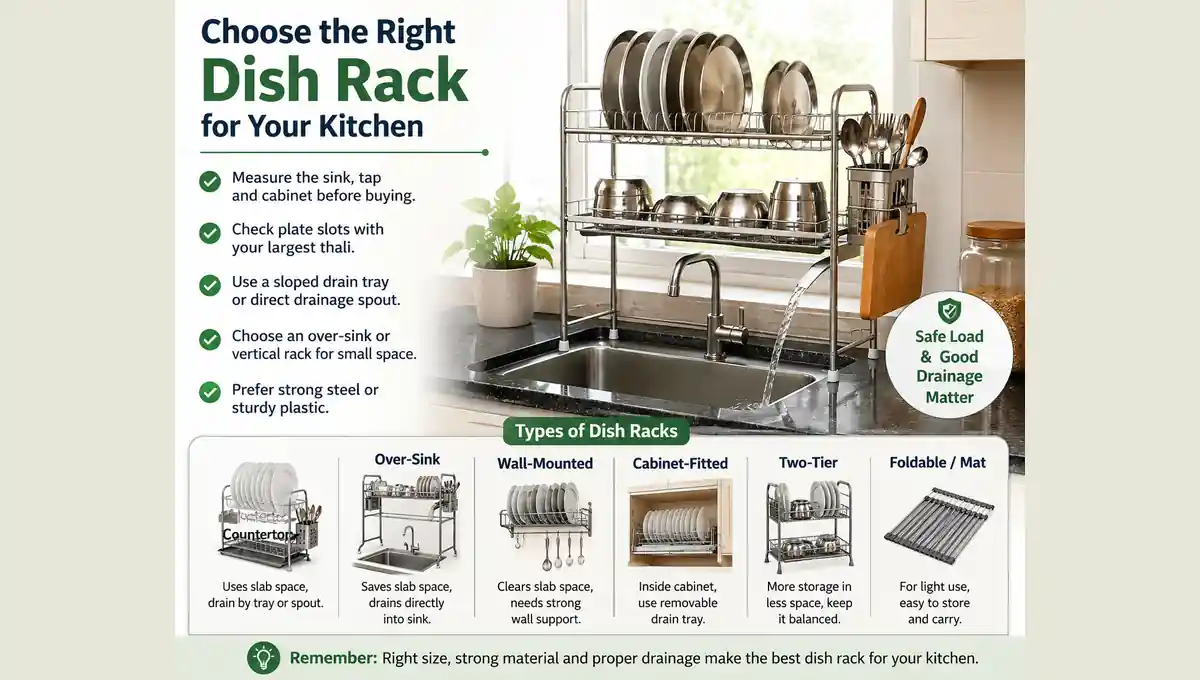
Choosing a dish rack for kitchen use is mainly a fit and drainage decision. A wide rack can consume preparation space, while a weak one may bend under steel thalis, bowls and cooker lids. Poor drainage also leaves hard-water marks, smells and moisture around the sink.
Indian homes need a rack that matches the kitchen slab, sink, tap, cabinet and daily bartan load. This guide compares countertop, over-sink, wall-mounted and cabinet racks. It also explains measurements, materials, current Indian price examples, cleaning and installation risks. By the end, you can choose confidently and avoid an expensive mismatch.
Quick Answer
A dish rack for kitchen use should fit your available space, largest thali and daily utensil load. The best dish drying rack also sends water into the sink or an accessible tray.
- Choose an over-sink or vertical rack for limited slab space.
- Measure the sink, tap and cabinet before ordering.
- Check plate slots with your largest thali.
- Prefer verified steel or sturdy plastic over vague material claims.
- Use a sloped drain tray or direct drainage spout.
- Avoid wall fitting without a safe load rating.
How to Choose a Dish Rack for Kitchen Use
Choose the rack type by deciding where it will stand, how water will drain and what it must hold. A fashionable design is useless if it blocks the tap or leaves no space for food preparation.
| Rack type | Suitable situation | Drainage method | Main limitation |
|---|---|---|---|
| Countertop | Open slab beside the sink | Tray or spout | Occupies preparation space |
| Over-sink | Small kitchen with clear tap space | Directly into sink | Can obstruct the tap |
| Wall-mounted | Strong wall near the sink | Tray or sink below | Needs secure installation |
| Cabinet-fitted | Planned modular kitchen | Removable tray | Needs airflow |
| Two-tier | High plate and bowl load | Lower drain tray | May become top-heavy |
| Foldable or mat | Light use and rental homes | Sink or absorbent mat | Offers less plate support |
Countertop and Over-Sink Racks
A countertop dish rack works well when the slab beside the sink remains free during cooking. Choose non-slip feet and a tray that slides out without lifting the loaded rack.
A dish rack over sink saves slab space and drains directly into the bowl. Measure the sink rim, tap height and wall-cabinet clearance before choosing one.
Some products described as a large sink-set dish rack with a drainer tray may still have narrow plate slots. Product words such as “large” and “heavy-duty” do not replace actual dimensions or a stated load capacity.
Check your kitchen sink guide details before selecting an over-sink model. Bowl width, rim height and tap position decide whether its feet will rest safely.
Wall, Cabinet and Foldable Racks
A wall mounted dish rack clears the slab and keeps plates near the washing area. It is unsuitable where brackets cannot grip the wall securely or water would drip outside the sink.
A cabinet dish rack hides wet utensils behind a shutter. It works best above the sink with airflow and an accessible tray beneath it.
A foldable dish rack suits renters and light daily loads. It can be stored after use, while a dish drying mat provides an even cheaper option for cups and bowls.
Which Dish Rack Is Best for a Small Kitchen?
The best dish rack for small kitchen use preserves preparation space without blocking the tap, window or overhead cabinet. Narrow countertop, over-sink and foldable models usually suit compact Indian flats.
A two tier dish rack uses height instead of slab width. Its wide base must remain stable when the top level holds plates or glasses.
Do not buy more tiers than you need. A tall rack can make a small kitchen feel crowded and may prevent an overhead shutter from opening.
Keep enough slab space for a chopping board, ingredients and a hot vessel. These countertop décor ideas show why leaving part of the slab open improves daily use.
A couple may need only a compact plastic drainer. A family washing thalis, katoris and steel vessels needs deeper plate slots, a wider base and separate space for bowls.
A roll-up sink rack is another option for very tight spaces. It stores easily and drains into the sink, but it cannot hold many plates upright.
Measure Before You Buy
Measure the proposed rack position, sink opening, tap and largest utensil before buying. A dish rack for kitchen use cannot be judged from “small,” “medium” or “large” labels alone.
| What to measure | How to check it | Decision it affects |
|---|---|---|
| Slab footprint | Mark length and depth with tape | Remaining preparation space |
| Sink opening | Measure clear inner width | Over-sink rack support |
| Tap clearance | Check height and forward reach | Tap movement |
| Largest thali | Measure diameter and thickness | Plate-slot fit |
| Cabinet opening | Measure clear inner width and depth | Fitted-rack size |
| Vertical space | Measure to shutter, shelf or window | Maximum rack height |
How to Measure a Sink for a Dish Rack
Measure where the rack feet will rest, not only the sink bowl. Some over-sink racks stand on the outer rim, while others extend onto the kitchen slab.
Check whether the tap can turn fully after installation. A tall mixer tap may hit the plate level even when the rack fits the sink width.
If you are planning a sink for kitchen use with a dish rack, decide both positions together. The sink installation guide explains the rim and slab conditions that affect placement.
Check Plates, Bowls and Heavy Bartan
A plate rack for kitchen use must accept your largest thali. Measure its diameter, thickness and the depth needed to stop it tipping forward.
Manufacturer plate counts need context. KAFF’s published specification, for example, states capacity for up to six thalis and ten plates on one cabinet rack.
Check room for katoris, glasses, spoons and cooker lids too. A detachable cutlery holder should remain inside the tray’s drainage area.
Never load a wall or over-sink rack beyond its stated load capacity. Where the seller provides no rating, keep heavy kadais, cookers and stacked steel vessels on the slab or in dry storage.
Is Stainless Steel Better Than Plastic?
A stainless steel dish rack usually supports heavier utensils, while plastic costs less and is easier to move. Construction quality and drainage matter more than the material name alone.
While comparing Indian manufacturer specifications, material descriptions varied between stainless steel, chrome-plated wire and coated metal. These constructions do not offer the same corrosion resistance.
Chrome-plated steel has a protective surface over another metal. Scratches or worn plating can expose the base material to water.
Powder-coated carbon steel resists moisture while its rust-resistant coating remains intact. Chipped coating around welds or joints can allow corrosion to start underneath.
Does a stainless steel dish rack rust? Stainless steel resists corrosion, but standing water, low-grade material, contamination and unfinished welds can still cause marks or rust.
Ask the seller to state the steel grade where durability affects your decision. “Premium steel” does not confirm the grade, thickness or treatment of welded joints.
Plastic avoids metal corrosion but can bend, stain or crack. It suits lighter utensils if the plate dividers, base and drain tray feel stable.
The expensive option is not automatically better. A strong plastic rack with good drainage may outlast a poorly finished metal rack in light household use.
Stop Water Pooling on the Kitchen Slab
Use direct sink drainage or a removable tray that you can empty without moving the rack. Standing water encourages hard-water deposits, odour and grime around the rack base.
Should a dish rack have a drain tray? It needs one when water cannot fall directly into the sink. A dish rack with drain tray should have raised edges and enough clearance for easy removal.
A dish rack drainer with tray for kitchen use works better when the base slopes towards a drainage spout. The spout must extend beyond the sink rim and face the correct direction.
Test the water path before adding utensils:
- Place the empty rack in its intended position.
- Pour a small amount of water into the tray.
- Check for water trapped in corners.
- Confirm that the spout empties inside the sink.
- Correct the position only through its intended feet or adjustment system.
Hard-water stains appear when mineral-rich droplets dry on the surface. Wash removable parts with mild dish soap, rinse them and dry joints after cleaning.
Avoid abrasive scrubbers on plated or coated racks because they can damage the finish. Follow the manufacturer’s care instructions before using vinegar or another acidic cleaner.
Empty a manual tray daily when it holds water. Clean it sooner if slime, discolouration or odour appears.
Fitting a Dish Rack in a Modular Kitchen
A dish rack for modular kitchen cabinets must match the clear internal opening, not only the nominal cabinet width. It also needs drainage, ventilation and access for cleaning.
Manufacturer pages label cabinet sizes differently. Outer cabinet width, inner opening and actual rack width are not interchangeable, so confirm the installation drawing before ordering.
Ozone’s published specifications show 600, 800 and 900 mm options for one range. That range also states a minimum cabinet depth of 300 mm.
A kitchen dish rack for cabinet fitting may attach to side walls or brackets above the sink. Board thickness, hinges and shutters reduce the usable internal width.
Available dish rack styles for modular kitchen cabinets include open wire frames, two-level racks and models with drain trays. A stainless rack for a modular kitchen saves slab space but still needs a clear moisture escape path.
Can Wet Dishes Dry Inside a Cabinet?
Wet dishes can dry inside a cabinet only when air circulates and water drains away. Closing damp utensils inside an unventilated cupboard traps moisture near shutters, laminate edges and plywood joints.
Repeated wetting can swell poorly sealed board edges or loosen laminate over time. Keep a removable tray under the rack and leave enough space between utensils for air movement.
Separate the wet zone from food and dry cookware. These cabinet storage ideas help assign storage by use, while an organise kitchen cabinets routine prevents the drying rack from becoming crowded permanent storage.
Is a Wall-Mounted Dish Rack Safe?
A wall-mounted rack is safe when the wall, brackets and fasteners support its intended load. Tiled walls require careful drilling because concealed pipes or electrical wiring may run behind them.
Use an experienced installer if the service layout is unknown. Confirm whether the quote includes brackets, drilling, fitting and corrections for an uneven wall.
Rental agreements, apartment rules and housing-society conditions vary. Check the relevant permission before making permanent holes.
Review these kitchen safety tips when choosing the fitting height. A rack should not create a head-level obstruction or place heavy utensils above fragile sink fittings.
What Does a Dish Rack Cost in India?
A dish rack for kitchen use can cost a few hundred rupees for a basic drainer or several thousand for a larger fitted system. Compare products within the same type because a drying mat and cabinet rack serve different needs.
As of August 2026, IKEA India listings showed selected drying products and racks from ₹149 to ₹3,000. Sunlight product listings included examples at ₹699 and ₹2,295, while KAFF listed its cabinet rack at ₹2,990.
These are dated product examples, not a national average. Prices vary by seller, city, material, size, delivery and installation scope.
Before paying, confirm whether the price includes:
- Drain tray and cutlery holder
- Mounting brackets and fasteners
- Delivery
- Wall or cabinet drilling
- Installation labour
- Replacement parts or warranty coverage
A drying mat is usually the least complex alternative for light loads. A roll-up sink rack saves more space but offers limited upright plate storage.
Mistakes That Lead to Rust, Leaks or Wasted Space
The most expensive mistakes happen before installation: poor measurements, weak drainage and unsuitable load capacity. Check the complete rack system rather than choosing by appearance or discount.
Avoid buying a rack that:
- Blocks the tap, window or cabinet shutter
- Uses narrow slots that reject thick thalis
- Drains outside the sink
- Hides a tray that cannot be removed
- Provides no load rating for heavy utensils
- Uses rough welds or damaged coating
- Traps wet dishes inside a closed cupboard
- Requires drilling where permission is uncertain
Inspect the rack as soon as it arrives. Check for wobbling feet, sharp edges, cracked plastic, damaged coating and loose joints before loading it.
Return or replace a poorly built rack rather than trying to strengthen it with makeshift supports. A weak wall or over-sink model can drop heavy utensils without warning.
Choose the Rack That Fits Your Routine
The right dish rack for kitchen use should match your sink, slab space and daily bartan load. Measure the footprint, tap clearance and largest thali before comparing prices. Choose direct sink drainage where possible, or use an accessible sloped tray. For a wall or cabinet rack, confirm ventilation, load rating, fitting hardware and installation scope. These checks prevent rust, standing water and an expensive product that never fits properly.