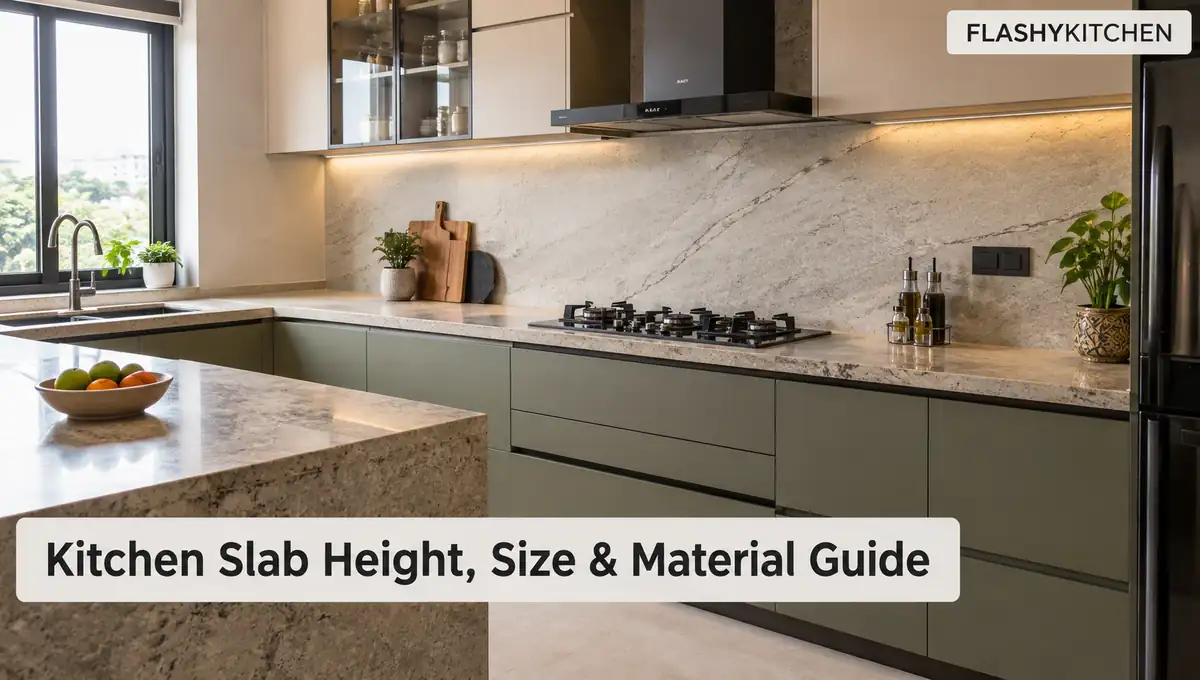
Choosing a kitchen slab is one of the biggest single decisions in an Indian kitchen renovation, and quartz kitchen countertops are usually the first premium option homeowners weigh up after granite. This guide covers what quartz actually is, what it costs across Indian cities, how it compares with granite and full body tiles, and where it genuinely falls short in daily use.
It also covers what commonly goes wrong after installation, since most guides skip this entirely. By the end, you should be able to decide whether a quartz kitchen platform fits your budget, your cooking habits, and the way your kitchen actually gets used.
Quick Answer
Quartz kitchen countertops are engineered slabs made from crushed quartz bound with resin, priced roughly ₹250 to ₹1,250 per square foot in India depending on brand and finish. They resist stains and scratches better than granite day to day, though they cost more upfront and are not fully heat-proof.
- Made from about 90–93% natural quartz with resin and pigment
- Priced mostly ₹250–₹1,250 per square foot, varying by city
- Resists oil, turmeric and daily spills better than untreated granite
- Needs a trivet near the gas stove; not fully heat-proof
- Costs more than full body vitrified tiles, which get close
What Is a Quartz Kitchen Countertop?
A quartz kitchen countertop is an engineered stone slab, not a solid block of natural quartz. Manufacturers grind natural quartz stone into small particles, then bind them with polymer resin and colour pigment under heat and pressure. The result is a hard, dense surface that behaves more consistently than natural stone, because the pattern and colour are controlled during manufacturing rather than left to nature.
While comparing manufacturer specifications available in India, I found that most brands settle in a narrow band for how much actual quartz goes into the slab — typically 90 to 93 percent, with resin and pigment making up the rest. That consistency across brands is unusual; most material specifications vary far more than this. It means the core performance of quartz, its hardness and low porosity, stays fairly similar across manufacturers, even when price and finish differ sharply.
This resin binding is also what makes quartz non-porous. Liquids cannot soak into the surface the way they can with untreated granite or marble, which is why quartz rarely needs sealing. That single manufacturing difference explains most of the practical advantages people associate with quartz.
Quartz is often confused with quartzite, which is a natural stone quarried in slabs, not an engineered product. If a seller uses the two names interchangeably, ask directly which one you are being shown, since they behave differently.
Quartz Countertop Colours and Design Options
Quartz kitchen countertop colours run from plain solid tones to detailed marble-look veining, and the finish you choose affects both maintenance and how the kitchen reads visually.
A white quartz kitchen countertop is the most searched colour choice, largely because it brightens small kitchens and pairs easily with most cabinet finishes. Darker shades hide daily marks better but show dust and water spots more visibly under kitchen lighting.
Common quartz countertop colour and finish groups include:
- Solid whites and off-whites — brighten compact kitchens, pair with almost any cabinet colour
- Greys and charcoals — hide daily marks well, suit contemporary kitchens
- Marble-look veined quartz — mimics the appearance of Carrara or Calacatta marble without the sealing upkeep
- Beige and warm neutrals — work well with wood-toned cabinets and warmer lighting
- Black and deep tones — dramatic in larger kitchens, show water spots and dust more readily
- Concrete-look quartz — suits industrial or minimalist kitchen styles
If you are also updating cabinet finishes, check current cabinet colour trends before finalising the slab colour, since the two should be chosen together rather than in sequence. The same applies to the wall behind the sink and stove — many homeowners choose the countertop first and only then realise it clashes with an existing or planned backsplash, so it helps to plan both at once if you are also installing a backsplash.
Finish also matters beyond colour. Polished quartz reflects more light and suits smaller kitchens; a honed or matte finish hides fingerprints and smudges better in a busy household with children.
Quartz Countertop Price in India
Quartz kitchen countertop prices in India generally fall between ₹250 and ₹1,250 per square foot, with the wide range driven mainly by brand, thickness, and how detailed the pattern is.
A note on where these figures come from: pricing data for quartz in India is not consistently published across sources, so treat any single number with some caution. One Indian quartz brand’s own published guide lists three price bands per square foot; a separate design platform quotes cost per full slab rather than per square foot, which is a different way of pricing the same material. Because these two figures measure different things and come from limited sources, they should be read as reference points, not a settled national average.
| Quality tier | Price range (₹ per sq ft) | What you typically get |
|---|---|---|
| Entry-level | ₹245 to ₹345 | Solid colours, thinner 15mm to 18mm slabs, fewer design choices |
| Mid-range | ₹325 to ₹550 | Popular patterns, marble-look designs, usually 20mm thickness |
| Premium | ₹525 to ₹1,250+ | Designer patterns, book-matched veining, branded finishes |
Separately, at least one source prices quartz by the full slab rather than per square foot: unbranded slabs from roughly ₹25,000 to ₹30,000, branded slabs from ₹45,000 to ₹60,000, and premium branded slabs from ₹85,000 upward. A full slab typically covers more area than a single kitchen platform, so this figure is not directly comparable to the per-square-foot tiers above without knowing your kitchen’s exact area — which is exactly why getting a measured quote matters more than any published range.
Two things consistently add to the base price and rarely appear in the headline figure: fabrication of the sink cutout and edge profile finishing, and delivery plus installation, which is usually priced separately from the slab itself. Ask specifically what a quoted price includes before comparing two quotes side by side.
Prices vary by city, seller, and whether labour is included, and figures here are as published in 2026 — confirm current rates with two or three local fabricators before setting your budget. If your overall renovation budget is tight, it’s worth reading how small kitchen renovation costs break down before committing a large share of it to the countertop alone.
Quartz vs Granite Countertop: Which Should You Choose?
Quartz is generally the better choice if you want consistent colour, no sealing, and easier daily cleaning; granite is usually better if you cook with very hot vessels often or want a lower upfront cost with a more natural, one-of-a-kind pattern.
| Feature | Quartz | Granite |
|---|---|---|
| Composition | Engineered, ~90–93% quartz + resin | 100% natural stone |
| Sealing needed | No | Yes, periodically |
| Heat tolerance | Moderate; use trivets | Higher; tolerates hot pans better |
| Pattern | Consistent, repeatable | Unique, varies slab to slab |
| Typical price in India | ₹250 to ₹1,250 per sq ft | Roughly ₹150 to ₹450 per sq ft |
Both ranges vary by city, seller and installation scope, so treat them as a starting point for comparison rather than a firm quote.
Is quartz good for a kitchen countertop? For most Indian households, yes, mainly because it removes the sealing routine that granite requires and resists stains from daily cooking without extra care. The trade-off is that quartz costs more on average and cannot sit under a very hot vessel taken straight off the flame.
There is no single “best” quartz for every kitchen. A heavy-frying household with a gas stove close to the counter edge benefits more from granite’s heat tolerance in that specific zone, even if quartz covers the rest of the platform. A household that values low maintenance over a natural look, and rarely places pans directly from the flame onto the counter, gets more day-to-day value from quartz.
Quartz vs Full Body Vitrified Tiles for Kitchen Countertops
Full body vitrified tiles are a genuine budget alternative to quartz, and almost no guide compares them directly, despite homeowners actively searching for this comparison.
Full body vitrified tiles are large-format ceramic slabs where the colour and pattern run through the entire thickness of the tile, not just the surface layer. This makes them chip-resistant in a similar way to quartz, since a scratch or chip does not expose a different-coloured layer underneath. They are non-porous in the same practical sense as quartz and resist staining from oil and spices reasonably well.
Where they fall short of quartz: full body tiles are typically installed in joined sections rather than as one continuous slab, so a kitchen platform longer than a single tile will show visible joints. Quartz slabs, by contrast, are cut and fabricated in one piece for most standard kitchen lengths, giving a single, joint-free look. Full body tiles are also more prone to hairline cracking at the edge if a heavy pot is dropped directly on a corner, since the tile is thinner than a quartz slab.
On price, full body vitrified tiles usually cost noticeably less than even entry-level quartz, based on tile retailer pricing for large-format slabs in this category. For a rented flat, a starter home, or a kitchen where the counter takes light daily use, full body tiles reasonably get close to quartz’s practical benefits for meaningfully less money. If the platform is long, gets heavy daily impact, or you want a single continuous surface with no visible joints, quartz remains the stronger choice despite the higher price.
How Quartz Handles Indian Kitchen Use
Quartz handles typical Indian cooking conditions well because its non-porous surface resists staining from oil, turmeric, and spice splatter, though it is not fully immune to heat damage near the gas stove.
Turmeric and oil are two of the most common staining agents in an Indian kitchen, and both sit on top of a quartz surface rather than soaking in, since the resin binder seals the pores that would otherwise absorb them. A damp cloth with mild soap generally lifts these spills if wiped within a reasonable time, without the deeper scrubbing that a porous stone might need.
Heat is the more genuine limitation. A pan lifted straight off a gas stove and placed directly on quartz can cause localised discolouration or, in some cases, a hairline crack from the sudden temperature change, because the resin in the slab reacts differently to heat than the stone particles around it. This risk sits specifically in the zone right beside the stove, not across the whole platform, so a heat pad or trivet in that one area solves most of the practical concern.
Scratch resistance holds up well against daily knife use and utensils, though cutting directly on the surface still dulls knives faster than using a chopping board, and can leave fine surface marks over years of heavy use.
In a modular kitchen setup, quartz integrates the same way granite does — it sits on the base cabinet carcass and is cut to fit sink and hob openings during fabrication, so switching from granite to quartz does not require changes to your cabinet layout.
What Goes Wrong: Quartz Countertop Trade-Offs and Regrets
A few practical problems come up often enough with quartz installations that they deserve a direct warning before you commit.
- Visible seams on longer platforms — a kitchen platform beyond a certain length needs two slab pieces joined together, and the join can be visible under close inspection even with a skilled fabricator
- Sink cutout cracking during fabrication — cutting the sink opening is one of the more delicate steps, and a rushed or inexperienced fabricator can crack the slab at this stage, which is difficult to fix invisibly afterward
- Showroom sample versus installed slab mismatch — a small sample piece in a showroom does not always represent the full slab’s pattern accurately, especially with marble-look veining, so ask to see the actual slab before it is cut
- Heat discolouration near the stove — as covered above, this is the most common regret reported around the hob area specifically
- Underestimating installation cost — many quotes lead with the per-square-foot slab price and list cutout fabrication, edge finishing, and delivery separately, which can add a meaningful amount to the final bill
None of these are reasons to avoid quartz outright, but each one is preventable if you ask the right question before installation rather than after.
How to Choose the Right Quartz Kitchen Slab
Choosing between quartz thickness and finish options comes down to your budget tier and how heavily your kitchen platform gets used, not which option is generically “better.”
For a tight budget with light daily use, an entry-level solid-colour quartz at 15mm thickness covers the basics. You won’t pay extra for pattern complexity you likely won’t notice day to day. For a mid-range household doing regular home cooking, 20mm thickness in a mid-tier finish balances durability with price. This is the most common choice among Indian buyers, based on how brands structure their tiered pricing. For a heavy-use kitchen with frequent frying and a larger family, a premium 20mm slab with a scratch-resistant finish earns back its higher price over the life of the kitchen.
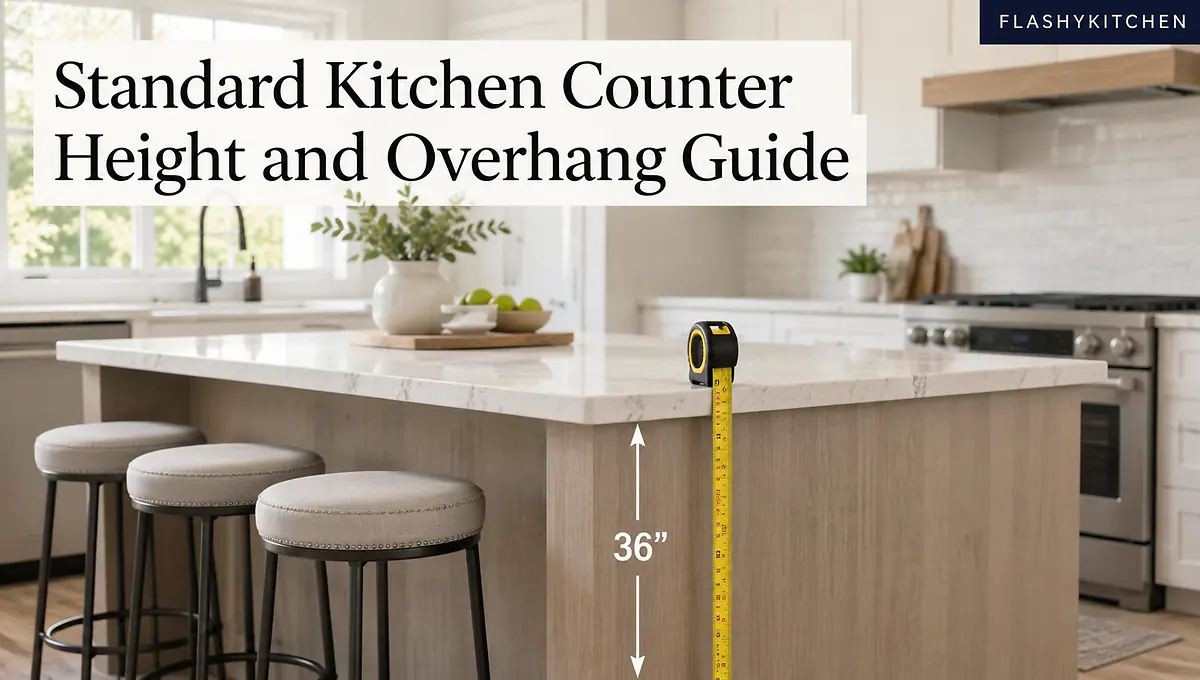
Before finalising, check the exact height your kitchen platform needs to sit at — standard kitchen counter height affects how much slab thickness adds to your total working height, which matters more in a compact kitchen. If cabinets are also part of this renovation, review a kitchen cabinets buying guide alongside the slab decision, since cabinet carcass quality affects how well it supports a heavier quartz slab over time.
If you’re unsure which tier fits your situation, err toward the mid-range tier rather than the cheapest option — the price difference between entry and mid-range is usually smaller than the difference in how the slab performs over five or more years of daily use.
How Quartz Countertops Are Installed
Quartz installation in India typically follows the same sequence as granite: a fabricator measures the base cabinets after they are fixed in place, prepares a template, cuts the slab off-site, then returns to fit it along with sink and hob cutouts.
Manufacturer pages quote fabrication timelines differently from what individual installers report on the ground, which is why it’s worth asking your specific fabricator for a realistic date rather than relying on a general timeline. This step also needs coordination with whoever is supplying your kitchen sink, since the sink model needs to be finalised before the cutout is cut — changing sink size after the slab is fabricated is not a simple fix.
Frequently Asked Questions
Is the quoted price for quartz countertops in India negotiable?
Often yes, particularly on branded slabs where showroom pricing includes some margin for negotiation. Fabrication and installation charges are less flexible than the slab price itself, since they reflect actual labour and cutting time regardless of brand.
Can quartz be installed directly over an existing granite countertop?
This is not standard practice. Quartz is usually installed after removing the old countertop entirely, since layering slabs adds weight the cabinet carcass may not be built to support, and it changes your counter height unpredictably.
Do all modular kitchen brands offer quartz as a slab option?
Most modular kitchen providers in India offer quartz as one of several countertop materials, alongside granite and laminate, though the specific brands and finishes available vary by provider and city.
Conclusion
Quartz kitchen countertops suit most Indian households that want low daily maintenance and are willing to pay more than granite or full body tiles for that convenience. If your kitchen sees heavy frying right at the stove edge, or your budget is tight, weigh granite’s heat tolerance and tiles’ lower cost first. Get a measured quote from two or three local fabricators, confirm what it includes, and pick the thickness that matches your actual daily use.