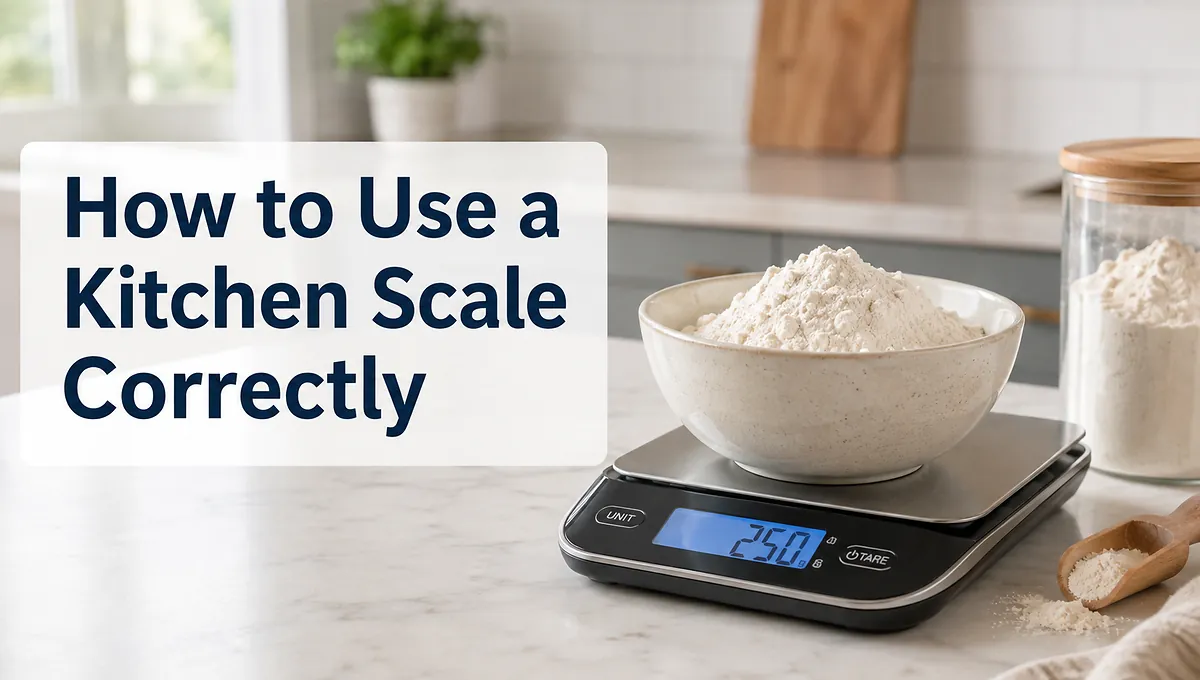
Learning how to use a kitchen scale is simple once you understand what the display, unit button, tare button, and weighing platform are doing. A digital kitchen scale can weigh flour, portion food, measure coffee, handle liquids by weight, and combine several ingredients in one bowl without manual subtraction or extra measuring cups.
Common mistakes come from choosing the wrong unit, skipping tare, confusing ounces with fluid ounces, or trusting an unstable reading. This guide also explains reverse tare, accuracy limits, calibration, capacity, and the fixes that matter before you spend money on another scale.
Quick Answer
To learn how to use a kitchen scale, place it on a firm, level countertop, turn it on, select the recipe’s unit, set an empty bowl on the platform, and press tare until the display returns to zero. Then add the ingredient until you reach the required weight.
- Match grams or ounces to the recipe.
- Tare away the container weight.
- Add food slowly near the target.
- Tare again before the next ingredient.
- Recheck the surface, unit, and battery if readings look wrong.
How to Use a Kitchen Scale Step by Step
Most digital food scales follow the same workflow: start from zero, select the unit, tare the container, and add food until the display reaches the target. You should not need to subtract the bowl’s weight yourself.
- Put the scale on a hard, level surface. A towel, warped counter, or object touching the weighing platform can make the reading less stable.
- Turn the scale on and wait for the digital display to settle at zero.
- Press the unit button until it matches the recipe, usually grams or ounces.
- Place the empty bowl, plate, or container on the scale.
- Press the tare button. The display should return to zero while the container stays in place.
- Add the ingredient slowly. Slow down near the target so an overshoot is easier to avoid.
- Press tare again before the next ingredient if you are building a recipe in one bowl.
- Stop before reaching the scale’s maximum capacity. The container and everything already in it count toward the total load.
This method also covers how to use a food scale, how to use a digital scale, and how to measure food with a scale. You can weigh food directly on the platform only if the manufacturer’s care instructions allow direct food contact.
Do not place a very hot pan on an electronic scale unless its instructions specifically permit it. Basic kitchen safety tips still matter with hot or heavy containers.
Tare, Zero, and Calibration Do Three Different Jobs
Tare removes the weight of a bowl or existing load, zero establishes the empty starting point, and calibration checks whether the scale matches a known reference. Treating all three as the same function can create confusing readings.
A digital scale senses the load on its weighing platform and converts that signal into the number on the display. In most kitchen models, a load cell is the sensor that changes slightly under force.
What does tare mean on a kitchen scale? If an empty bowl weighs 12 ounces, place it on the scale and press tare. The display returns to zero, so the next number is the net weight of the ingredient rather than the bowl plus ingredient.
The zero function has a different job. With nothing intentionally being weighed, the display should begin at zero. Some models use one button for both zero and tare.
Calibration is a separate accuracy check. If you need to calibrate a kitchen scale, follow that model’s manual and use the reference weight it specifies. Do not copy a generic button sequence from another scale because procedures differ.
Across the scale instructions reviewed for this article, tare was part of normal everyday use, while calibration was model-specific troubleshooting. That distinction prevents unnecessary recalibration when the real problem is a missed tare.
Ounces or Grams? Read the Display Without Guessing
Use the unit stated in the recipe whenever possible. Grams are convenient for baking and small food quantities, while ounces or pounds-and-ounces work well when a US recipe already gives weights in those units.
| Display | What it represents | Best use | Common mistake |
|---|---|---|---|
| g | Weight in grams | Recipes written in grams | Confusing grams with milliliters |
| oz | Weight in ounces | Ingredients listed by weight | Treating oz as fluid ounces |
| lb:oz | Pounds and ounces | Larger quantities | Missing the pounds part |
| fl oz / mL mode | Estimated volume on supported models | Specific liquid modes | Assuming every liquid has the same density |
If you are asking how to read a food scale, first identify the unit beside the number. A reading of 4 oz means four ounces by weight, not automatically four fluid ounces.
Fluid ounces measure volume. Ordinary ounces on a scale represent weight. Oil, honey, milk, and water can fill the same volume yet weigh different amounts because their densities differ.
A water, milk, milliliter, or fluid-ounce mode therefore needs care. The scale senses weight first, then a volume mode converts that reading using assumptions programmed into the device.
To measure grams of food, select g, tare the container, and add food until the number reaches the target. If a display uses lb:oz, remember that 16 ounces make one pound.
Weigh Flour and Several Ingredients Without Doing Math
To weigh flour on a kitchen scale, put the mixing bowl on the platform, press tare, and add flour until the recipe’s gram or ounce target appears. For several ingredients, tare again after each one so the display starts from zero without removing the bowl.
Measuring by weight avoids some variation that comes with measuring by volume. Flour can pack into a cup differently depending on how it is filled.
Across three published baking references reviewed for this article, one cup of flour ranged from 120 to 128 grams, with a midpoint of 124 grams. Figures reviewed as of August 2026. The lesson is not that 124 grams is universally correct; the recipe author’s stated weight should take priority over a generic conversion chart.
If a recipe says 125 grams of flour, weigh 125 grams. Do not replace its target with a cup conversion from another source.
Keeping flour, sugar, and grains together can make weighing faster. An organized kitchen pantry reduces the time spent hunting for dry ingredients.
Can you weigh multiple ingredients in the same bowl? Yes. Tare after each ingredient, then add the next one to its own target.
The limitation is overshooting. If two ingredients are already mixed and you add too much of the third, removing only the excess may be impossible. Slow down near the target, or weigh a fast-pouring ingredient separately first.
A basic scale with 1-gram resolution is enough for most flour, sugar, butter, and ordinary food quantities. A high-precision digital kitchen scale is worth extra cost only when a recipe needs tiny amounts your normal scale cannot register.
A scale can still earn space among small kitchen appliances because one device can replace several volume-measuring steps.
Use the Scale for Food, Liquids, Coffee, and Sticky Ingredients
Once you know how to use a kitchen scale for a recipe, the same tare-and-weigh method works for vegetables, meat, dough portions, pasta, grains, coffee beans, leftovers, and many liquids. Use the unit and target given by the recipe instead of inventing a conversion.
To weigh food, set a plate or bowl on the scale, press tare, and add the food. If the recipe gives grams, use grams; if it gives ounces, use ounces.
Can a kitchen scale measure liquids? It can measure their weight directly. If a recipe gives liquid weight in grams or ounces, use that figure rather than assuming one milliliter equals one gram for every liquid.
Coffee is another simple use. A scale near a kitchen coffee bar can help repeat the same coffee-to-water ratio from one brew to the next.
Use Reverse Tare When Scooping From a Jar
Reverse tare is useful when the ingredient starts in a jar, tub, or bag. Put the original container on the scale, press tare, then remove food; the negative number shows how much weight left the container.
If the display reaches -30 g, about 30 grams have been removed. This works well for peanut butter, yogurt, flour, or another ingredient that is awkward to transfer cleanly.
Why does a kitchen scale show a negative number? Often, the scale was tared with weight on it and some of that weight was removed. Return the item, tare again, or use the negative reading intentionally.
Not every model handles negative tare the same way. If its behavior conflicts with the manual, reset the scale instead of forcing the method.
Why Does My Scale Jump a Gram or Two?
A jumping or inconsistent reading usually comes from an unstable surface, something touching the platform, a weak battery, the scale’s resolution, or a fault. Check those causes before assuming calibration is necessary.
| Problem | Likely cause | Practical fix |
|---|---|---|
| Reading jumps | Unstable surface, contact, weak battery | Move to a firm surface and check the battery |
| Negative number | Weight was removed after tare | Return the load, reset, or use reverse tare |
| Will not stay at zero | Platform touches something or scale is unstable | Clear the area and restart |
| Tiny amount does not register | Quantity is below scale resolution | Use a precision scale if required |
| Overload/error | Bowl plus ingredients exceed capacity | Remove weight immediately |
| Scale shuts off | Auto shutoff timer | Restart and rebuild the tare state carefully |
How do you know if a kitchen scale is accurate? Check that it sits level, starts at zero, has a good battery, and gives repeatable readings for the same unchanged object. If those basics fail, troubleshoot before attempting calibration.
Scale resolution is the smallest increment the display can show. A 1-gram scale cannot tell you whether a tiny amount weighs 0.2, 0.5, or 0.8 gram.
Published guidance reviewed for this article placed many full-size kitchen scales in a 10-to-15-pound capacity span, with much of the guidance around 11 to 13 pounds. Figures reviewed as of August 2026. Check your own model because the bowl and all ingredients count toward maximum capacity.
Auto shutoff can interrupt a recipe and erase the previous tare state. If the scale powers down, re-establish the correct weights instead of guessing what the new zero means.
A large bowl may hide the display without changing the measurement. Use a container that lets the screen remain visible while sitting fully on the platform.
Keep flour, liquid, and sticky residue away from buttons and seams. During a deep kitchen clean, wipe the scale as its care instructions direct rather than immersing the electronic body.
Once dry, store kitchen appliances where heavy cookware cannot crush the platform. If your scale already covers the units, capacity, and resolution you need, replacing it adds cost without solving a real problem.
Final Recommendation
The easiest way to learn how to use a kitchen scale is to make one routine automatic: choose the recipe’s unit, tare the container, add the ingredient, and tare again before the next one. Use grams or ounces instead of guessing conversions, slow down near target weights, and check the surface before blaming the scale. Practice once with an empty bowl and a dry ingredient; after that, multi-ingredient weighing becomes much easier.