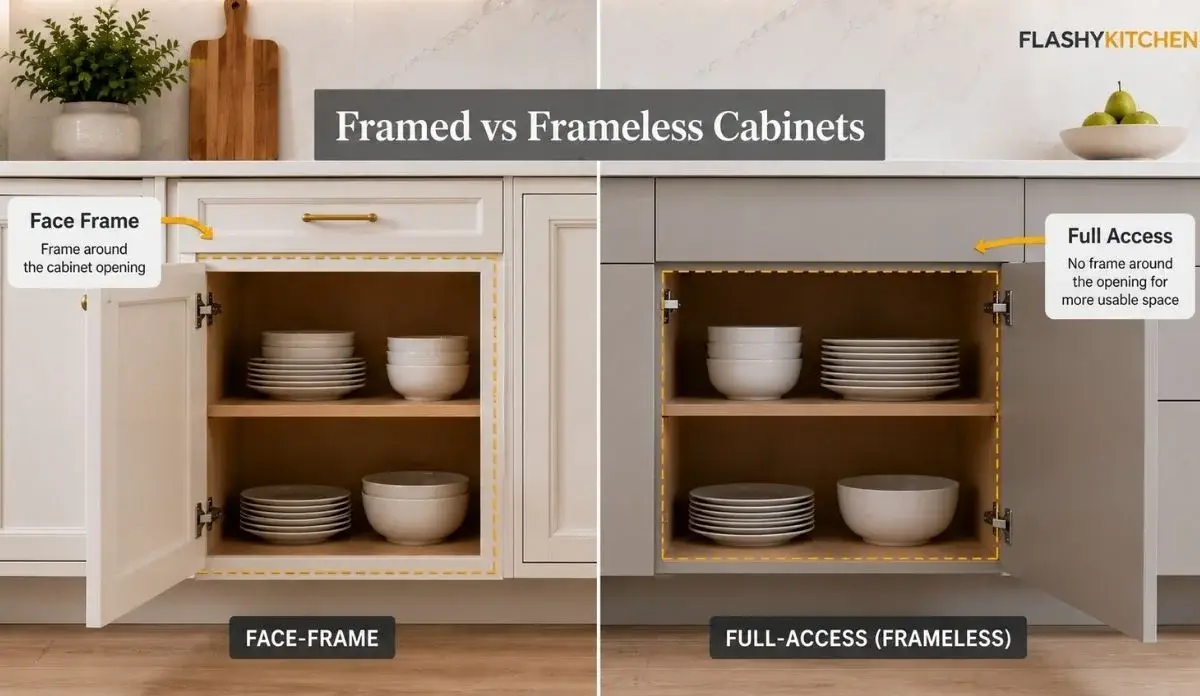
Deciding between framed vs frameless kitchen cabinets changes how your kitchen looks, stores items, and feels during daily use. Cabinet construction dictates the final style, structural integrity, and installation process of your remodel.
Whether you have a tight galley layout or a massive open floor plan, the underlying box structure matters. Face frames offer traditional strength and easy alignment, while full-access designs provide a sleek, modern finish with slightly wider interior storage.
Quick Answer: Framed vs Frameless Kitchen Cabinets
When comparing framed vs frameless kitchen cabinets, the main difference is the box construction.
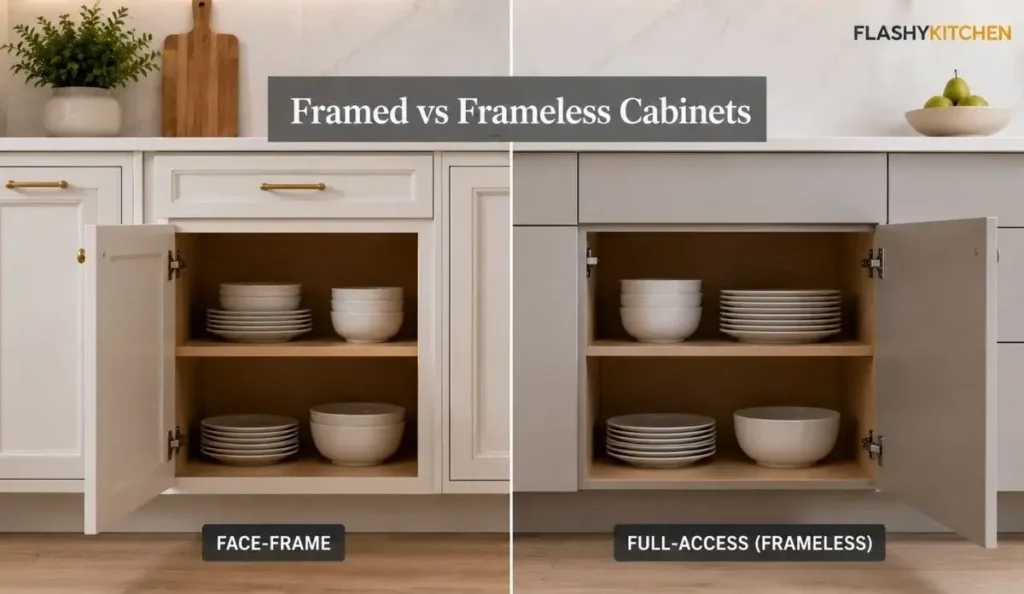
Framed cabinets have a solid wood face frame on the front, providing a traditional look and a sturdy base for the doors.
Frameless cabinets, often called European-style cabinets, lack this front frame. This allows for wider interior access and a sleek, modern look.
Choose framed for a classic American style and easier installation. Choose frameless if you want maximum storage space and clean, minimal lines.
Framed and Frameless Cabinets at a Glance
| Cabinet Type | Best For | Typical Look | Storage Access | Main Advantage | Main Drawback | Best Kitchen Style |
|---|---|---|---|---|---|---|
| Framed | Traditional homes and DIY installs | Visible wood frame around doors | Slightly reduced by the face frame | Very sturdy and forgiving to install | Center stiles can block large items | Classic, Farmhouse, Transitional |
| Frameless | Modern homes and tight spaces | Flush, tight gaps between doors | Full, open interior access | Maximizes drawer and shelf space | Requires highly precise installation | Modern, Minimalist, European |
What Are Framed Kitchen Cabinets?
A framed cabinet features a face frame attached to the front of the cabinet box. This looks much like a flat, rigid picture frame. The doors and hinges attach directly to this solid wood face frame rather than the inside walls.
When reading any complete kitchen cabinet guide, you will usually see this called traditional American-style construction. The hardwood frame adds significant rigidity to the box, making it very strong and resistant to racking (twisting out of square).
According to custom cabinetry experts like Dura Supreme, this 1.5-inch face frame gives the cabinet a classic visual anchor and helps keep the box perfectly square during shipping and wall installation.
What Are Frameless Kitchen Cabinets?
Frameless cabinets have no face frame at all. The cabinet box is simply a finished, open shell. The hinges, doors, and drawer glides attach directly to the inside walls of the box.
These are also known as full-access or European-style cabinets. Because there is no front frame blocking the perimeter of the opening, you get slightly wider drawer boxes and completely unobstructed access to the interior shelves.
When looking at different types of kitchen cabinets, frameless designs are the absolute standard for clean-lined, modern layouts.
Pros and Cons of Framed Kitchen Cabinets
Framed construction is the standard in the United States for good reason, but it does have some storage limitations.
| Pros | Cons |
|---|---|
| Highly durable and structurally stable. | The face frame creates a slightly smaller opening. |
| Easier to install on uneven walls. | Center stiles on double doors can block wide items. |
| Works with partial, full overlay, and inset doors. | Drawers are slightly narrower. |
| Excellent for traditional and farmhouse designs. | Can look a bit too classic for ultra-modern homes. |
Pros and Cons of Frameless Kitchen Cabinets
Frameless construction offers an incredibly clean aesthetic, but it demands higher quality materials to stay strong.
| Pros | Cons |
|---|---|
| Provides completely open interior access. | Cabinet box quality matters much more for stability. |
| Allows for wider drawer boxes. | Requires perfectly level and plumb installation. |
| Offers a smooth, clean, modern look. | Hinges may need more careful adjustment over time. |
| Great for maximizing space in small kitchens. | Poor-quality boxes can feel flimsy and weak. |
Framed vs Frameless Cabinet Comparison Table
| Feature | Framed Cabinets | Frameless Cabinets |
|---|---|---|
| Construction | Box with solid wood front frame | Box only (no front frame) |
| Storage Access | Good, but frame blocks the edges | Excellent, full open access |
| Style | Traditional, classic, rustic | Modern, sleek, contemporary |
| Installation | More forgiving on unlevel walls | Requires extreme precision |
| Durability | Very strong box structure | Relies heavily on side panel thickness |
| Door Options | Partial, full overlay, inset | Full overlay mostly |
Which Gives More Storage Space?
Frameless cabinets give you more accessible storage space. Without a center stile or a front frame blocking the opening, sliding large dinner plates, crockpots, or wide appliances inside is much easier.
Framed cabinets lose a little bit of drawer width because the drawer box must fit inside the face frame opening rather than the wider box interior.
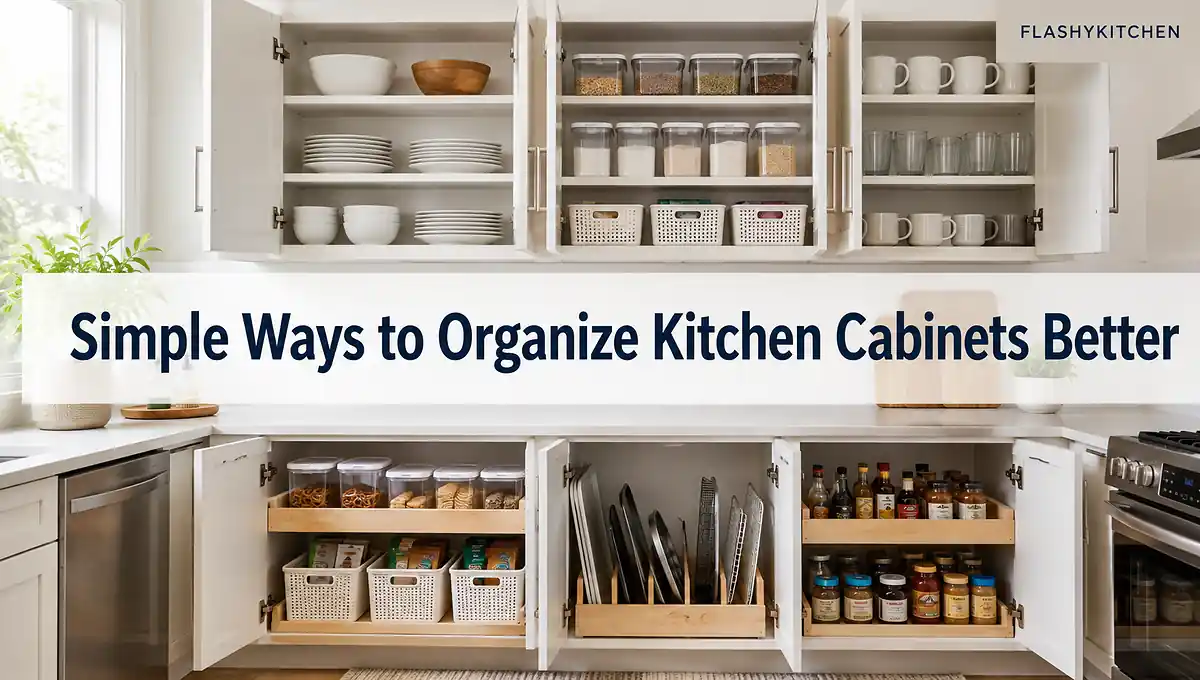
However, no matter which box style you pick, adding smart cabinet storage upgrades like pull-out trash cans, deep drawer dividers, and roll-out trays will ultimately dictate how usable your space is.
Which Looks Better: Framed or Frameless?
Framed styles look best in traditional, transitional, and classic kitchens. The visible wood frame adds nice architectural detail, giving the space a crafted, furniture-like feel.
Frameless styles look best in modern, minimalist, and contemporary kitchens. Because the doors sit very close together with tiny reveal lines, they create a smooth visual surface. This makes them the perfect match for flat slab cabinet doors.
Door Options: Overlay, Inset and Full Overlay
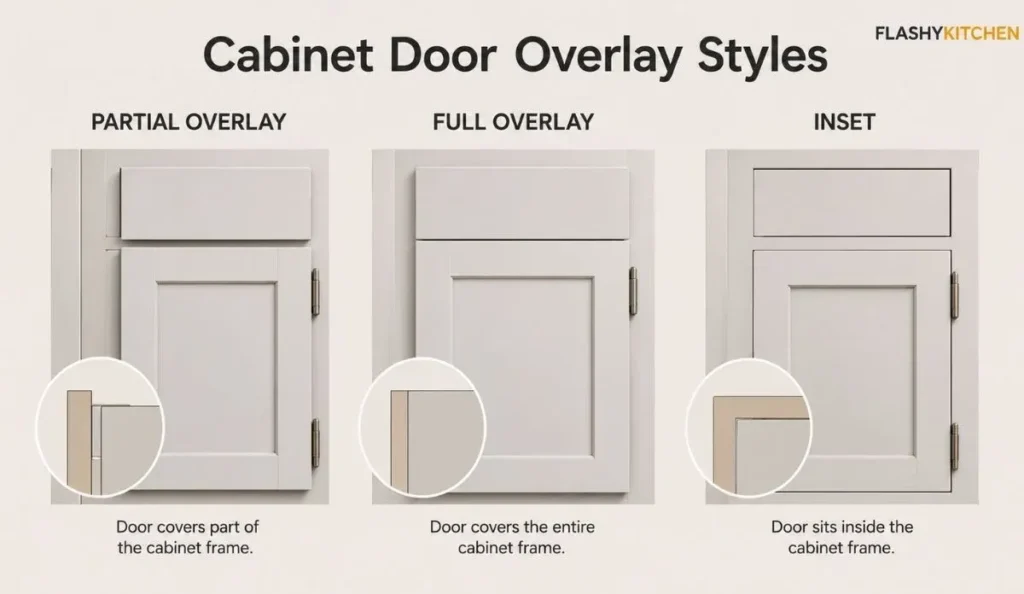
Cabinet construction heavily affects which doors you can use. Framed cabinets are highly flexible. You can use partial overlay, full overlay, or custom inset styles.
Frameless cabinets almost always use full-overlay doors to completely hide the raw front edges of the cabinet walls.
Understanding your inset and overlay cabinet doors is critical before buying. Inset doors only work with framed cabinets, as the door sits perfectly inside the face frame opening, completely flush with the front.
Materials and Build Quality Matter More Than the Label
A well-built framed cabinet will generally outperform a cheap frameless cabinet. Box stability comes down to your material choices.
Always check your cabinet box materials before ordering. Plywood boxes hold up best to moisture and heavy stone countertops.
Frameless styles rely entirely on their side panels for strength. According to manufacturing standards at ProCraft Cabinetry, frameless units require much tighter engineering. If you buy a cheap particle board frameless cabinet, the heavy doors might pull the concealed hinges out of the soft wood over time.
Are Frameless Cabinets Good for Small Kitchens?
Yes, frameless cabinets are excellent for small kitchens. The lack of a face frame means you gain extra fractions of an inch inside every drawer and cabinet box.
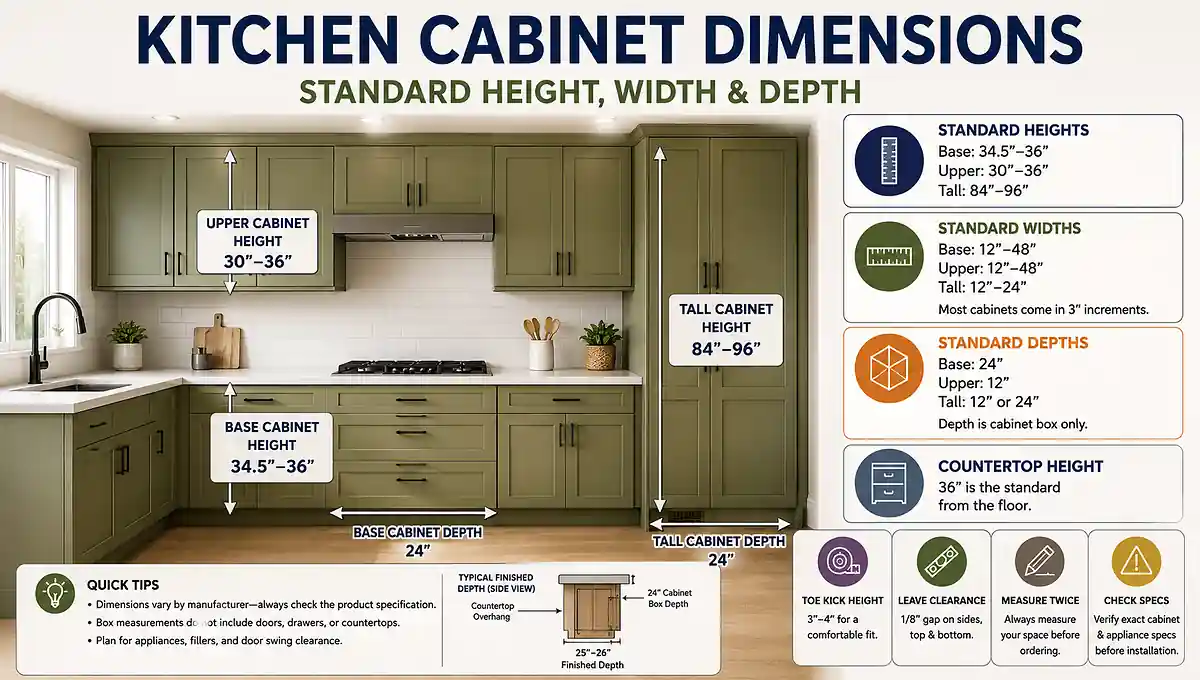
A wider, unobstructed opening also makes it much easier to reach items stored in back corners. When planning your base, wall, and tall cabinet layout, using frameless units can make a tight, narrow galley kitchen function much more comfortably.
Where Can You Buy Framed or Frameless Cabinets?
Most local hardware stores and cabinet dealers stock traditional framed kitchen cabinets because they are the standard in American homes.
If you want a modern look, you can easily find frameless kitchen cabinets online. Many specialized brands sell frameless RTA kitchen cabinets (ready-to-assemble) that ship flat to save you money on freight. When searching for frameless kitchen cabinets near me, check for local European design showrooms or modern kitchen suppliers rather than standard big-box home centers.
Common Mistakes to Avoid
- Choosing only by style: Do not ignore the box construction just because you like a specific door color.
- Ignoring cabinet box material: Buying cheap particle board for a frameless setup is a huge risk.
- Assuming framed is outdated: Framed cabinets look highly modern when paired with full-overlay doors.
- Not checking hinge quality: Frameless cabinets require heavy-duty hinges to hold the doors straight over time.
- Poor installation: Installing frameless cabinets on a wavy wall without proper shimming will make the doors impossible to align.
- Forgetting side panels: Frameless ends often need finished cover panels to look complete.
Final Verdict
When deciding on framed vs frameless kitchen cabinets, the best choice comes down to your personal style, storage needs, and installation plan. Choose framed cabinets if you want a classic look, desire flush inset doors, and need a very sturdy box that is forgiving to install. Choose frameless cabinets if you prefer a sleek modern design, want maximum drawer width, and have a precise installer to handle the tight tolerances.