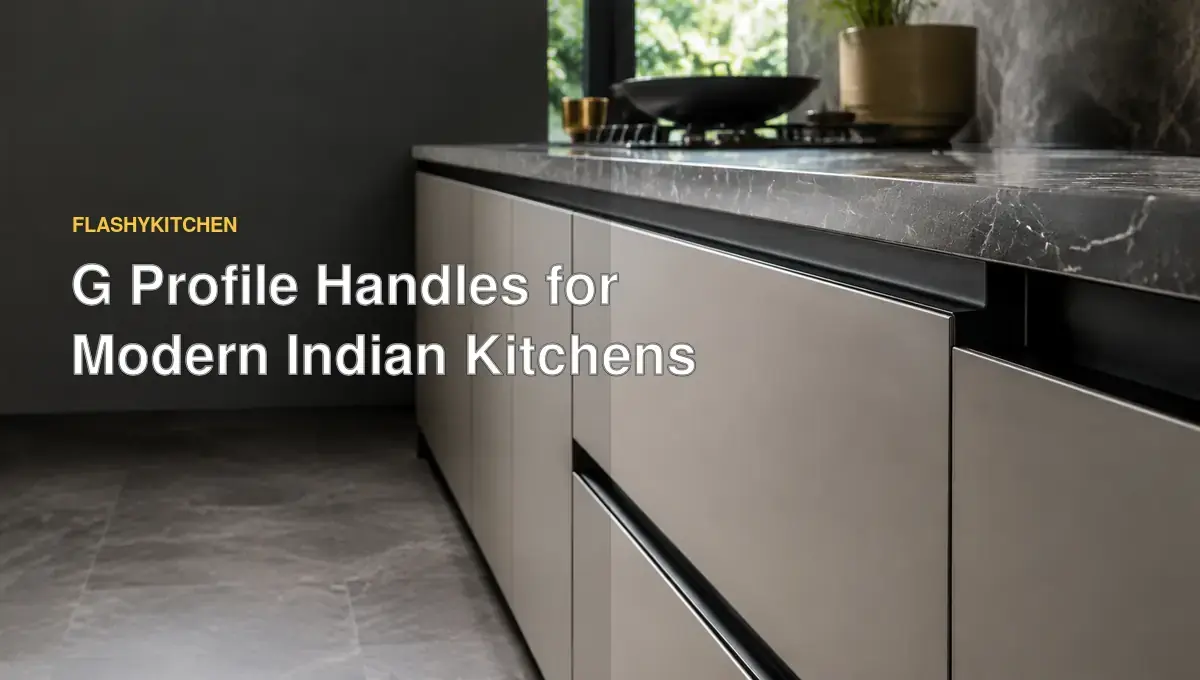
A G profile handle kitchen uses recessed aluminium grips instead of projecting knobs or bar pulls. The style looks clean, but appearance should not be your only reason for choosing it. Grip depth, shutter thickness, drawer weight and installation quality decide how well the handle works every day.
Indian sellers also quote these profiles by the foot, metre, piece or full 3 m length, making prices difficult to compare. By the end of this guide, you will know which type, size, colour and fitting method suits your modular kitchen and when another handle would work better.
Quick Answer
A G profile handle kitchen system uses an aluminium section fixed along a cabinet shutter or drawer front to form a recessed finger grip. Choose it only after checking the cross-section and testing the grip on a loaded drawer.
- Check shutter thickness and opening clearance.
- Compare prices using the same length and scope.
- Include cutting, matching end caps and fitting.
- Inspect black and metallic finishes for scratches.
- Choose J, Gola or normal pulls if the grip feels narrow before approving the complete kitchen.
What Is a G Profile Handle in a Kitchen?
A G profile handle is an aluminium section shaped to create a recessed finger grip. It normally runs across a drawer’s top edge or along the edge of a cabinet shutter.
Unlike a knob or bar pull, the profile does not project far beyond the cabinet front. This can reduce snagging in compact kitchen passages.
The handle is often marketed as a handleless kitchen profile. That term describes the appearance, not the mechanism. The aluminium channel still functions as a handle.
G Profile Handle Versus Gola Rail
A shutter-mounted G profile and a Gola rail are different systems, although sellers sometimes mix the names. A G handle usually attaches to a shutter edge, while a Gola rail sits on the cabinet carcass behind plain fronts.
Ask the seller for a cross-section drawing and fitting photograph. These reveal which system is being quoted and whether your cabinet construction supports it.
What Size G Profile Handle Does Your Cabinet Need?
There is no universal profile size for every kitchen cabinet. The correct option depends on shutter thickness, grip opening, cross-section, fixing method and space between adjacent fronts.
Many Indian suppliers sell profiles in a nominal length of 3 m, commonly described as 10 ft. The installer cuts this raw section to match individual shutters and drawers. Indian supplier listings from Imperia Innovations and Royal Aluminiums show this common stock length.
Stock Length Is Not the Fitted Handle Size
A 3 m profile does not have to run across one cabinet. It may be divided into several handles according to the drawer widths.
Ask the installer to prepare a cutting list first. Poor planning can create unnecessary joints, material waste or a shortage that requires another complete profile.
Full-width handles produce a continuous line across slab kitchen cabinets. Shorter pieces may cost less, but inconsistent lengths can make adjacent drawers look uneven.
Check the Cross-Section Before Ordering
Length alone cannot tell you whether a profile will fit. Use the manufacturer’s cross-section drawing and check the actual sample against the cabinet.
| Check | Why it matters | What to confirm |
|---|---|---|
| Shutter thickness | The profile must sit securely | Compatible thickness range |
| Profile depth | It affects gaps and projection | Exact cross-section |
| Grip opening | It controls finger comfort | Test a physical sample |
| Stock length | It affects cuts and waste | 3 m, 10 ft or another length |
| End-cap design | Caps are not universal | Matching left and right caps |
Profiles may need different fitting methods on laminate, acrylic, MDF and plywood shutters. Confirm compatibility after choosing your kitchen cabinet materials.
Treat catalogue dimensions as nominal until the installer measures the actual product. Even a small mismatch can cause rubbing, uneven gaps or a drawer that does not close correctly.
How Much Does a G Profile Handle Cost in India?
Prices vary because sellers quote different lengths, materials and units. Published August 2026 listings include examples from about ₹400 per piece to more than ₹2,000 for branded systems, but these figures do not represent identical products. Indian manufacturer listings and branded hardware listings show the wide difference in product scope.
Some suppliers quote per foot or kilogram. Others quote for one full profile, a short cut handle or a complete rail system. A low wholesale price may also require a large minimum order.
To compare a G profile handle kitchen price correctly, ask each seller to include:
- Profile length and cross-section
- Material, colour and finish
- GST status
- End caps and connectors
- Cutting and edge finishing
- Delivery and installation charges
Convert every offer to the same length and installation scope. The lowest displayed rate may not deliver the lowest fitted cost after wastage, accessories and labour.
For branded products, compare the exact profile drawing, cap availability and warranty terms. A brand name does not prove that the handle will fit your shutters.
Prices vary by city, seller, material, finish and order quantity. Get the full product code and included work in writing before paying.
G Profile vs J Profile vs Gola: Which Is Better?
A G profile suits homeowners who want a long aluminium grip attached to the shutter. J profile suits a shaped shutter edge, while Gola suits new cabinets designed around a separate rail.
| Option | Grip and appearance | Cabinet work | Best suited to |
|---|---|---|---|
| G profile | Recessed aluminium grip | Fixed to the shutter edge | New modular cabinets and long drawer lines |
| J profile | Curved finger recess | Built into or fixed along the edge | Lighter shutters and subtle grips |
| Gola rail | Gap behind plain fronts | Carcass and shutter gaps planned together | New handleless kitchens |
| Normal pull | Full-hand grip with visible hardware | Usually needs simple drilling | Heavy drawers and easy replacement |
No option wins for every household. A G profile can give cleaner lines, but a narrow opening may feel uncomfortable on a heavy cookware drawer.
Choose by Grip, Not Appearance Alone
Profile handles can look attractive in photographs yet feel awkward after installation. Grip depth, edge shape and drawer resistance matter more than the profile name.
Ask the installer to fit one sample to a loaded drawer. Open it with wet fingers and from your usual standing position.
A regular bar pull may suit elderly users or people with limited finger strength better. It provides a full-hand grip and is usually simpler to replace.
Best Materials, Colours and Cabinet Combinations
Aluminium is the most common material for these kitchen profile handles because it is light, easy to cut and available in several finishes. Anodising treats the aluminium surface, while powder coating creates a coloured outer layer.
Neither finish is damage-proof. Rough cutting, abrasive cleaning and impacts from metal utensils can mark the visible surface.
Black, Silver or Rose Gold?
A black G profile creates strong lines against white, grey, beige and wood-look cabinets. Matte black may hide some fingerprints, but dust and scratches can remain visible.
Silver aluminium is easier to match with stainless-steel appliances. It is also more likely to remain available if one section needs replacement.
Rose gold, champagne and gold add a warm metallic accent. However, a replacement piece may not match if the original shade or batch becomes unavailable.
Keep one finish across connected cabinet runs. Small colour differences become noticeable where separate profiles meet.
Which Cabinet Fronts Suit G Profiles?
G profiles work best with flat laminate, acrylic and painted slab fronts. Their straight lines also complement simple modular kitchen designs.
Wood-look laminate with a matte-black profile creates clear contrast. White or light-grey shutters with silver profiles produce a softer division between drawers.
Profile handles can help make oak cabinets modern, but older shutters may need cutting or replacement. Do not assume that every existing cabinet can accept the new profile.
Installation, End Caps and Retrofitting
G profile fitting requires accurate measurement, clean cuts and consistent alignment. A small height difference becomes visible when several drawers sit side by side.
Before you install kitchen cabinets, confirm the profile system and required shutter gaps. Retrofitting after production can mean recutting or replacing finished fronts.
Do G Profile Handles Need End Caps?
End caps cover exposed cuts and produce a finished edge. They also prevent fingers from touching a rough or sharp profile end.
Caps are specific to the profile’s cross-section. One manufacturer’s cap may not fit another product carrying the same G profile name.
Confirm left, right and corner accessories before ordering. Buy them with the profile because matching parts may become difficult to source later.
Can You Fit Them to Existing Cabinets?
Retrofitting is possible only when the old shutter construction and available clearances support the selected profile. Some products need a groove cut into the shutter, while others attach along its edge.
Do not cut acrylic, glass-front or finished shutters without testing a sample. The work can chip the surface, expose the substrate or leave insufficient closing space.
If every shutter requires major modification, retaining conventional handles may be cheaper. Professional cutting and fitting are safer because one inaccurate cut can ruin a finished front.
What Goes Wrong With G Profile Handles?
Most failures start when homeowners approve a profile by colour without testing its grip or fitting. The expensive problems are poor clearance, rough cut edges and inconsistent alignment.
Common mistakes include:
- Narrow grips that strain fingers on heavy drawers
- Sharp ends left without matching caps
- Uneven profiles across adjoining shutters
- Coating damage around poorly finished cuts
- Profiles that obstruct nearby drawers or doors
- Oil, crumbs and dust collecting inside the channel
- No spare material for future colour-matched repairs
Indian cooking can leave oily residue inside recessed grips, especially near the hob. Use a soft cloth, mild washing solution and narrow brush to clean kitchen cabinets and profile channels.
Avoid steel wool, abrasive powder and harsh chemicals. These can scratch aluminium or dull anodised and powder-coated finishes.
Before approving production, compare the sample with the actual kitchen cabinet dimensions. Check drawer gaps, profile projection, finger space and opening movement.
Frequently Asked Questions
Are G Profile Handles Suitable for Elderly Users?
G profiles suit elderly users only when the opening provides a comfortable grip. People with arthritis, weak fingers or reduced hand movement may find a normal bar handle easier.
Test the chosen profile on a loaded drawer. An empty showroom shutter cannot show how much pulling force daily use will require.
Should I Order Spare Profile and End Caps?
A spare profile piece and extra matching caps can simplify future repairs. This is especially useful for black, champagne and rose-gold finishes that may vary between production batches.
Store spare material flat and protected. Long aluminium sections can bend or become scratched if left unsupported.
Can G Profile Handles Be Used on Overhead Cabinets?
G profiles can work on overhead cabinets when the grip direction allows easy downward pulling. However, a bottom-edge J profile or finger pull may feel more natural in some layouts.
Test the opening position at the actual cabinet height. A handle that feels comfortable on a base drawer may not work equally well overhead.
Is a G Profile Handle Right for Your Kitchen?
Choose a G profile handle kitchen if you want flat cabinet fronts and the sample feels comfortable on loaded drawers. Avoid it when the grip is narrow, retrofit work is extensive or matching accessories are uncertain. Ask your installer for one fitted sample, its cross-section drawing, finish code, matching end caps and an itemised quote. Approve the remaining profiles only after checking grip, alignment and shutter clearance.