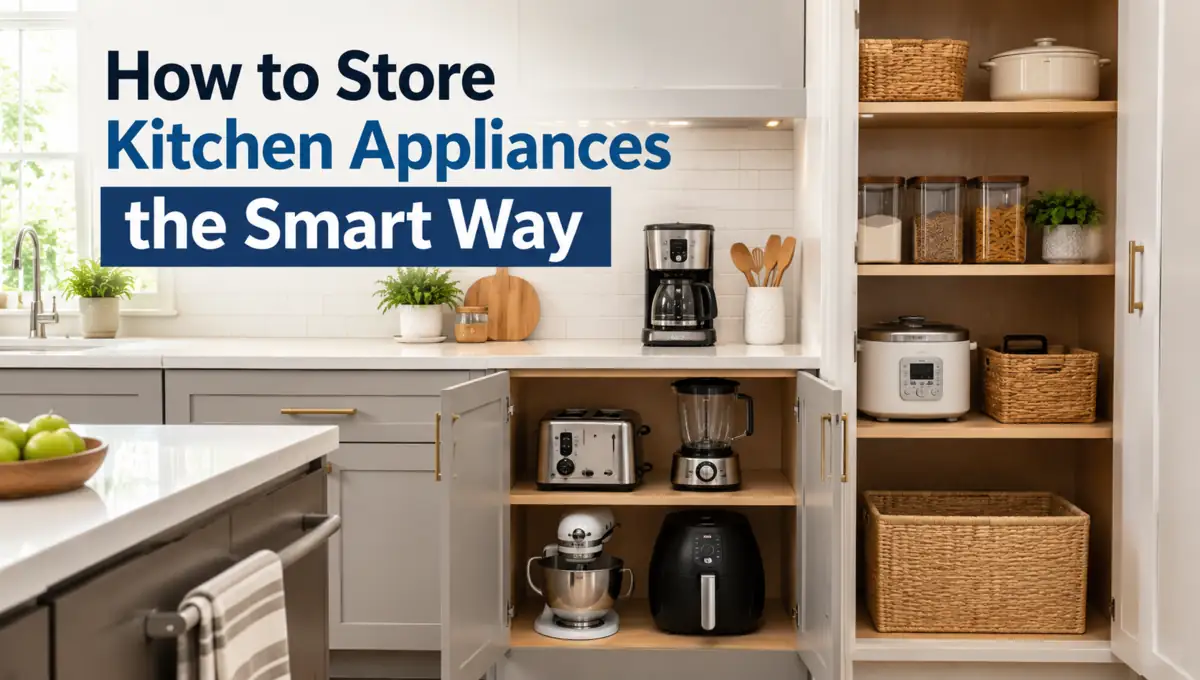
Knowing how to store kitchen appliances is less about hiding everything and more about giving each appliance a practical home. A coffee maker used every morning should not compete for space with a slow cooker used twice a month. Weight matters too, because a heavy stand mixer can be unsafe on a high shelf even if you rarely use it.
The best system looks at four things: how often you use the appliance, how heavy it is, how much space it needs, and where it can safely operate. Use those four checks to organize counters, cabinets, pantry shelves, and small-kitchen storage without buying unnecessary organizers.
Quick Answer
To decide how to store kitchen appliances, keep daily-use items closest to their work area and move occasional appliances out of prime counter and cabinet space. Then let weight, size, and safe operating clearance decide the exact shelf or cabinet.
- Keep daily appliances within easy reach.
- Put weekly-use items in accessible cabinets or pantry shelves.
- Store heavy appliances in lower cabinets or sturdy pull-outs.
- Move light, rarely used appliances to higher or secondary storage.
- Keep cords, attachments, ventilation, and outlet access in mind.
Sort Appliances by How Often You Actually Use Them
Start by sorting appliances by real use, not by what you hoped you would use when you bought them.
Use four groups: daily, weekly, occasional, and unused. Daily appliances may stay on the counter; weekly items belong in an easy cabinet; occasional items can move to secondary storage; broken, duplicate, or unused appliances should leave the main kitchen.
A comparison of current organization advice shows one common mistake: some storage guides push rarely used appliances higher without giving enough weight to how heavy they are. Use frequency to decide how close an appliance should be, but let weight override shelf height when lifting would be awkward or unsafe.
This is also the right point to decide how to store extra kitchen appliances. A light seasonal item may work on a high pantry shelf. A heavy appliance belongs in a lower secondary cabinet even if you use it only a few times a year.
What Should Stay on the Counter?
An appliance should stay on the countertop when you use it often enough that putting it away creates more work than the counter space is worth. A coffee maker, kettle, toaster, or blender may earn that spot in one household and not in another.
Do not chase clutter-free countertops if the result is hauling the same appliance in and out of a cabinet every day. The trade-off is simple: hidden appliances look tidier, but they can become harder to use.
Keep counter items that support your normal routine, then group them by task. A coffee maker and grinder can share one zone, while a toaster can sit near the breakfast-prep area instead of spreading appliances across the room.
If you want to keep appliances off kitchen counters, move weekly and occasional items first. Relocating one bulky air fryer or food processor may free more useful prep space than hiding three small daily-use tools.
How to Store Kitchen Appliances in Cabinets and Pantries
The best way to decide how to store small kitchen appliances is to match each item with the closest cabinet, drawer, or pantry location that suits its frequency and weight. Small appliance storage works best when one item can come out without unloading everything in front of it.
Before buying organizers, improve your existing kitchen cabinet storage first. Moving a shelf or clearing a lower cabinet may solve the problem at no added cost.
| Appliance situation | Best starting location | Why |
|---|---|---|
| Daily and light | Counter or front cabinet | Fast access |
| Weekly and light | Easy cabinet or pantry | Frees counter space |
| Heavy and frequent | Lower cabinet or pull-out | Reduces lifting |
| Heavy and occasional | Lower secondary cabinet | Avoids overhead lifting |
| Light and rarely used | High or secondary shelf | Saves prime storage |
| Many loose parts | Cabinet with accessory bin | Keeps the set together |
Lower Cabinets and Deep Drawers
Lower cabinets and deep kitchen drawers are usually the best choice for heavy or awkward small appliances. They keep the load below shoulder height and can place bulky items closer to where you lift them.
A pull-out appliance shelf makes a deep base cabinet easier to use because the appliance comes toward you.
Avoid storing appliances two or three deep unless the back items are genuinely rare-use. If reaching a blender requires moving a slow cooker and food processor every morning, the storage plan is fighting your routine.
Pantry and Secondary Storage
Pantry appliance storage works well for weekly and occasional items, but shelf position should still follow weight. Keep frequently used items between knee and shoulder height when your layout allows, and reserve higher shelves for lighter appliances.
If the pantry is crowded, organize the kitchen pantry around frequency before adding more bins.
A pantry also answers where to store extra kitchen appliances that you still use. Seasonal waffle makers, specialty blenders, or extra serving appliances can live outside prime cabinets as long as they stay clean, dry, and practical to retrieve.
Where Do You Put Appliances in a Small Kitchen?
To store appliances in a small kitchen, protect your best counter and cabinet space for the items you use most, then move lighter low-use items upward or out of the main work zone. Limited space makes each appliance earn its place.
If you are deciding how to store kitchen appliances in a small kitchen, start with duplication. Two machines that do nearly the same job can consume more room than a new shelf will recover.
When replacing equipment, compact small kitchen appliances or one useful multi-function appliance may reduce the storage problem at the source.
A tall pantry storage cabinet can add vertical storage when floor space exists but built-in cabinets are limited. Keep heavy items low and use upper shelves for lighter, rarely used equipment.
A portable kitchen island can help when a small kitchen lacks both prep space and lower appliance storage. It can suit renters or layouts that need flexible floor space.
The cheapest small-kitchen fix is usually rearranging what you already own. Shelf risers, pull-outs, carts, appliance garages, and custom cabinetry cost progressively more, so buy hardware only after you know the exact problem it must solve. Custom work and electrical changes vary in cost by region, cabinet construction, and labor.
How to Store Heavy and Large Kitchen Appliances
When deciding how to store kitchen appliances that are heavy or bulky, keep them low enough to lift, slide, or pull out without reaching overhead. A sturdy countertop, lower cabinet, load-rated deep drawer, or properly rated pull-out is usually safer than an upper shelf.
This includes stand mixers, large air fryers, pressure cookers, slow cookers, and food processors. It does not cover long-term storage of refrigerators, ranges, or freezers, which is a different moving and storage problem.
Current manufacturer specifications show why appliance-by-appliance checking matters: stand mixers vary greatly in size and weight. Do not assume a shelf that handles a toaster can safely handle a mixer; confirm the appliance weight and the cabinet or hardware load rating before assigning the space.
Match the Appliance to the Storage Spot
| Appliance | Sensible starting spot | Main caution |
|---|---|---|
| Coffee maker | Counter or coffee zone | Frequent access |
| Toaster | Counter or easy cabinet | Crumbs and cord |
| Blender | Counter if daily; cabinet if occasional | Jar height |
| Air fryer | Counter or lower cabinet | Heat and clearance |
| Stand mixer | Counter, lower cabinet, or lift | Weight |
| Food processor | Lower or easy cabinet | Bowl and attachments |
| Slow cooker | Lower cabinet or pantry | Bulky footprint |
| Pressure cooker | Lower cabinet or pantry | Height and lid storage |
These are starting points, not fixed rules. Frequency still decides how easy each appliance should be to reach.
Heavy Appliances Stay Low
Heavy appliances should stay low even when they are rarely used. Frequency can move a lightweight waffle maker to a high shelf, but it should not send a heavy mixer overhead.
This is where convenience and safety beat visual neatness. If bending is difficult, use a waist-height shelf, sturdy pull-out, appliance lift, or permanent counter position instead of forcing the appliance into an uncomfortable location.
The same rule answers how to store large appliances in a small kitchen: give heavy equipment lower secondary space before using hard-to-reach upper cabinets. Safe retrieval matters more than making every cabinet look full and tidy.
Keep Appliances Out of Sight Without Creating New Problems
Hidden appliance storage is useful only when it improves access as well as appearance. An appliance garage, pull-out shelf, deep drawer, or appliance lift cabinet can reduce visual clutter, but each option takes space and may add hardware, electrical, ventilation, or installation requirements.
An appliance garage is a countertop-level cabinet or enclosure that hides appliances while keeping them nearby. It suits equipment you use often, but it is a poor choice if the enclosure steals valuable counter depth, makes removal awkward, or cannot fit a future replacement.
A pull-out shelf is simpler and often cheaper than custom concealed cabinetry. An appliance lift can solve the lifting problem for a heavy mixer, but the cabinet needs enough interior space, the mechanism must support the appliance, and the extended platform needs clear room in front of the counter.
Custom storage is not automatically better. Rearranging a normal lower cabinet may give you most of the benefit without new cabinetry, hardware, or electrical work.
Measure Before You Assign a Cabinet
Measure the appliance and the usable cabinet opening before assigning a permanent storage spot. Exterior cabinet dimensions do not tell you how much clear space remains after hinges, shelves, and hardware.
Check the appliance width, depth, full height, weight, cord reach, and any extra room needed to open a lid or tilt a mixer head. Then verify the shelf or pull-out load rating, which is the maximum weight the hardware is designed to support.
Keep beaters, bowls, blades, lids, and other accessories with the appliance or in one nearby container. Secure cords loosely so they do not tangle, and never trap a cord where a drawer or door can pinch it.
Storage Location Is Not Always the Operating Location
A cabinet can be a good storage location and still be the wrong place to operate an appliance. Heat-producing appliances need the clearance and ventilation required by their manufacturer, so do not assume an air fryer, toaster, coffee maker, or pressure cooker can run inside a closed appliance garage.
While reviewing current appliance-garage guidance, the recurring planning issues were usable dimensions, cord reach, outlets, ventilation, and future appliance size. The right question is not only “Does it fit?” but also “Can I use it here safely?”
Federal fire-safety guidance recommends unplugging small appliances when they are not in use, avoiding overloaded outlets, and replacing appliances with damaged cords. Do not route permanent extension cords through cabinets as a substitute for proper electrical work.
If hidden appliance storage requires a new outlet or changes to fixed wiring, check local requirements before work begins. Use a licensed electrician where your jurisdiction requires one, and keep manufacturer clearances ahead of appearance.
Conclusion
The simplest way to decide how to store kitchen appliances is to judge each one by frequency, weight, size, and safe operating needs. Keep daily tools easy to reach, move occasional equipment out of prime space, and keep heavy machines low.
Start with one crowded counter or cabinet. Give every appliance there a permanent home before spending money on organizers or custom storage, then change only the spots that still make everyday use difficult.
Rule exception: the slug keeps “to” because it is part of the exact target keyword.