
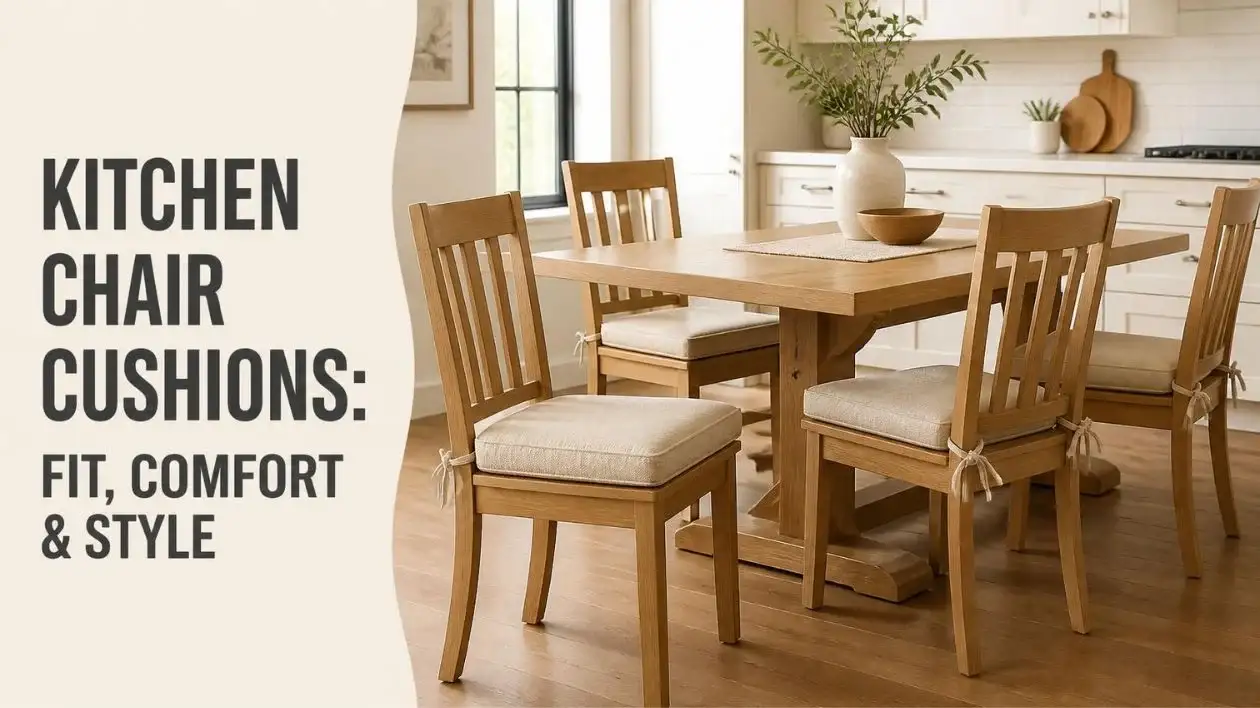
Kitchen chair cushions should soften a hard seat without causing poor fit, sliding, or awkward table clearance. A wide pad may overhang, while a thick one can raise you too high. The right choice must match the chair, stay secure, and handle food spills. By the end, you will know how to measure the seat, compare fill and fabric, choose a useful thickness, and select an attachment. Start with the chair, not the color shown online.
Quick Answer: How Do You Choose the Right Kitchen Chair Cushions?
Choose kitchen chair cushions by matching the seat’s shape and measurements before comparing fabric or fill. The best pad keeps the final sitting height comfortable, supports the way the chair is used, cleans easily enough for the household, and uses an attachment that suits the chair frame.
- Measure front width, rear width, and usable depth.
- Match square, round, tapered, U-shaped, or D-shaped seats.
- Choose thickness by final seat height.
- Pick fill and fabric for daily use and simple cleaning.
- Use ties, grip backing, or another secure attachment.
How Do You Measure a Kitchen Chair for a Cushion?
Measure the front edge, rear edge, and usable seat depth before choosing a cushion. Note the seat shape, back posts, tie locations, and table clearance as well. These checks matter more than labels such as “standard” or “universal,” which do not guarantee a close fit.
Measure the Front Width, Rear Width, and Usable Depth
Measure the widest front edge and the narrower rear edge. Measure depth across the flat area from the front to where the chair back begins. A kitchen furniture guide can help compare chair and table height.
Record all three numbers. A pad that matches only the front may bunch up at the rear.
Check Shape, Tie Points, and Final Sitting Height
Trace an unclear seat outline on paper, including rounded corners and rear posts. Add the planned cushion thickness to the current seat height, then check table clearance. Also mark where ties can wrap safely.
Published Sizes Are References, Not Standards
Reviewed listings range from 12 5/8-inch round pads to 21-by-21-inch cushions. The products use different shapes and measurement methods, so the figures should not be averaged into a “standard” size.
| Published example | Dimensions | Thickness | Fit lesson |
|---|---|---|---|
| Small round pad | 12 5/8 in diameter | Not listed | Round size cannot guide a square seat |
| Tapered chair pad | 16/14 × 15 in | 3 in | Front and rear widths can differ |
| D-shaped cushion | 17 × 16 in | 2 in | Shape matters as much as width |
| Three-size cushion line | 17 × 15 to 19 × 19 in | 2.5 in | One collection may span several chairs |
| Small to medium/large line | 17.25 × 15.25 to 19.5 × 17.5 in | 1.5 in | Measure instead of trusting “universal” |
Use published dimensions as examples, not a substitute for measuring your chair.
Which Cushion Shape and Size Will Fit Your Chair?
The right cushion follows the usable seat outline without curling, bunching, or hanging far over the edge. Match both front and rear widths on tapered chairs, then choose the closest available shape. A close fit looks neater, supports the sitter more evenly, and usually moves less.
Square, Round, Tapered, U-Shaped, and D-Shaped Cushions
Square pads suit seats with similar front and rear widths. Round pads fit circular seats. Tapered cushions narrow toward the back.
U-shaped pads wrap around a rear post or curve. D-shaped pads have a straight back and rounded front. A rectangular pad may match the width yet fit a tapered seat poorly. Avoid deep pads that press behind the knees or slide when someone stands.
Seat-Only Cushions, Back Cushions, and Sets
Seat-only pads preserve sitting depth. Back cushions add support but may push the sitter forward.
For a kitchen table with bench, chairs and bench seating may need different thicknesses. Measure every chair before buying a set of four or six because small frame differences can change fit and tie placement.
Which Fill and Thickness Are Best for Daily Dining?
Choose cushion fill by sitting time, preferred firmness, and available seat height. Memory foam is not automatically better for every chair or sitter. Conventional polyurethane foam, latex foam, and polyester fiber respond differently to weight, recover at different speeds, and create different levels of loft.
Memory Foam, Conventional Foam, Latex, and Fiber Fill
Memory foam molds around the sitter but may feel warm or slow to respond. Conventional polyurethane foam comes in several densities and firmness levels; density and firmness are not the same measure.
Latex feels springy but appears in fewer ready-made styles. Polyester fiber feels plush, yet loose fill can flatten or shift. Thin fiber or foam may suit short meals, while longer sitting needs a core that keeps its support.
How Thick Should a Kitchen Chair Cushion Be?
Reviewed listings include cushions from 1.5 to 3.7 inches thick, with several common examples between 2 and 3 inches. This is not a comfort ranking because solid foam, shredded latex, and tufted fiber compress differently.
A thick pad can reduce thigh clearance, raise the elbows, or make a tall chair unstable. Fill, firmness, tufting, and body weight change the compressed height, so check the final sitting position before choosing extra loft.
Who Should Avoid Very Soft or Thick Cushions?
Choose a thinner, firmer pad if the chair already sits high, has a shallow seat, or slides beneath a low table apron. A stable surface may also make sitting down and standing up easier.
What Fabric Is Easiest to Clean for Dining Chairs?
The easiest dining-chair fabric to clean has a removable washable cover or a smooth wipeable surface. Cotton feels natural but absorbs spills. Microfiber handles many everyday marks, faux leather wipes clean quickly, and performance fabric adds stain resistance while keeping a woven upholstery look.
Cotton, Microfiber, Faux Leather, and Performance Fabric
Cotton feels soft but can absorb sauce, grease, and drinks. A washable cotton cover works better than a fixed shell.
Microfiber’s tight surface often handles light spills and pet hair. Faux leather cleans quickly but can feel warm. Performance and outdoor fabrics resist stains and moisture.
Near a farmhouse kitchen table, washable checks or textured neutrals can suit the room. Patterns also hide small marks better than pale solids.
Removable Cover, Machine Washable, or Spot Clean Only?
Retailer care information shows that “machine washable” may describe the removable cover, the full cushion, or only certain fabric options.
Check care instructions for both the cover and insert. A zipper does not prove the cover is washable. Spot-clean-only and dry-clean-only pads demand more care after food spills.
Best Fabric for Children, Pets, and Spills
Choose a removable washable cover, tight microfiber, wipeable faux leather, or stain-resistant performance fabric. Avoid pale fixed covers and loose weaves where spills, claws, or pet hair are common.
How Do You Keep Chair Cushions From Sliding?
A chair cushion stays put when its size, shape, and attachment method match the chair. Ties need usable rear posts, while non-slip backing works best on clean, flat seats. Snaps and hook-and-loop fasteners provide stronger control, but they may require permanent or adhesive changes to the chair.
Ties, Grip Backing, Mats, Snaps, and Hook-and-Loop Fasteners
Ties remove easily for cleaning but can loosen or tear. Non-slip backing creates friction without visible straps, though dust, polish, curves, and poor fit reduce grip.
A gripper mat helps a loose pad. Snaps modify the chair, while hook-and-loop adhesive may leave residue. No attachment can correct a badly sized cushion.
Match the Attachment to the Chair
Use ties where they can wrap safely. Choose grip backing for a clean, flat seat. Use snaps or hook-and-loop fastening only when stronger control justifies modifying the chair, and test adhesive on a hidden area.
Which Kitchen Chair Cushions Suit Your Home—and What Do Buyers Regret?
Choose a cushion by the problem it must solve, not by the product photo alone. Homes with children need easier cleaning, long dinners need support, and smooth wooden seats need reliable grip. Low chairs may benefit from added height, while counter-height chairs often need less thickness.
Choose by Household Situation
| Situation | Best starting point | Attachment | Main trade-off |
| Frequent spills | Washable or wipeable cover | Ties or grip backing | Wipeable surfaces may feel less soft |
| Children or pets | Tight weave or performance fabric | Secure ties or grip pad | Light colors show marks |
| Long dinners | Supportive foam core | Match the chair frame | Thick foam may raise the seat |
| Smooth wood | Close-fitting pad | Non-slip backing | Grip weakens on dusty or polished wood |
| Low chair | Medium supportive thickness | Ties where possible | Added height changes clearance |
| Unusual shape | Custom-cut cushion | Custom ties or snaps | Higher cost |
A formal dining area may coordinate cushion fabric with a nearby kitchen hutch, but fit and cleaning should come first.
Common Mistakes and Regrets
The biggest mistake is buying by color before measuring. “Universal” may mean a loose fit rather than a precise one.
Common regrets include sliding pads, broken ties, thin fill, lost seat depth, and excessive height. A fixed, spot-clean-only cover can also frustrate busy households.
Ready-Made, Custom Cushion, or Reupholstery?
Choose ready-made pads for common shapes and easy replacement. Custom cushions suit tapered, oversized, curved, or mismatched chairs. A full-size paper seat template can help a custom maker reproduce the usable outline, corner curves, rear posts, and tie positions accurately before fabric is cut.
Reupholstery suits a chair that needs a permanent fitted seat. A loose cushion will not fix cracked wood, a weak frame, broken webbing, or a damaged upholstered base.
Which Kitchen Chair Cushion Should You Choose?
Choose kitchen chair cushions only after recording the front width, rear width, usable depth, shape, thickness, and attachment points. Put fit and final sitting height before color or advertised softness. Measure one chair twice, write the numbers down, and reject poor fits before comparing fabric or fill. This protects comfort, table clearance, and easy cleaning.