
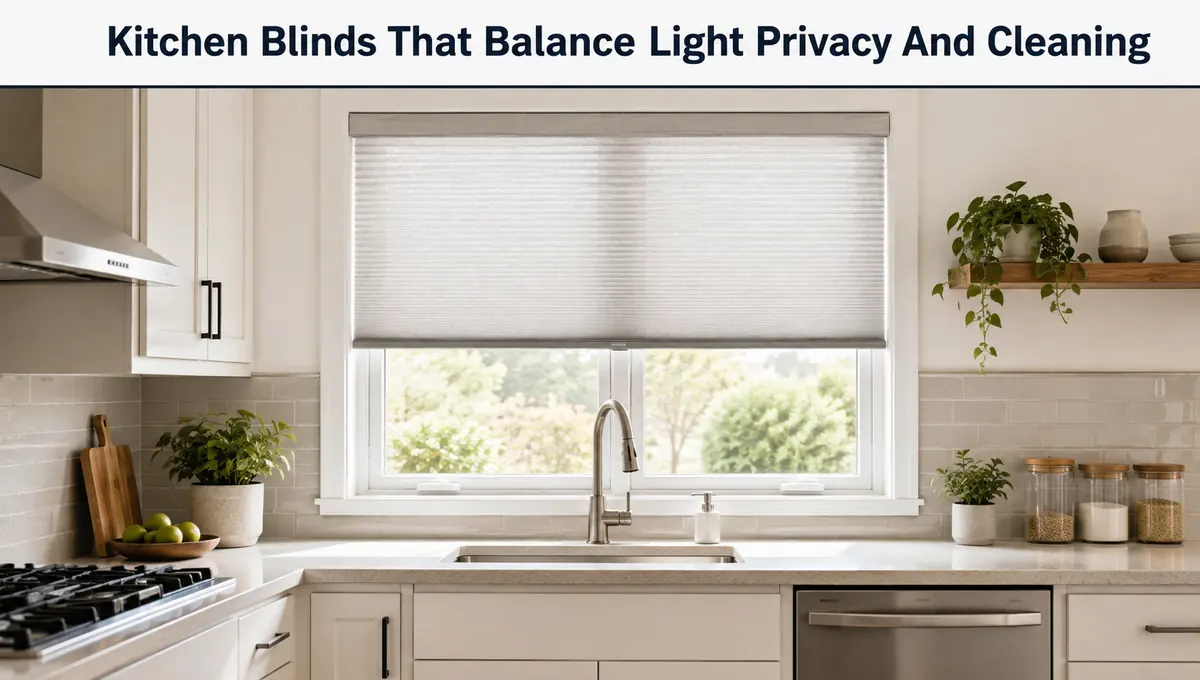
Kitchen blinds need to handle more than privacy. A window above the sink may get splashed, one near the range can collect grease, and a small window can lose daylight behind a bulky treatment. The best choice therefore depends first on where the window sits and what reaches it.
Start with exposure, cleaning, privacy, light, reach, and fit. Style comes after those decisions, then the treatment can tie into the wider kitchen decor. By the end, you should know which roller, faux wood, aluminum, Roman, cellular, or shutter option suits your window and which types create unnecessary maintenance.
Quick Answer
The best kitchen blinds depend on the window’s location. Wet or greasy zones favor smooth, moisture-resistant materials, while fabric Roman or cellular shades make more sense in drier areas where softness or insulation matters and splashes rarely reach the fabric.
- Use wipe-clean materials around a busy sink.
- Keep absorbent fabric away from repeated splashes.
- Choose adjustable light control where privacy matters.
- Minimize headrail and fabric bulk on small windows.
- Favor cordless controls, especially where young children may reach the window.
Which Kitchen Blinds Work Best in Each Zone?
Choose by exposure before color, pattern, or style. Sink windows need moisture tolerance and easy cleaning; windows near cooking areas need surfaces that release grease easily; dry breakfast areas allow softer fabrics.
While comparing current manufacturer and retailer guidance for kitchen window treatments, the clearest pattern was location. Wet zones repeatedly favored synthetic, wipeable materials, while Roman, cellular, and woven treatments appeared more often away from splashes and cooking residue.
For a sink window, start with faux wood, suitable vinyl roller shades, or aluminum blinds. Near a range, keep loose fabric and hard-to-clean texture away from direct heat and heavy grease.
A dry coffee area gives you more freedom, and nearby coffee bar ideas can use softer Roman or cellular shades away from splashes.
Strong afternoon sun changes the priority. Glare control and light filtering may matter more than moisture resistance.
If the window has a good view, no privacy problem, and little glare, leaving it uncovered can be the better choice.
Roller, Faux Wood, Roman, or Cellular: Which Type Fits?
No blind type wins every kitchen. Roller shades simplify wiping, faux wood gives precise light control, aluminum stays slim, Roman shades soften dry areas, and cellular shades focus more on insulation and filtered light.
| Type | Best location | Steam/grease fit | Main trade-off |
|---|---|---|---|
| Roller shade | Sink or general window | Good with suitable material | Material varies by product |
| Faux wood | Sink or humid area | Good | More slat edges to wipe |
| Aluminum blind | Sink or small window | Good | More utilitarian appearance |
| Roman shade | Dry window or nook | Poorer in wet zones | Fabric folds hold residue |
| Cellular shade | Dry or sunny window | Better away from splashes | Harder to deep-clean |
| Faux shutter | Humid or larger window | Good | Can look bulky on small glass |
Kitchen roller blinds are strong candidates where easy cleaning matters because one broad surface has fewer edges than horizontal slats. Do not assume every roller shade is waterproof; check the material and cleaning instructions for the actual product.
Faux wood blinds tolerate kitchen humidity better than natural wood and allow fine privacy control. Real wooden blinds can still suit a dry window, but repeated wetting makes them a weaker choice behind a sink.
Aluminum blinds resist moisture and use little visual space. Their drawback is cleaning each slat when grease and dust settle.
Roman shades work better in dry areas. A Roman shade in a breakfast nook can be practical, while the same fabric behind a frequently splashed faucet creates more maintenance.
Cellular shades help slow heat transfer and filter light, but they are harder to clean deeply. Their strength is comfort, not sink-side durability.
Shutters offer durable light control, but frames and louvers add visual bulk to small windows.
Cost varies by window size, material, stock or custom sizing, operating system, and motorization. Published retail prices were too product-specific to support a fair national average, so compare quotes using the same dimensions and options.
What Blinds Hold Up Over the Sink?
The best blinds for a kitchen window over the sink are easy to wipe, moisture-tolerant, and simple to operate across the countertop. Faux wood, suitable roller materials, and aluminum usually create less maintenance than absorbent fabric with deep folds.
A window over the sink faces more than room humidity. Faucet splashes, condensation, wet hands, and cleaning spray may reach the treatment.
Moisture resistance and grease cleaning are different tests. A material may tolerate humidity but still be annoying if residue collects in seams, texture, or many narrow slats.
The sources reviewed also used terms such as “waterproof” inconsistently. Treat waterproofing as a product-specific claim, not a promise for an entire blind category.
Reach matters too. A deep sink, faucet, countertop items, or wide sill can make controls harder to reach. Cordless lift or motorization may solve an access problem, but motorization adds cost when a manual control is comfortable.
Keep the sill and controls clear. Countertop decor ideas should not block a treatment you open every morning.
How Do You Get Privacy and Still Let Light In?
You can get privacy without making the kitchen dark by using adjustable slats or a light-filtering shade instead of jumping straight to blackout material. First decide whether you need privacy all day, mainly at night, or only from a particular viewing angle.
Slatted blinds let you change sightlines while keeping part of the glass open. Light-filtering roller and cellular shades soften daylight rather than eliminating it.
Solar shades need more care. A fabric that reduces daytime glare and keeps part of the view may give less privacy after dark when interior lights are on. Check the nighttime view before choosing an open solar fabric for a street-facing window.
If the room is already dim, coordinate the treatment with your kitchen lighting ideas rather than blocking daylight and compensating with artificial light all day.
What Works on a Small or Hard-to-Reach Window?
A small kitchen window needs a low-profile treatment with simple controls. Large headrails, thick fabric stacks, or heavy shutter frames can cover a noticeable part of the glass even when the treatment is open.
Check the frame before choosing an inside mount. Casement windows may have handles or cranks that compete for the same recess.
An inside mount sits within the window opening and usually looks compact. An outside mount sits on the trim or wall and can help when the recess is shallow or hardware blocks the blind.
For modern kitchen blinds on a narrow window, keep the profile simple. Green or patterned roller shades can work, but bold pattern adds visual weight.
Cordless operation is worth prioritizing. The U.S. Consumer Product Safety Commission recommends cordless window coverings where young children are present because accessible cords can create a strangulation hazard.
Motorization helps on a genuinely hard-to-reach sink window. Battery-powered systems avoid electrical work; hardwired systems may require an electrician or permit depending on local rules. Manual operation is simpler when the blind is easy to reach.
In a compact room, preserving daylight often matters more than adding decoration. The same principle applies to small kitchen remodel ideas and broader kitchen safety tips.
Blinds, Shades, or Curtains: Which Is Easier in a Kitchen?
Blinds, shades, and curtains can all work, but they suit different kitchen conditions. Slatted blinds give adjustable privacy, smooth roller shades simplify wiping, and curtains add softness but can be harder to manage around moisture, grease, and heat.
Café curtains can suit a dry window where lower-level privacy matters and the upper glass can stay open. Roman and cellular shades also make more sense in dry locations.
If the window sits behind a working sink or close to cooking residue, a wipeable blind or shade is usually easier to live with.
What About Kitchen Doors and Sliding Doors?
Kitchen door blinds need different mechanics from a small sink-window treatment. Wide sliding glass doors usually suit vertical blinds, panel-style treatments, or other systems designed to move across a broad opening.
For a glazed patio door, check handle clearance and how the door travels before choosing the mount. The treatment should not interfere with daily entry.
A narrow-window product is not automatically right for a sliding door just because its material performs well in kitchens.
Measure the Window Before You Order
Measure the actual opening and follow the chosen manufacturer’s instructions instead of making your own sizing deduction. Inside- and outside-mounted products use different ordering rules, and window openings are not always perfectly square.
Measure width and height at several points. Record recess depth, trim, handles, casement cranks, tile, and anything else that could interfere with the headrail or controls.
While checking current retailer specifications, I found examples where the ordered width and finished blind width differed because the manufacturer applied its own deduction. That is a reader-protection point, not a universal amount to subtract.
If the opening is shallow or irregular, confirm the minimum mounting depth before ordering. For an outside mount, check how much wall or trim the product needs around the opening.
Measure carefully, then use the exact ordering method for that product.
Choose the Window First, Then the Blind
The right kitchen blinds start with the window, not the catalog. Decide whether the location is wet, greasy, sunny, private, small, or hard to reach, then remove options that do not suit those conditions.
Compare cleaning effort, daylight, privacy, controls, and fit before choosing color or pattern. Measure the actual opening last and follow the manufacturer’s instructions. That order prevents buying a treatment that looks right but becomes awkward to clean, operate, or live with.