A Victorian kitchen is easier to design once you separate historical reality from the ornate rooms often shown online. Real kitchens from the Victorian era were working spaces, with ranges, dressers, worktables, hard-wearing floors, pantries, and sometimes a separate scullery for washing. Today’s homeowner usually needs a different balance: period character with current appliances, storage, lighting, and ventilation.
This guide explains what makes the style believable, how dark or decorative it should be, which original features deserve protection, and when a lighter modern interpretation makes more sense. By the end, you should know which Victorian details fit your house and which ones to leave out.
Quick Answer
A Victorian kitchen should take its character from the house, not from a pile of decorative accessories. Start with architecture, cabinet profiles, freestanding furniture, color, flooring, and lighting, then fit current appliances and storage around that base.
- Keep meaningful original features before adding reproduction details.
- Use dark color only where the room has enough light.
- Treat ornate Gothic design as a sub-style, not a requirement.
- Consider a worktable before forcing in a large island.
- Modern appliances can stay when the surrounding design carries the period character.
What Did a Real Victorian Kitchen Look Like?
A real Victorian kitchen was primarily a workroom, not the formal showpiece that many current period-style photos suggest. During the Victorian era, 1837 to 1901, larger houses often separated cooking, washing, food storage, and service into a kitchen, pantry, and scullery, which was a separate washing and prep room.
Typical historic features included a cooking range, a dresser for dishes and supplies, open shelving, ceiling hooks, sturdy tables, and stone or tiled floors. Wealthy houses could have much larger service areas, while a modest Victorian home kitchen was simpler and more compact.
This distinction matters when comparing kitchen design styles. An authentic period kitchen is not defined by dark green paint, ornate wallpaper, or carved cabinetry alone. Those details can support a Victorian-inspired room, but they do not replace the practical layout and furniture-based character of a historic kitchen.
A Mid-Century 1950s kitchen moved toward very different materials and forms, while Victorian design leaned on furniture, traditional joinery, durable surfaces, and the architecture of the house.
Victorian Gothic is a darker, more dramatic sub-style with stronger architectural detail. Folk Victorian homes usually support a simpler treatment, so copying a mansion-scale scheme into a modest house can feel out of place.
How Much Victorian Character Should You Use?
Choose the level of historical character before choosing cabinets, wallpaper, or hardware. The right approach depends on whether you are protecting original fabric, updating an old house, or simply borrowing Victorian design ideas for a newer kitchen.
| Approach | Best for | What usually changes |
|---|---|---|
| Historic restoration | Rooms with valuable original features | Repair, conservation, careful reproduction |
| Victorian-inspired update | Newer or heavily altered kitchens | Color, hardware, lighting, furniture, surfaces |
| Modern Victorian remodel | Old houses needing current function | Cabinetry, appliances, storage, lighting, layout |
An original period kitchen deserves a conservation-first approach when significant flooring, joinery, fireplaces, dressers, or plasterwork survive. A Victorian-inspired kitchen has more freedom because it recreates a mood rather than claiming historical accuracy.
Modern Victorian design ideas sit between those two. They keep the architecture and visual language of the house while allowing integrated appliances, better storage, task lighting, and a layout suited to current cooking.
Cabinets and Freestanding Furniture Set the Character
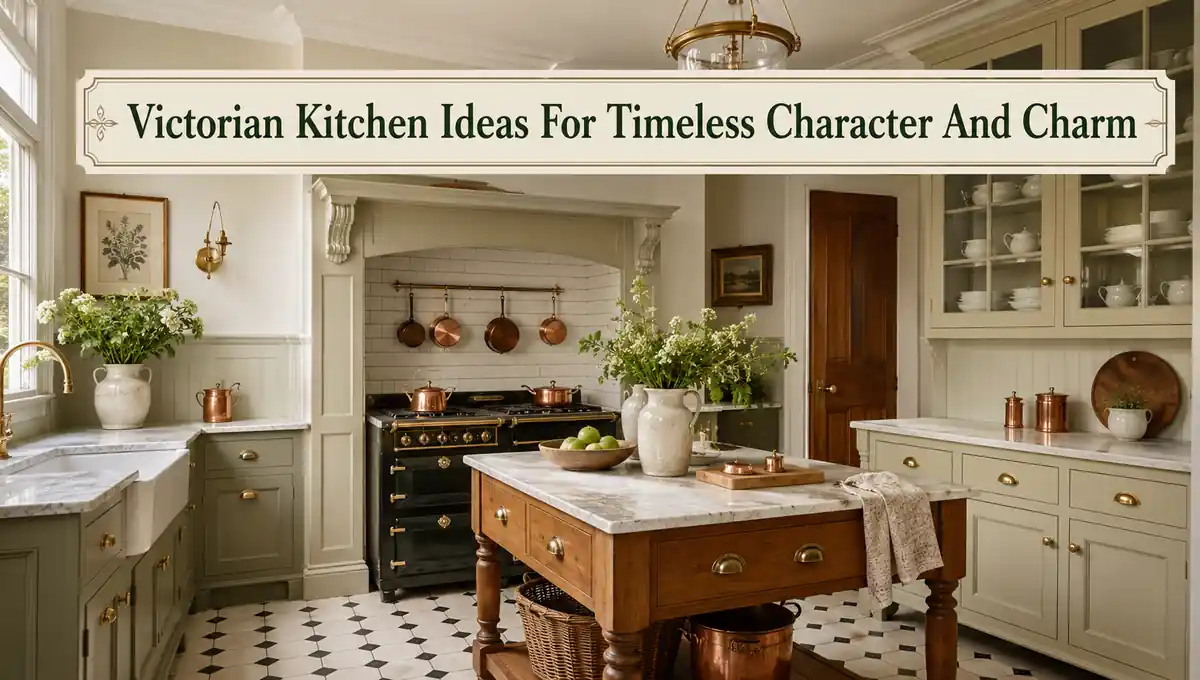
Victorian-era cabinets in a current remodel should look connected to furniture and traditional joinery rather than like an ornate showroom set. Inset doors, which sit inside the cabinet face frame, recessed or raised panels, glass-front doors, painted wood, and visible hardware all fit that direction.
For deeper cabinet detail, raised-panel cabinets suit more formal rooms, while simpler framed doors work better in Folk Victorian or smaller houses. Victorian-style cabinetry can be green, cream, warm white, deep blue, or natural wood; dark wood is not mandatory.
Freestanding pieces matter just as much. A dresser, hutch, pantry cabinet, or Victorian-style table can make the room feel more period-aware because historic kitchens relied heavily on furniture rather than continuous fitted cabinetry.
The same logic applies to the island. A fitted island can work when the room is large enough, but a furniture-style worktable often looks more convincing and takes up less visual space. Check circulation against a kitchen island guide before adding one simply because modern kitchens usually have them.
A mansion-scale room can support heavier cabinetry and larger furniture. A small Victorian house usually needs less molding, fewer upper cabinets, and tighter control of decorative detail.
Colors, Tile, Flooring, Sink, and Lighting
Victorian colors do not have to make the room dark. Deep green, blue, burgundy, warm cream, muted pink, wood tones, brass, and copper can all support the style, but the palette should respond to daylight and room size.
Deep green can feel rich without becoming heavy when the counters, walls, or upper cabinets stay lighter. A dark period scheme works better with strong natural light and useful task lighting. In a small room, using dark color on every surface can reduce visual breathing room.
Period-style tile can be plain or patterned. Geometric and decorative patterns work best when one surface leads; a busy floor, wallpaper, and backsplash competing together can make the room feel more theatrical than historic.
The floor can use wood, stone, or tile depending on the house and the condition of existing material. If original flooring survives, assess it before covering or removing it.
A period-style sink today is usually an interpretation rather than a literal historic fixture. Porcelain or ceramic forms can fit well, while a bridge faucet may use cross handles, brass, or polished nickel. These choices should support the room rather than act as proof of historical accuracy.
Wallpaper and brass or glass lighting can add character quickly. Use decorative fixtures alongside adequate task light; kitchen lighting ideas can help separate atmosphere from the light needed over counters and cooking areas.
How Do You Keep the Character Without Making It Too Dark?
Small rooms in Victorian houses work best when you reduce visual weight instead of removing all period detail. Keep one or two strong historic cues, then use lighter surfaces, clear work areas, and good lighting to stop the room from feeling crowded.
A small room does not need dark cabinets from floor to ceiling. Deep green lower cabinets with lighter walls, a wood table, simple framed doors, and restrained brass can keep the character without making the upper half of the room heavy.
The same restraint applies to Gothic Victorian design. Use darker color, pointed or carved details, and dramatic lighting only if the architecture supports them. For a lighter contrast, Scandinavian kitchen design shows how pale materials and reduced ornament change visual weight; a Victorian room can borrow that restraint without becoming Scandinavian.
Decor should be the final layer. If the room needs many accessories to look Victorian, the cabinets, furniture, materials, and architecture are not doing enough work.
What Do You Do About Modern Appliances?
Modern appliances can work in a Victorian house kitchen without destroying the period character. The practical goal is to let the architecture, cabinetry, furniture, and finishes dominate the view while current equipment handles refrigeration, cooking, washing, and ventilation.
Integrated appliances can disappear behind cabinet panels where the layout allows. Stainless steel can also work if the room has enough traditional material around it. You do not need reproduction appliances just to make a modern Victorian style believable.
Before ordering cabinetry, measure refrigerator depth, dishwasher clearance, range width, door swings, and landing space beside major appliances. Old rooms often have windows, doors, chimney breasts, and irregular walls that reduce usable cabinet runs.
This is also where a period remodel can become expensive. Custom inset cabinetry, stone, restored historic fabric, wall changes, and moving plumbing or electrical work raise scope quickly. Keeping a sound layout and changing paint, hardware, lighting, or selected cabinet fronts is the cheaper route when function is already good.
What Should You Keep Before Remodeling?
Before removing anything, identify the features that give the room or house its history. Original floors, doors, windows, plasterwork, fireplaces, chimney breasts, dressers, pantry details, and old joinery may be harder to reproduce than they first appear.
Preservation does not mean keeping every old feature. Cabinets that are damaged, awkward, or incompatible with safe appliance installation can be changed. The better question is whether removing something improves daily use enough to justify losing original character.
While comparing historic guidance with current remodel examples, the strongest projects do not copy the Victorian era literally. They protect useful character and update the systems people now depend on.
Electrical, gas, plumbing, ventilation, or structural work may require permits or licensed trades depending on local rules. Check local requirements before opening walls or moving utilities, and have old-house systems assessed before building expensive finishes around them.
Keep the House in Charge
A Victorian kitchen works best when the house sets the level of detail. Start with original architecture and the features worth saving, then choose cabinetry or color, furniture, flooring, lighting, and appliances that support that base.
Your next step is to classify the project as restoration, Victorian-inspired, or modern Victorian. Then list the original features you will keep and the functional problems you must solve. That short decision will prevent most mismatched finishes and unnecessary replacement.