
Choosing kitchen light fixtures is less a design problem than a filtering problem. You open a retailer page, find four hundred options that all look fine, and have no way to narrow them.
A kitchen also asks two things of a fixture that no other room does. It has to be sized to furniture rather than to a wall, and it has to survive cooking grease. This page gives you the sizing math, the finish and durability criteria, and the quality checks that separate a fixture worth buying from one that just photographs well.
Quick Answer
Narrow the field by size first, finish second, and construction third. Style comes last, because a well-proportioned fixture in a poor finish will annoy you every week and a beautiful one that is too small will look wrong forever.
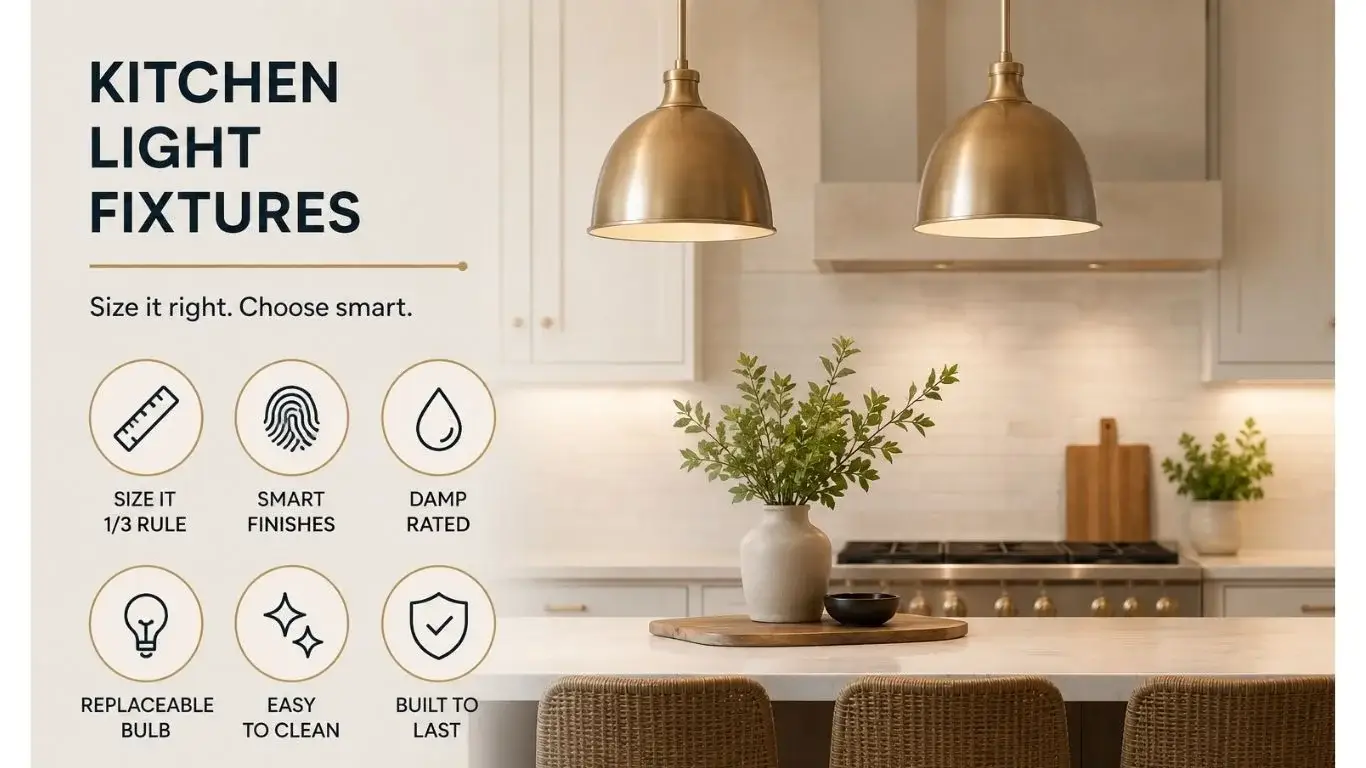
- Size a single fixture to about one-third of your island or table length
- Matte and brushed finishes hide fingerprints; polished chrome shows every one
- Open cages and fabric shades trap cooking grease and are miserable to clean
- Integrated LED means no replaceable bulb, so the whole fixture is scrap when it fails
- Over a sink, use a damp-rated fixture
The Kitchen Light Fixture Types That Actually Work
Six fixture types earn their place in a kitchen: hanging lights, flush and semi-flush mounts, long linear fixtures, chandeliers and lanterns, track lighting, and wall-mounted options. Each solves one problem well and fails at something else, which is the part product pages leave out.
Reading through three retailer and shelter-media pages, I noticed each lists fixture types without ever naming a limitation. Every option is presented as a good choice. That is what makes filtering impossible.
Hanging lights and pendants
Hanging lights, called pendants in the trade, drop from the ceiling on a rod or cord and put light directly on a work surface. They are the default over an island or a sink.
Their limitation is physical. A pendant occupies head height and blocks sightlines across a room, so they suit an island nobody walks over and fail over a peninsula people pass.
Flush and semi-flush mounts
A flush mount sits tight against the ceiling. A semi-flush hangs 6 to 10 inches below it, which lets light bounce off the ceiling instead of only pointing down.
Both are the right answer under a low ceiling. Their limitation is flat, shadowless light — a single flush mount lights the floor well and the counters poorly.
Long fixtures and linear suspensions
A long fixture, sometimes sold as a linear suspension, is a single elongated unit that spans a distance rather than a cluster of separate pendants. Over a long island it reads calmer than three separate lights.
The catch is commitment. A linear fixture is sized to one island length, so it does not adapt if you change the layout later.
Chandeliers and lanterns
Chandeliers and lanterns bring visual weight and work best over a table, where people sit rather than work. Bell jar lanterns, cage lanterns and multi-arm designs all sit in this group.
Their limitation is maintenance, and it is worse in a kitchen than anywhere else. Intricate frames and multiple glass panels collect cooking residue, which the durability section below covers properly.
Track lighting
Track lighting mounts a rail to the ceiling and lets you aim several heads independently. It is the most adjustable option and the easiest retrofit, since one ceiling box feeds the whole run.
It also dates faster than any other type on this list. If you are staying more than a few years, weigh that.
Wall sconces and counter lamps
Wall sconces mount beside open shelving, a range, or a window, throwing light forward rather than down. A small lamp on the counter does something similar at a coffee station.
Neither appears on most retailer category pages, and both are useful in kitchens where the ceiling is already crowded. Over a sink, choose a damp-rated fixture, meaning one certified for use where moisture collects.
What Size Light Fixture Do You Need?
Size a single fixture to roughly one-third of the length of the surface below it. For a 6-foot island that means a fixture about 24 inches wide. Multiply your island or table length in inches by 0.33 and you have your target width, which is the calculation nobody publishes.
Across three retailer and shelter-media pages reviewed in August 2026, none publishes a fixture sizing rule, a price range, or a durability warning. One publishes illuminance figures; the largest editorial page publishes 51 photographs and no measurement of any kind. [VERIFY: whether any manufacturer or design association publishes a standard fixture-width-to-surface-length proportion].
| Surface length | Single fixture width | Or this many fixtures |
|---|---|---|
| Under 4 ft | 14″ to 16″ | 1 |
| 4 to 6 ft | 16″ to 24″ | 1, or 2 small pendants |
| 6 to 8 ft | 24″ to 32″ | 2 pendants |
| 8 to 10 ft | 32″ to 40″ | 3 pendants, or 1 linear |
| Over 10 ft | 40″+ | 3 to 5, or 1 linear |
Proportions are a design convention, not a published standard. Widths are calculated from the one-third rule.
Undersizing is the more common error by a wide margin. A 12-inch pendant over a 9-foot island looks like an accident, and the fix costs another fixture.
Room size matters separately from surface size. A useful check: add your room’s length and width in feet, and treat that number in inches as a sensible maximum diameter for a central fixture. A 12 by 14 foot kitchen tops out around 26 inches.
Height changes the answer as much as width. A tall six-sided lantern and a shallow dome at the same 24 inches wide read completely differently, because visual weight comes from both dimensions together. In a small kitchen or under a low ceiling, keep the fixture shallow even when the width calculation allows something larger.
Head clearance limits everything. Anything hanging where people walk needs to clear the tallest person in the house, which is why fixtures with arms sloping upward work over walkways and wide drum shades do not.
Sizing to an island
Two pendants suit most islands between 6 and 8 feet. Three start to make sense past 8 feet, and beyond 10 feet a single linear fixture often reads cleaner than a row.
Multiple fixtures each get sized smaller than a single one would be. Two pendants over a 7-foot island want roughly 12 to 14 inches each, not 28.
Hanging height is a separate question from width, and it is covered properly in our guide to kitchen lighting ideas alongside spacing and brightness.
Sizing to a table
Over a dining table, a single fixture should be about half to two-thirds the table width — not the length. A 40-inch-wide table takes something in the 20 to 26 inch range.
Leave at least 6 inches of clear table surface beyond each edge of the fixture. Anything wider starts catching heads when people lean in.
How to Choose a Finish (And Whether It Has to Match Your Hardware)
Kitchen light fixtures do not have to match your cabinet hardware. Coordinating within the same metal family reads more deliberate than exact matching, and a fixture in a deliberately different finish often looks better than one trying and failing to match. What looks like an error is a near-match — brushed nickel against polished chrome.
Pick the finish for how it behaves before you pick it for how it looks. A kitchen puts fingerprints, steam and grease on everything at eye level, and finishes differ enormously in how they show it.
Matte black and brushed metals hide fingerprints well. Polished chrome and polished nickel show every one, which matters more on a fixture over a sink than on a cabinet pull nobody touches.
Unlacquered brass is the finish people underestimate. It patinas on purpose, darkening unevenly with handling, and buyers who wanted it to stay bright are the ones who regret it.
Painted and powder-coated finishes chip. Solid metal wears. On a fixture you will own for a decade that difference outlasts any trend.
On trends specifically: warm metals have been ascendant for several years and matte black before that. Both will keep looking current for a while, but choosing a finish because it is trending is the reliable route to a dated kitchen. Choose the one that suits your cabinets and hides marks.
Are Flush Mount Lights Outdated?
Flush mount lights are not outdated. They are the correct fixture under a ceiling below about 8 feet, and no amount of style commentary changes the physics of head clearance. What dates a flush mount is the specific design — a frosted dome from the 1990s reads old, while a simple opal glass or a low-profile drum does not.
The question is worth separating into two. Fixture types rarely date, because they exist to solve physical problems. Fixture styles date constantly, because they follow fashion.
Three things age a kitchen fixture fastest. Heavily ornamented shapes tied to one moment. Exposed filament bulbs in cage frames, which peaked hard and are now doing what peaks do. And track lighting in its dated forms, which is why the types section flags it.
Three things age slowly. Simple geometric shapes with clean lines. Clear or lightly frosted glass, which does not commit to a color story. And solid metal in a finish that patinas rather than chips.
If you plan to sell within five years, that matters more. A fixture is one of the cheapest things to swap before listing, which is a genuine argument for spending less on it now.
How to Tell a Well-Made Fixture From a Cheap One
Check three things: whether the bulb comes out, what the shade is made of, and how heavy the fixture feels for its size. Those three separate a fixture that lasts a decade from one that looks identical in photographs and fails in three years.
The bulb question is the big one and almost nobody selling fixtures raises it. Integrated LED fixtures have the diode built into the housing with no socket and no replaceable bulb. When that LED fails, the fixture is scrap.
Every accessible retailer page I read markets LED as a benefit. Not one mentions that integrated means unserviceable, despite all of them selling integrated fixtures. Check the product specifications for a bulb type — if it lists one, the bulb comes out.
Shade material tells you a lot. Real glass has weight and slight variation; acrylic is lighter and yellows over years near heat. Fabric shades look warm and hold grease permanently.
Weight is a reasonable proxy for build. Solid brass or steel feels substantially heavier than plated aluminum at the same size, and plated finishes are what chip at the canopy where the fixture meets the ceiling.
The canopy and mounting bracket are worth a look on the product photos. A thin stamped canopy with visible seams is a signal about everything you cannot see.
What Grease and Heat Do to Kitchen Light Fixtures
Cooking puts an oily film on everything above a stove, and kitchen light fixtures collect it faster than any other surface in the room. This is the criterion that separates a kitchen fixture from a dining room one, and no retailer or shelter-media page in the reviewed sample mentions it.
The pattern in the search data makes the point. People search specifically for how to clean greasy kitchen light fixtures, while the only maintenance advice in the reviewed sample recommends cage lanterns because they need less dusting. Dust is not the kitchen problem, and open cage frames are among the harder designs to degrease.
| Finish or shade | Grease and fingerprints | Cleaning effort |
|---|---|---|
| Polished chrome or nickel | Shows both badly | Easy to wipe, needs it often |
| Brushed nickel | Hides fingerprints well | Low |
| Matte black | Hides fingerprints, shows dust | Low |
| Unlacquered brass | Patinas, hides marks | Low, but do not polish it |
| Clear glass | Shows film clearly | Easy, but visible fast |
| Frosted glass | Hides film longer | Moderate, film dulls it |
| Fabric or linen shade | Absorbs grease permanently | Cannot be cleaned properly |
| Open cage or frame | Traps film in corners | High, every bar by hand |
Ratings reflect how these materials behave, not published test results.
Fabric shades are the choice to think hardest about. They look warm in photographs and they absorb airborne oil, which does not come out. Over a dining table away from the range they are fine; directly over a cooking zone they are a mistake.
Heat matters within about 3 feet of a range hood. Sustained warmth accelerates yellowing in acrylic and can loosen adhesive-mounted trim over years.
Moisture matters over a sink, and it is the reason damp-rated fixtures exist. A standard dry-rated fixture is not built for the steam and splash that a sink location produces.
What You Should Expect to Pay
No retailer or shelter-media page in the reviewed sample publishes a fixture price. One links products spanning designer pendants, a mid-market glass globe and an independent maker’s fixture, presented identically with no figure attached and no signal that they occupy different tiers. [VERIFY: current US price ranges for kitchen pendant, flush mount and chandelier fixtures, sourced figures needed].
What drives cost is knowable even without those numbers. Five things account for most of the spread.
Material comes first. Solid brass or steel costs more than plated aluminum, and the difference shows up at the canopy and the joints where plating wears through.
Glass is second. Hand-blown and seeded glass carries a real premium over molded, and the variation is visible up close.
Integrated LED usually costs more up front and cannot be repaired, so the lifetime math is not as favorable as the price tag suggests.
Size scales price steeply, which is why a large linear fixture over a long island is often the single most expensive item in a lighting plan.
Brand tier is the fifth, and it is the one where paying more buys the least. A well-made fixture from an unglamorous maker outperforms a designer name in thin plated metal.
Buying nothing is a real option and nobody selling fixtures will suggest it. A well-made fixture that is merely dated can often take a new shade for a fraction of the replacement cost, and a fixture on an existing box can be rewired rather than replaced. In a rental, or where the layout might change within a year or two, spending nothing now is usually the better call.
Get the sizing right before you set a budget. An undersized fixture is a repurchase, and that costs more than choosing carefully once.
Common Kitchen Light Fixture Mistakes
Most fixture regret comes from four decisions made in the wrong order — style first, size last. Size, finish behavior and construction should all be settled before you look at a single photograph.
Undersizing over a large island. The most common error and the most visible. Run the one-third calculation before you shop.
Choosing a fabric shade over a cooking zone. It absorbs oil and never recovers. Save fabric for a table.
Buying integrated LED without checking. No bulb socket means no repair. Worth knowing before, not after.
Matching every finish exactly. Rigid matching reads flat and near-matching reads like a mistake. Coordinate instead.
Ignoring head clearance at a peninsula. A pendant over an island is fine. The same pendant over a walkway is a hazard.
Picking a fixture before the layout is settled. Choose how many fixtures and where they go first, then choose what they look like.
Frequently Asked Questions About Choosing Kitchen Light Fixtures
Should kitchen light fixtures match the cabinet hardware?
Fixtures and hardware do not need to match, and coordinating within one metal family usually looks more deliberate than an exact match. Warm metals with warm metals, cool with cool. The combination that reads as a mistake is a near-match, like brushed nickel hardware beside polished chrome lighting, where the eye reads the gap as an error.
How high should kitchen pendant lights hang?
Pendants generally hang 30 to 36 inches above the countertop, measured from the surface to the bottom of the shade rather than from the ceiling. Ceiling height shifts that figure. Spacing between pendants, setback from island ends and total brightness are covered in full in our lighting planning guide.
What does damp rated mean for a kitchen light fixture?
A damp-rated fixture is certified for locations with moisture in the air but no direct water contact, which describes the area above a kitchen sink. Dry-rated fixtures suit everywhere else in the room. The rating appears in the product specifications and comes from the safety certification listed on the fixture.
Bottom Line
Run the one-third sizing calculation before you look at a single product photo, then filter by finish behavior and whether the bulb comes out. Style is the last filter, not the first, and it is the only one you can change cheaply later.
If the layout is not settled yet, start there instead. Our guide to under cabinet lighting covers the task layer that most kitchen light fixtures cannot reach.