
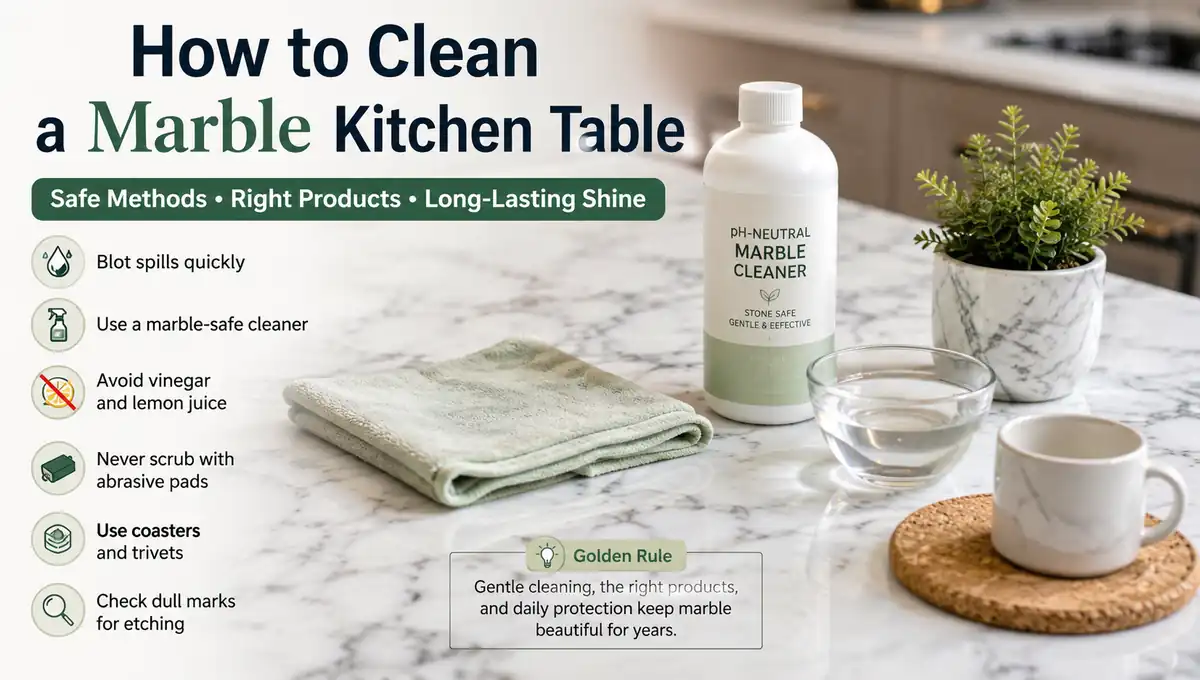
Knowing how to clean a marble kitchen table is less about scrubbing harder and more about using the right treatment for the mark. Everyday dirt usually needs a soft cloth and pH-neutral stone cleaner.
A dark stain may need targeted treatment, while a dull ring can be etching that cleaning cannot remove. Marble also reacts badly to common kitchen acids such as vinegar and lemon juice.
By the end, you will know how to clean the tabletop safely, identify stains and etching, avoid damaging products, protect the finish, and decide when professional marble restoration makes more sense than another DIY attempt.
Quick Answer
The safest way to clean a marble kitchen table is to remove loose grit, wipe with a microfiber cloth and pH-neutral stone cleaner, rinse away residue, and dry the surface. Treat stubborn marks according to their cause rather than using a stronger cleaner.
- Blot spills quickly.
- Use a marble-safe cleaner.
- Avoid vinegar and lemon juice.
- Never scrub with abrasive pads.
- Use coasters and trivets.
- Check dull marks for etching.
If gentle cleaning fails, identify the mark before trying another treatment.
What Can You Use to Clean Marble?
For routine marble table cleaning, use a soft microfiber cloth, clean water, and a pH-neutral marble cleaner or natural stone cleaner. These supplies handle most crumbs, fingerprints, light grease, and food residue without exposing the stone to unnecessary acids or abrasives.
You need only a few items:
- Clean microfiber cloths
- pH-neutral marble cleaner
- Clean water
- Soft drying towel
- Soft-bristle brush for detailed edges, if needed
Marble contains calcium carbonate. That composition makes natural marble sensitive to acids, which is why cleaner choice matters more here than on many synthetic kitchen surfaces.
Can you use dish soap on marble?
Some stone-care instructions allow a small amount of mild soap in water, while other care guidance favors dedicated pH-neutral stone cleaners to avoid residue or unsuitable ingredients. That disagreement makes a marble-safe cleaner the simpler default.
If you want to use dish soap, check the table, stone, or sealer manufacturer’s care instructions first. Use only a small amount if those instructions permit it, then rinse the marble with clean water.
Do not assume that “mild” automatically means suitable for marble.
How to Clean a Marble Kitchen Table Step by Step
For normal dirt and food residue, how to clean a marble kitchen table comes down to five steps: remove grit, apply a suitable cleaner, wipe gently, rinse, and dry. More pressure does not make marble cleaner and can increase the risk of scratching a polished finish.
1. Remove crumbs and grit first
Wipe away crumbs, dust, and loose particles with a dry microfiber cloth.
Do this before wet cleaning. Hard particles trapped under a cloth can drag across the surface and leave fine scratches.
2. Apply a marble-safe cleaner
Use your pH-neutral marble cleaner according to its directions. Avoid soaking the table unless the product instructions specifically require more liquid.
A damp cloth is usually enough for everyday marble tabletop care.
3. Wipe gently
Move across the tabletop with light pressure. Pay extra attention to fingerprints, grease, sticky food, and areas where people regularly place drinks.
If food has dried onto the marble, soften it with the appropriate cleaner instead of scraping it with a knife or another hard object.
4. Remove cleaner residue
Dampen a second microfiber cloth with clean water and wipe the surface again.
This rinse matters. Soap or cleaner left behind can create a film that makes polished marble look cloudy or dirty even after you have cleaned it.
5. Dry the marble
Dry the tabletop with a clean, soft towel rather than leaving standing water behind.
If hard water regularly leaves mineral marks in your home, distilled water can reduce the amount of dissolved minerals introduced during cleaning.
This process is the safest answer to how to clean marble without damaging it during normal use. If a mark survives this routine, do not automatically move to a stronger chemical.
Is That Marble Mark a Stain, Water Ring, or Etching?
A stubborn mark needs diagnosis before treatment. A marble stain usually changes the stone’s color, a mineral deposit sits on the surface, and marble etching changes the finish itself.
| What you see | Likely problem | What to do next |
|---|---|---|
| Darker discolored patch | Absorbed stain | Identify what caused it before treating it |
| Pale or dull patch | Etching | Stop scrubbing and assess the finish |
| Chalky material on top | Mineral deposit | Use a marble-safe deposit treatment |
| Dull ring after an acidic spill | Likely etching | Consider polishing or restoration |
| Mark unchanged by gentle cleaning | Stain, etch, or damage | Diagnose it before escalating |
How do you tell a stain from etching?
Look at what changed. A stain changes the color within the stone, while etching changes how the surface reflects light.
Cooking oil or grease may create a darker area after soaking into porous marble. Lemon juice or vinegar can instead react with the marble and leave a lighter, cloudy, or dull patch.
Polished marble makes this distinction especially noticeable because an etched area loses some of its surrounding shine. Honed marble already has a lower-sheen finish, so light etching may be less obvious.
This distinction prevents one of the most common mistakes in marble stain removal: repeatedly cleaning damage that is no longer dirt.
What about a water ring on marble?
Do not assume every ring is a “water stain.” A ring can be a mineral deposit, absorbed moisture, staining from a drink, or etching caused by an acidic beverage.
Look at the surface first. A crusty deposit sitting above the marble is different from a smooth but dull ring where the polish has changed.
If you cannot identify it confidently, use only the gentle cleaning method first. Avoid experimenting with vinegar or abrasive powders.
How Do You Remove Stains From Marble?
To remove stains from marble safely, start by identifying what was spilled. Oil, grease, coffee, food, and colored liquids can create different types of discoloration, so no single DIY mixture is appropriate for every marble stain.
Blot fresh spills instead of rubbing them outward. Then clean the area with the same pH-neutral method used for routine care.
If discoloration remains, an appropriate poultice may help with some absorbed stains. A poultice is an absorbent treatment placed over a stain to help draw the staining material from porous stone.
Some published marble-care instructions describe baking-soda-based poultices for certain stains. That does not make baking soda a universal marble stain remover.
Avoid turning a difficult mark into a chemistry experiment. If you cannot tell what caused it, using several household products one after another can make diagnosis harder and may damage the finish.
A persistent dark patch points more toward staining. A pale patch that has lost its shine points more toward etching.
What Should You Never Use on Marble?
Do not use vinegar, lemon juice, abrasive powders, steel wool, rough scouring pads, or cleaners that are not suitable for natural marble. The risk is not simply poor cleaning performance; some products can chemically or physically alter the surface.
Avoid these common mistakes:
- Cleaning marble with vinegar
- Using lemon as a “natural” cleaner
- Scrubbing with abrasive powder
- Using steel wool
- Scraping dried food with a hard tool
- Mixing several cleaners together
- Continuing to scrub a dull etch mark
Can you use vinegar on marble?
Vinegar should not be used as a routine marble cleaner. Its acid can react with the calcium carbonate in natural marble and leave a dull etched area.
This is one place where general household cleaning advice fails. A homemade vinegar spray may work well elsewhere, but that does not make it safe for a marble kitchen table.
Acid exposure can also come from food rather than cleaning products. Lemon and lime juice, vinegar-based dressing, wine, tomatoes, and other acidic foods should be wiped up promptly.
How Do You Protect a Marble Tabletop?
The easiest way to maintain a marble kitchen table is to prevent long contact with acids, oils, colored liquids, heat, and abrasive debris. A few small habits reduce the amount of stain removal and marble polishing you may need later.
Use these protections:
- Put drinks on coasters.
- Use placemats during meals.
- Place hot cookware on trivets.
- Prepare acidic foods on cutting boards.
- Blot spills as soon as possible.
- Remove grit before wiping.
- Dry the tabletop after cleaning.
How do you prevent water rings on marble?
Use coasters under cold glasses, coffee cups, wine glasses, and other drinks. Wipe condensation rather than letting moisture remain under a glass for hours.
Coasters also protect against more than water. They reduce direct contact between marble and acidic drinks that could otherwise leave etching mistaken for a water ring.
Can you put hot pans on marble?
Use a trivet instead of putting hot cookware directly on a marble table. This avoids unnecessary thermal stress and protects the finish from dirty or rough pan bottoms.
There is little benefit in testing how much heat your particular table can tolerate. A trivet is the simpler alternative.
Does a Marble Table Need Sealer?
A marble sealer can reduce liquid absorption and improve resistance to certain stains, but it does not make marble stain-proof. More importantly, a sealer does not make natural marble immune to acid etching.
That limitation changes how you should use a sealed table. You still need to wipe lemon juice, vinegar, wine, and other acidic spills promptly.
How often should marble be sealed?
There is no reliable sealing interval that applies to every marble kitchen table. The correct timing depends on the stone, its finish, the sealer used, and how heavily the table is used.
Follow the sealer manufacturer’s directions and the stone supplier’s care information. Avoid automatically applying another coat because an online article says marble must be sealed every six or 12 months.
More sealer is not automatically better.
What If Cleaning Does Not Remove the Mark?
If gentle cleaning leaves a smooth but dull patch, stop trying stronger cleaners. The surface may need marble polishing or restoration rather than more cleaning.
Cleaning removes dirt and residue. Polishing works on the surface finish, while marble restoration can address more extensive etching, scratches, chips, and uneven areas.
This boundary is important because stronger cleaning can be the wrong response to etching.
A small, light etch may sometimes be suitable for a marble polishing product designed for the stone and finish. Follow the product directions exactly and use any recommended test area.
Professional help makes more sense when:
- Etching covers a large area.
- Deep scratches are visible.
- The finish looks uneven across the table.
- A valuable tabletop has significant damage.
- A correctly treated stain remains.
- You cannot identify the problem confidently.
Professional restoration costs vary widely with location, tabletop size, finish, stone condition, and the work required. Get a written estimate before authorizing restoration rather than relying on a generic national figure.
For ordinary cleaning, buying more specialty products is rarely necessary. A good pH-neutral cleaner and reusable microfiber cloths cover routine care; the expensive mistake is damaging the finish and then needing restoration.
Can a Marble Cleaner Remove Etching?
A regular marble cleaner cannot remove true etching because there is no dirt layer to wash away. Acid has altered the marble’s surface, so the solution may require polishing or refinishing rather than another cleaning product.
This explains a common complaint: “I cleaned the marble, but the mark keeps showing.”
If the area is clean yet still looks dull when light crosses it, stop treating it as dirt. That clue can save repeated cleaning attempts and further surface damage.
Does Sealing Stop Marble From Etching?
Sealing does not stop acid etching. An impregnating sealer enters pores to reduce absorption, which can help with staining, but it does not create an acid-proof shield over the marble.
This is why sealed marble still needs coasters, cutting boards, and quick spill cleanup.
Treat sealing as stain protection, not permission to use vinegar or leave lemon juice on the table.
How to Clean a Marble Kitchen Table Every Day
For daily care, how to clean a marble kitchen table is much simpler than treating an old stain. Remove crumbs, wipe fresh spills, use a damp microfiber cloth when needed, and bring out a pH-neutral stone cleaner for food residue or grease.
Deep cleaning every day is unnecessary. Frequent aggressive cleaning can create more risk without giving you a cleaner table.
The practical routine is:
- Remove loose crumbs.
- Blot fresh spills.
- Wipe with a soft damp cloth.
- Use marble-safe cleaner when needed.
- Rinse away residue.
- Dry the surface.
- Investigate any mark that remains.
The goal is consistent gentle care, not constant polishing.
Final Takeaway
Knowing how to clean a marble kitchen table also means knowing when to stop cleaning. Use a microfiber cloth, pH-neutral stone cleaner, clean water, and a soft towel for routine care. Protect the surface from acids, grit, heat, and standing spills. If a dark mark remains, investigate staining. If the surface becomes pale or dull, suspect etching instead. When the finish itself is damaged, proper polishing or professional restoration is safer than experimenting with stronger household cleaners.