
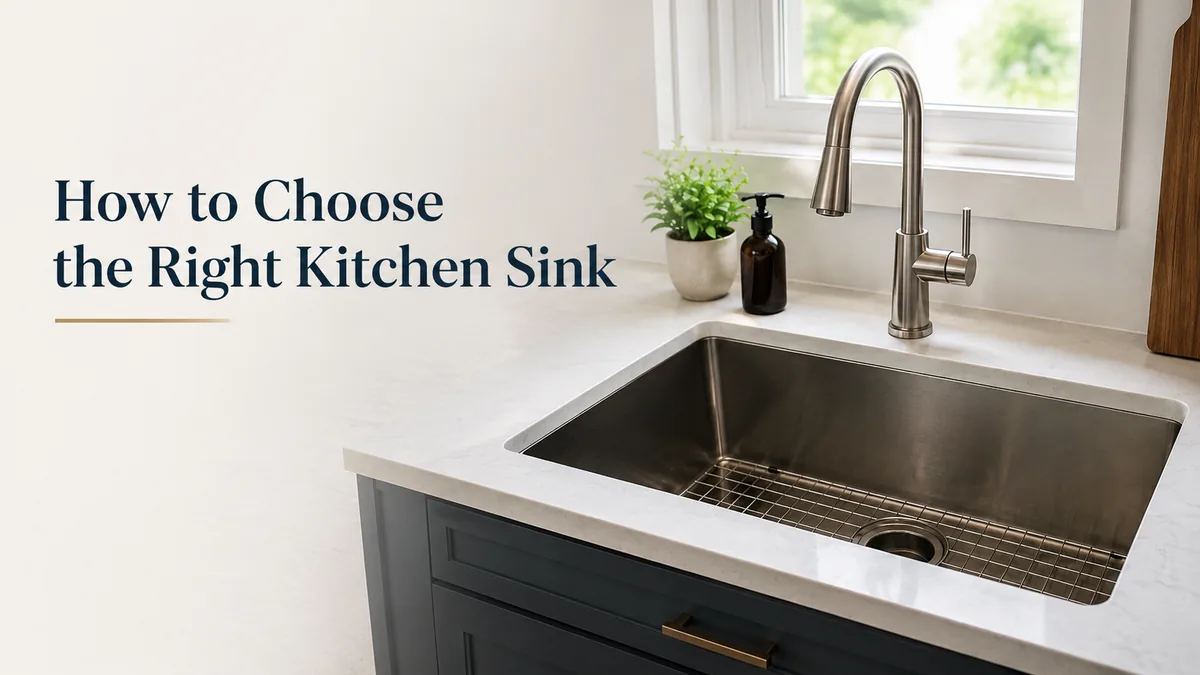
A kitchen sink looks simple until you have to choose one. Width, bowl depth, mounting style, material, faucet holes, and drain position can all affect whether the sink fits and how well it works after installation.
Start with the cabinet and countertop, not the finish or color. A beautiful sink is still the wrong sink if the cabinet is too narrow, the existing cutout will not work, or the bowl leaves no useful space underneath. By the end, you should know which type fits your project and which features are worth paying attention to.
Quick Answer
Choose a kitchen sink by checking physical fit first, then bowl layout, material, mounting style, and daily-use features. The best kitchen sink is the one that works with your cabinet, countertop, cookware, plumbing, and cleaning habits without forcing changes you did not plan.
- Measure the cabinet and existing countertop opening.
- Choose one or two bowls based on how you wash large cookware.
- Compare materials by scratches, chips, stains, weight, and care.
- Check faucet holes, drain position, disposal space, and accessories.
- Price the complete installation, not just the sink.
How to Choose the Right Kitchen Sink
The right kitchen sink is usually determined by constraints before style. Check the base cabinet, countertop, existing cutout, bowl needs, and mounting method before comparing finishes or accessories.
Start with the cabinet. The bowl, rim, mounting clips, drain assembly, and any garbage disposal all need room. A listed sink width does not prove the sink will fit the cabinet below it.
Check the countertop next. A new countertop can be fabricated around the selected model, while an existing opening may limit the size and mounting styles that work without extra cutting. Countertop material also matters because an undermount installation leaves the cut edge visible.
Think about use after fit. Large roasting pans favor a wide uninterrupted basin. Separate washing and rinsing may favor two bowls. A workstation can help when prep space is scarce, but only if its ledge accessories match how you actually cook.
While comparing current product specifications, one pattern is easy to miss: exterior width is often easier to find than the manufacturer’s minimum cabinet requirement. Check both numbers before ordering. If your choice changes the cabinet, countertop, faucet, or drain, treat sink installation as part of the buying decision.
Which Sink Type Fits Your Countertop?
Mounting style controls how the sink meets the countertop and how much modification installation may require. Drop-in and undermount sinks fit many projects, while farmhouse, workstation, corner, and prep sinks solve more specific needs.
Drop-In or Top-Mount
A drop-in sink, also called a top-mount sink, sits in the countertop opening with a visible rim resting on top. It is often the least complicated choice when an existing cutout already matches.
The rim helps support the bowl and hides a small amount of the opening edge. That can make a drop-in model more forgiving during replacement.
The drawback is the raised lip. Crumbs and water can collect around it, and you cannot sweep debris straight from the counter into the bowl as easily as with an undermount.
Undermount
An undermount kitchen sink attaches below the countertop, so the counter edge remains visible around the opening. It gives a flat transition that makes wiping water and crumbs into the basin easier.
That cleaner edge demands a suitable countertop and accurate cutout. The exposed edge must look finished, and hidden clips or another approved support method must hold the sink securely.
A white undermount model may look similar in photos to a white drop-in model, but the installation rules are different. Do not force an undermount into an existing counter simply to get the look if the opening or material is a poor match.
Farmhouse or Apron-Front
A farmhouse sink exposes the front wall of the basin instead of hiding it behind the cabinet face. “Farm sink” and “apron-front sink” are common names for the same general form.
The cabinet usually needs to be designed or modified around the apron. Heavy fireclay or cast-iron versions also need dependable support beneath the bowl.
This is one of the easiest styles to underestimate during a replacement. If keeping the current cabinet and countertop matters more than the farmhouse look, a compatible drop-in or undermount is often the safer alternative.
Workstation and Specialty Sinks
A workstation sink has an integrated ledge that supports accessories such as a cutting board, colander, or drying rack. In a small kitchen, that can temporarily turn part of the basin into prep space.
Do not pay for a large accessory package unless you will use it. Unused boards, racks, and baskets simply move the clutter from the countertop to a cabinet.
A corner sink can solve an unusual cabinet layout, while a small prep or bar sink works as a secondary basin. A modern sink may use any of these forms; “modern” describes the design more than the mounting method.
Single Bowl or Double Bowl: Can You Wash Large Pans?
Choose a single bowl when sheet pans, stockpots, roasting dishes, and other bulky cookware are your main washing problem. Choose a double bowl when separating washing, rinsing, draining, or food prep matters more than one wide basin.
A single-bowl sink, also called a single-basin sink, gives you one uninterrupted work area. That makes it easier to lay a sheet pan flatter or turn a large pot without hitting a center divider.
A double-bowl sink divides the space into two basins. Equal bowls work for people who want two similar zones, while offset designs keep one side larger.
The main risk is usable size. A 33-inch double bowl does not give each side the same freedom as a 33-inch single-bowl model. If your largest pan cannot sit comfortably in either basin, the divider may become the feature you dislike most.
A low divider is a useful middle ground. It can hold shallow water separately while letting the upper part of a wide pan span both sides.
Materials: What Lasts and What Shows Wear?
Sink materials differ most in scratching, chipping, staining, noise, weight, and cleaning needs. Stainless steel is light and widely available, while fireclay, cast iron, composite, porcelain, and copper trade different looks for different ownership risks.
| Material | Best fit | Main thing to watch | Weight/support |
|---|---|---|---|
| Stainless steel | Broad everyday use | Scratches, water spots, noise | Lower |
| Fireclay | Apron-front and light-color designs | Chipping, heavy weight | High |
| Cast iron/porcelain enamel | Glossy traditional finish | Enamel chips, heavy weight | Very high |
| Granite/quartz composite | Muted color and solid feel | Mineral film, cleaning needs | High |
| Copper | Changing natural finish | Patina and finish variation | Moderate |
A stainless steel kitchen sink is a practical starting point because it comes in many sizes and mounting styles. Gauge describes sheet thickness. A lower gauge number means thicker metal, so 16-gauge stainless steel is thicker than 18-gauge stainless steel.
Do not treat gauge as a quality score by itself. Bowl shape, sound insulation, finish, mounting, and price also affect how a stainless sink feels and performs. A thicker model can still show scratches or water spots.
Fireclay provides the thick, bright surface used on many farmhouse sinks. It resists ordinary staining, but a hard impact can chip an edge or surface. Its weight makes cabinet support more important.
A porcelain-enamel sink often uses the finish over another structural material. Enameled cast iron feels solid and can hold a glossy finish for years, but a deep chip can expose the darker material below.
Granite composite and quartz composite sinks combine mineral material with a binder. They offer black, gray, beige, and other muted finishes, though mineral residue can stand out on some dark colors.
That is why a black sink should be chosen by its actual material and care needs, not by color alone. The same is true of a white sink, which might be fireclay, enamel, composite, or another construction.
A copper sink changes appearance as the surface develops a patina. Choose copper if that natural color change is part of the appeal. It is a poor fit if you expect the finish to stay visually identical.
What Size Sink Fits Your Cabinet?
There is no single standard kitchen sink size that fits every base cabinet. Common retail width classes include roughly 24, 27, 30, 33, and 36 inches, but the individual model’s minimum cabinet requirement and mounting method decide whether it actually fits.
| Sink width class | Typical role | What to verify | Main risk |
|---|---|---|---|
| 24–25″ | Compact or secondary sink | Interior cabinet width | Losing bowl space |
| 27–30″ | Common full-size range | Minimum cabinet requirement | Assuming nominal width equals fit |
| 33″ | Larger main sink | Cabinet, clips, plumbing | Tight side clearance |
| 36″+ | Large/workstation/farmhouse | Cabinet and structural support | Lost counter/storage space |
Treat those width classes as planning categories, not installation rules. Manufacturers can require different cabinets for sinks with similar exterior dimensions.
Before choosing a model:
- Measure the outside width of the sink base cabinet.
- Measure the usable interior width inside the cabinet.
- Measure the existing countertop opening if the counter will stay.
- Check the manufacturer’s minimum cabinet requirement.
- Check bowl depth and the room needed below for the drain and disposal.
The difference between nominal sink dimensions and real fit causes expensive mistakes. A model sold as a 30-inch sink does not automatically belong in every 30-inch sink cabinet.
An undermount needs space for its support system around the bowl. A farmhouse unit may require cutting the cabinet front. Sink-base construction also differs from ordinary base cabinet types because plumbing occupies much of the interior.
Bowl depth changes more than capacity. A deep basin can hide dishes and handle tall pots, but it also lowers the working surface. If you already bend or reach far at the counter, a very deep bowl may feel worse rather than better.
A deep bowl also consumes storage. Drain fittings, supply lines, and the garbage disposal compete with an under-sink organizer for the same cabinet space.
A small sink can protect counter space in a compact layout. A large sink earns its width when the extra basin area solves a real cookware, prep, or cleanup problem. Do not give up useful counter space for bowl capacity you rarely use.
Features That Change Daily Use
Faucet setup, drain position, strainers, disposal clearance, sound control, and accessories affect daily use more than many decorative upgrades. Check these details after size and mounting style but before you finalize the model.
Faucets may mount through predrilled holes in the sink or through the countertop behind it. Count the openings needed for the main faucet, side sprayer, soap dispenser, or filtered-water fixture before fabrication begins.
A pull-down faucet or side sprayer can make rinsing corners and oversized pans easier. A soap dispenser or filtered-water faucet also needs a compatible opening or mounting location.
Drain position is easy to overlook. A rear or off-center kitchen sink drain can leave more uninterrupted floor area in the bowl and may shift plumbing away from the center of the cabinet. That can improve room for an organizer or trash pull-out.
A center drain can still be the simpler fit when existing plumbing already lines up. Moving the drain just to gain storage may not be worth the added work.
Common parts below the bowl include the drain assembly, basket strainer, tailpiece, P-trap, drain pipe, and possibly a garbage disposal. A stopper holds water in the basin, while a drain strainer catches food scraps.
Workstation accessories can include a sink grid, cutting board, colander, drying rack, and caddy. Sink mats or a bottom grid can protect the basin, but they also need cleaning underneath.
Can You Replace the Sink Without Replacing the Countertop?
You can often replace the sink without changing the countertop when the new model matches the existing opening, mounting approach, faucet layout, and cabinet. The farther the new sink moves from those conditions, the more likely extra work becomes.
Measure the actual opening rather than relying on the old sink’s advertised size. Two sinks with similar outside dimensions can use different cutouts, corner radii, or mounting hardware.
Countertop material matters too. A drop-in rim can hide part of an imperfect edge, while an undermount exposes that edge around the entire opening. Changing from drop-in to undermount can therefore require more than removing one sink and attaching another.
Farmhouse conversions are harder because the cabinet front may need cutting and new support. Changing bowl depth or drain position can also force a different plumbing arrangement underneath.
If the existing sink works well and the project is mostly cosmetic, keeping it can be the better decision. Replacing a serviceable sink is not an upgrade if the change creates countertop, cabinet, and plumbing work without solving a real problem.
What Installation and Plumbing Really Involve
Kitchen sink installation connects the bowl to the countertop, faucet, water supply, and drain system. A like-for-like replacement can stay relatively contained, while moving the drain, enlarging the cutout, or changing to an apron-front sink can expand the job quickly.
The drain path normally includes the basket strainer or disposal connection, tailpiece, P-trap, and drain line. A clear plumbing diagram helps identify how these parts relate before work begins.
The tailpiece is the short straight pipe below the drain. The P-trap is the curved section that holds water to block sewer gases. Supply lines are separate hoses or tubes that carry hot and cold water to the faucet.
A faucet replacement is simpler when the hole layout and supply connections remain compatible. Moving plumbing or altering supply and drain lines may require a licensed plumber, depending on local rules.
Permit and licensing requirements vary by city and county. Check local requirements before changing plumbing rather than assuming a sink replacement is exempt.
An outdoor sink has extra drainage, weather, freeze-protection, and material concerns. Treat it as a separate installation problem instead of copying an indoor setup.
What Does a Sink Really Cost?
The sink-only price can be a small or large share of the finished project. Representative current US retailer listings reviewed in August 2026 ranged from about $180 to $1,690 for very different sink products, so that spread should not be treated as a national average.
Material, size, gauge, bowl configuration, workstation features, and brand positioning explain part of the difference. Installation conditions can matter even more.
A complete quote may need to account for:
- removal and disposal of the old sink
- faucet and drain installation
- garbage-disposal reconnection
- countertop cutting or fabrication
- cabinet modification
- changes to supply or drain lines
Prices vary by region and by whether labor, disposal, and extra materials are included.
This is why the cheapest sink can produce the more expensive project. A model that fits the existing opening, cabinet, faucet layout, and plumbing may cost less in total than a lower-priced model that forces fabrication or cabinet work.
Cleaning, Maintenance, and Common Problems
Maintenance depends on the sink material and the plumbing below it. Stainless steel can show scratches and water spots, enamel and fireclay can chip, dark composite can show mineral residue, and copper changes color as it ages.
Use a care method suited to the actual material when you clean the sink. Avoid assuming that one abrasive cleaner is safe for every finish.
Regularly clean the sink drain to reduce residue around the strainer and drain opening. A sink that will not drain, however, has a plumbing problem that may need more than routine cleaning.
Low water pressure at the sink can come from the faucet aerator, cartridge, supply valve, or plumbing. Diagnose the cause before paying for a repair or replacing the basin.
Placement, Windows, and Island Sinks
Sink placement affects lighting, traffic, plumbing, and usable counter space. Kitchen windows over sink locations can provide daylight, but the faucet still needs enough clearance from the sill, trim, and window hardware.
Lighting above a sink beneath a window should provide useful task light after dark without interfering with the window. A dedicated task light can help when overhead fixtures leave the bowl in shadow.
A kitchen island with sink can shorten some prep paths but also consumes valuable island work surface and complicates plumbing. Check the wider kitchen island guide before committing the center of the room to a sink.
Choose Fit Before Finish
The safest kitchen sink decision starts with measurements, not color. Confirm the cabinet, countertop opening, mounting method, bowl depth, drain position, and faucet setup before comparing finishes or accessories.
Then choose the bowl configuration and material that fit how you actually cook and clean. Your next step is simple: measure the cabinet and existing cutout, then compare those numbers with the installation sheet for any sink you are considering.




2 thoughts on “Kitchen Sink Guide: Types, Materials, Sizes & How to Choose”