By a kitchen design consultant with 10+ years of hands-on experience evaluating hundreds of cabinet brands, materials, and installations.
⚡ QUICK ANSWER
| How to Choose the Best Kitchen Cabinets |
|---|
| The best kitchen cabinets match your budget, kitchen layout, and lifestyle. Plywood-box cabinets with solid wood or MDF doors offer the best quality-to-cost ratio for most homeowners. |
| ✅ Measure your kitchen dimensions before anything else |
| ✅ Choose plywood boxes over particleboard for long-term durability |
| ✅ Pick a door style first — it drives the whole kitchen look |
| ✅ Soft-close hinges and full-extension drawers are non-negotiable |
| ✅ Budget $150–$650/linear foot for semi-custom quality |
| ✅ Always check the cabinet box material, not just the door finish |
Introduction
Kitchen cabinets are the single biggest visual element in any kitchen — and the largest chunk of most renovation budgets. I’ve walked through hundreds of kitchens, and the most common regret I hear? ‘I picked them because they looked pretty in the showroom.’
This guide cuts through the noise. You’ll learn what actually separates a cabinet that lasts 30 years from one that warps in five. I’ll cover every type, material, style, and price range, plus the questions you must ask before handing over a deposit.
Whether you’re doing a full gut renovation or just refreshing dated oak, this is everything you need to choose confidently.
Measure Your Kitchen First
Before you look at a single door sample or browse a single catalog, measure your kitchen. This is not optional — it’s the foundation every decision rests on. Cabinets ordered to the wrong dimensions cost thousands to fix.
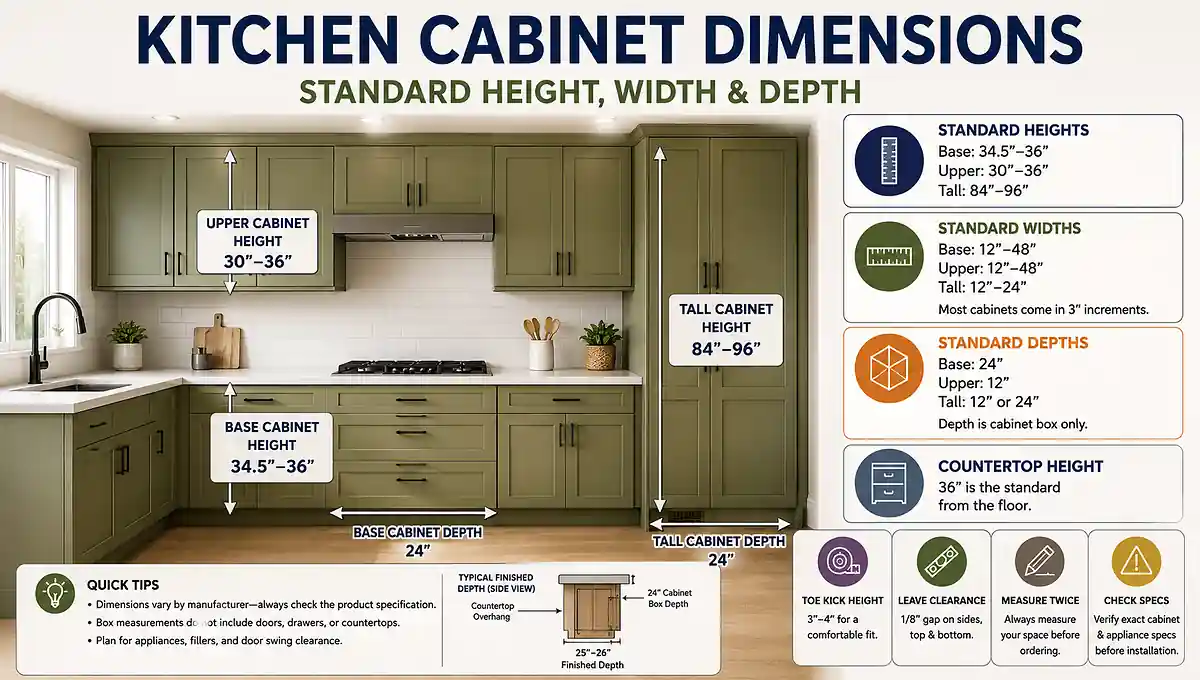
You need three measurements for every wall: the total wall length, the height from floor to ceiling, and the depth available (typically 24 inches for base cabinets, 12–15 inches for uppers). Note every window, door, outlet, and pipe location.
What to measure:
- Floor-to-ceiling height — determines whether tall cabinets reach or leave a gap
- Wall length for each run of cabinets
- Window and door opening widths and heights
- Distance from floor to window sill (affects upper cabinet placement)
- Location of all outlets, switches, and plumbing
- Any soffits or bulkheads above the cabinet zone
💡 Pro Tip: Take photos after measuring. You’ll reference them constantly when ordering, and contractors will ask.
Different Types of Kitchen Cabinets
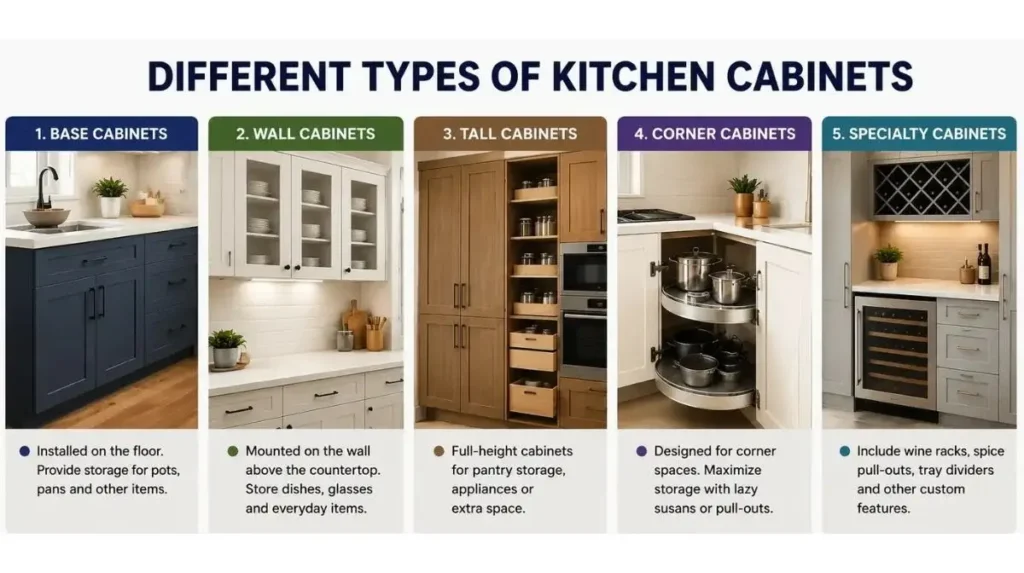
Cabinet types refers to the structural placement in the kitchen — not the style. Getting this right is about function before form.
Base Cabinets
Base cabinets sit on the floor and form the foundation of the kitchen. Standard height is 34.5 inches (which becomes 36 inches with a countertop). Standard depth is 24 inches.
These handle the heaviest use. Drawers, pull-outs, and sink bases all fall here. In my testing, base cabinets with full-extension, soft-close drawers dramatically improve day-to-day kitchen satisfaction compared to basic door-and-shelf designs.
- Single-door base: narrowest spaces (9–15 inches wide)
- Double-door base: standard storage (24–36 inches wide)
- Drawer base: best for pots, pans, and utensils
- Sink base: open interior to accommodate plumbing
- Blind corner base: fills L-shaped corners with pull-out solutions
Wall Cabinets
Wall cabinets mount above the countertop, typically 18 inches above the counter surface. They’re shallower than base cabinets — usually 12 inches deep. Standard heights are 30, 36, or 42 inches; taller cabinets reach closer to standard 9-foot ceilings and maximize storage.
I always recommend going as tall as your ceiling allows. The space above 30-inch wall cabinets is almost universally wasted on dust-collecting clutter.
Tall Cabinets
Tall cabinets (also called pantry or utility cabinets) run floor to ceiling, typically 84 or 96 inches. They work as pantry towers, oven housings, or broom closets. A single tall cabinet can replace two wall cabinets and a matching base unit while giving you deeper, more accessible storage.
Check this article also, hope it help you to better understand base, wall and tall kitchen cabinets.
Corner Cabinets
Corners are where kitchen storage goes to die — unless you plan them properly. A standard blind corner cabinet wastes nearly half its space. Upgrade options include lazy Susans, pull-out swing trays (LeMans style), or magic corner units. These cost more but recover storage that would otherwise be inaccessible.
💡 Pro Tip: Specify hardware for corner solutions during the cabinet order, not after. Retrofitting is expensive.
Best Materials for Kitchen Cabinets
Cabinet material is where the real quality divide lives. The door face gets all the visual attention, but it’s the box material that determines whether your cabinets survive 20 years of heat, humidity, and heavy use.
| Material | Durability | Cost | Best For |
|---|---|---|---|
| Solid Wood | ★★★★★ | $$$ | Long-term investment, character kitchens |
| Plywood | ★★★★☆ | $$ | High-moisture areas, structural integrity |
| MDF | ★★★☆☆ | $ | Painted finishes, budget builds |
| Particleboard | ★★☆☆☆ | $ | Very tight budgets only |
| Thermofoil | ★★★☆☆ | $$ | Easy-clean modern kitchens |
Wood Cabinets
Solid wood cabinet doors offer natural beauty and can be refinished — a major long-term advantage. Common species include maple (fine, consistent grain), cherry (rich reddish tones that darken beautifully with age), oak (pronounced grain, very durable), and alder (affordable, paints well).
Solid wood cabinet boxes are less common because wood expands and contracts with humidity, which can cause doors to warp or joints to separate. Most premium manufacturers use solid wood doors on plywood boxes — this is the sweet spot.
Plywood Cabinets
Plywood box construction is the benchmark for quality cabinets. It handles moisture better than particleboard, holds screws more reliably, and doesn’t sag under heavy loads. I tell every client: the single best upgrade from builder-grade cabinets is switching from particleboard to plywood boxes.
Look for 3/4-inch plywood on shelves and cabinet sides. Some budget lines use 1/2-inch — it works, but won’t hold up to decades of heavy loading.
MDF Cabinets
MDF (medium-density fiberboard) is dense, smooth, and takes paint extraordinarily well. It’s the preferred material for painted cabinet doors because it doesn’t expand, contract, or show grain telegraphing through the finish. Thermofoil cabinets wrap MDF in vinyl — they’re easy to clean and look sharp, though the vinyl can peel in extreme heat near ovens.
Avoid MDF for the cabinet box itself. MDF is heavy and does not handle moisture well — swelling, delaminating, and failing at joints when it gets wet.
Cheap Budget Cabinets
Entry-level cabinets use particleboard (also called furniture board) boxes. These hold up fine in dry, low-use environments, but they’re the first to fail in humid kitchens or under heavy loads. If budget forces this choice, prioritize spending on the sink base and lower cabinets — those take the most moisture exposure.
Ready-to-assemble (RTA) cabinets are a budget-friendly option that has improved dramatically. Brands like IKEA SEKTION and Lily Ann Cabinets offer genuine plywood construction at stock-cabinet prices, making them worth serious consideration.
💡 Pro Tip: The cheapest durable upgrade: whatever box material you choose, apply edge banding or a bead of silicone caulk on exposed raw edges near the sink.
Popular Kitchen Cabinet Styles
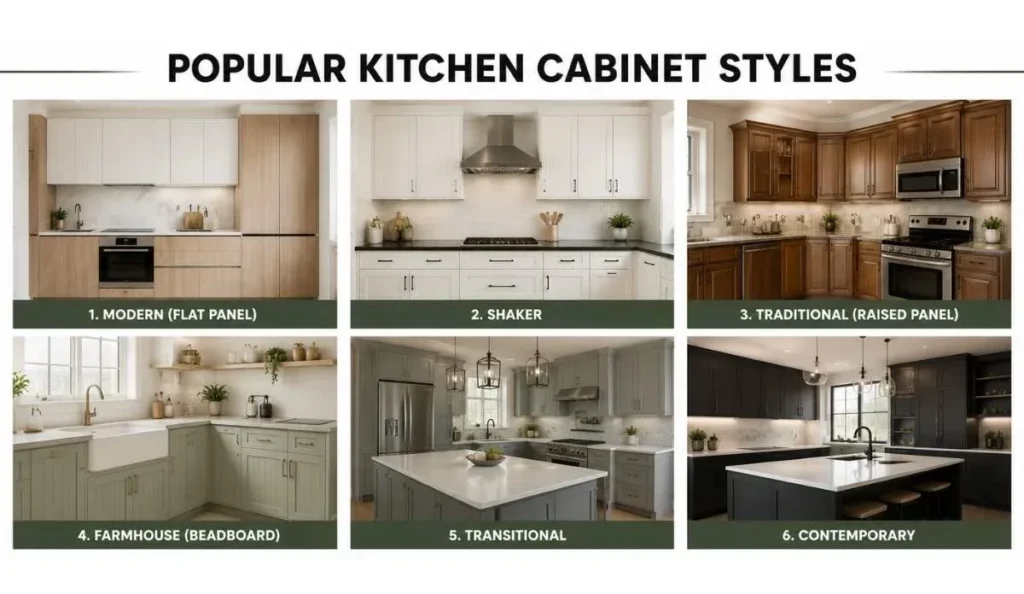
Cabinet style refers to the door profile and design character — the visual identity of your kitchen. Style preference is personal, but understanding how each style ages and how it complements other kitchen elements helps you make a decision you’ll still love in a decade.
Shaker Style Cabinets
Shaker cabinets feature a five-piece door with a flat recessed center panel. They originated in 18th-century American design and remain the most popular cabinet style in the country — and for good reason. They’re clean enough to read as modern, have enough detail to feel traditional, and work with virtually every countertop and hardware choice.
In my experience, Shaker is the safest choice for resale value. It appeals to the broadest range of buyers and doesn’t read as dated in the way ornate raised-panel profiles do. To further customize your Shaker doors, you’ll need to choose between inset vs overlay kitchen cabinets—a decision that completely transforms the overall look of your kitchen.
Modern Flat Cabinets
Flat-panel (slab) doors have no frame, no profile, just a flush surface. They define contemporary and modern kitchens. The challenge: flat panels are unforgiving — every smudge, dent, and installation imperfection shows. High-gloss finishes amplify this further.
High-gloss acrylic and lacquered flat-panel cabinets look stunning in design magazines but require obsessive upkeep in working kitchens. Matte flat-panel finishes are more practical and just as current.
Traditional Cabinets
Traditional cabinets use raised-panel doors with more elaborate profiles and often include decorative elements like crown molding, corbels, or furniture-style legs. They suit large kitchens in older homes where the architecture calls for formality.
One practical note: raised-panel doors have more grooves that collect grime. If easy cleaning is a priority, this style requires more maintenance.
Glass Door Cabinets
Glass-front cabinets are typically used for upper cabinets only, creating visual openness and display opportunities. Clear glass works if your shelves are curated. Frosted or reeded glass is more forgiving — it shows light and form without exposing what’s behind it.
Glass doors cost 15–25% more than solid doors. Budget for interior cabinet lighting when specifying glass — unlit glass cabinets look like murky aquariums at night.
Best Colors for Kitchen Cabinets
Cabinet color is the most emotionally charged decision in a kitchen renovation. I’ve seen homeowners love a color in the showroom and resent it six months later. The key is understanding what drives longevity in a color choice.
Colors with proven staying power:
- White and off-white: Timeless, brighten smaller kitchens, hide fingerprints less than you’d think — choose eggshell over high-gloss for practicality.
If you are also deciding between painted walls and wallpaper, this kitchen wallpaper vs paint comparison can help you choose the best option for your kitchen style.
- Warm gray: Replaced cool gray as the dominant neutral. Works with both warm wood tones and cool whites.
- Navy blue: Deep, rich, and luxurious on lower cabinets with white uppers. Has remained popular for a decade.
- Forest and sage green: The current dominant trend with surprising staying power. Connects to natural materials and works with brass hardware beautifully. These natural cabinet colors also pair beautifully with modern kitchen wallpaper ideas that add warmth and texture without overwhelming the space.
- Black: Bold, dramatic, demanding. Works best in large kitchens with strong natural light.
- Natural wood tones: Quarter-sawn white oak in a natural finish is the darling of design. If you want to explore more options, check out the latest kitchen cabinet color trends for 2026 to see what else is dominating modern homes.
Two-tone kitchens — upper cabinets in a light color, lower cabinets in a darker tone — have become standard practice. They add depth and visual interest while keeping the kitchen from feeling too heavy or too sterile.
💡 Pro Tip: Test paint samples in your actual kitchen at different times of day before committing. Showroom lighting lies.
Stock vs Custom Kitchen Cabinets
This is one of the most consequential decisions in a kitchen project — and it’s primarily a budget and timeline question.
Stock cabinets are manufactured in fixed sizes (typically in 3-inch increments) and sold off the shelf. They’re available immediately, cost the least, and work fine in standard kitchen layouts. The limitation is flexibility — stock sizes may not fill unusual spaces perfectly, requiring filler strips.
Semi-custom cabinets offer more size options, more finish choices, and optional interior upgrades (soft-close, pull-outs, etc.). Lead time is typically 4–8 weeks. This is the category most home renovation professionals recommend as the best balance of cost and quality.
Semi-custom cabinets offer more flexibility and value — for a deeper breakdown, see this semi-custom vs custom kitchen cabinets comparison guide.
Custom cabinets are built to exact specifications — any size, any wood species, any feature combination. Lead times of 10–16 weeks are common. The cost premium is significant, but for complex kitchen layouts, unusual ceiling heights, or premium design goals, custom is the only path.
💡 Pro Tip: For most kitchens, semi-custom is the right answer. The price difference versus stock rarely exceeds 15–20%, but the quality and size flexibility gap is significant.
How to Check Cabinet Quality
Showroom lighting makes everything look good. Here’s how to evaluate quality in person before you buy.
- Check the box material: Knock on the side panel. Plywood has a dull thud; particleboard has a hollow sound. Ask for a cutaway sample.
- Open and close the drawers: Quality drawers use full-extension, undermount soft-close slides. They should glide smoothly under their own weight with zero side-to-side wobble.
- Examine the hinge: European-style concealed hinges should have six-way adjustability. The door should close on its own from 45 degrees.
- Look at the interior finish: Shelves should have a melamine or painted finish — not raw particleboard. Raw interiors absorb moisture and odors.
- Check the dovetail joint: Quality drawer boxes use dovetail joinery at the corners. Stapled corners indicate budget construction.
- Inspect the finish edge: Run your finger around the door perimeter. Quality cabinets have smooth, sealed edges. Exposed raw MDF edges are a red flag.
- Look for certifications: KCMA (Kitchen Cabinet Manufacturers Association) certification means the cabinet passed a standard set of structural and finish tests.
Smart Storage Ideas for Kitchen Cabinets
Most cabinets use less than 30% of their space well. These smart storage ideas fix that without breaking the bank:
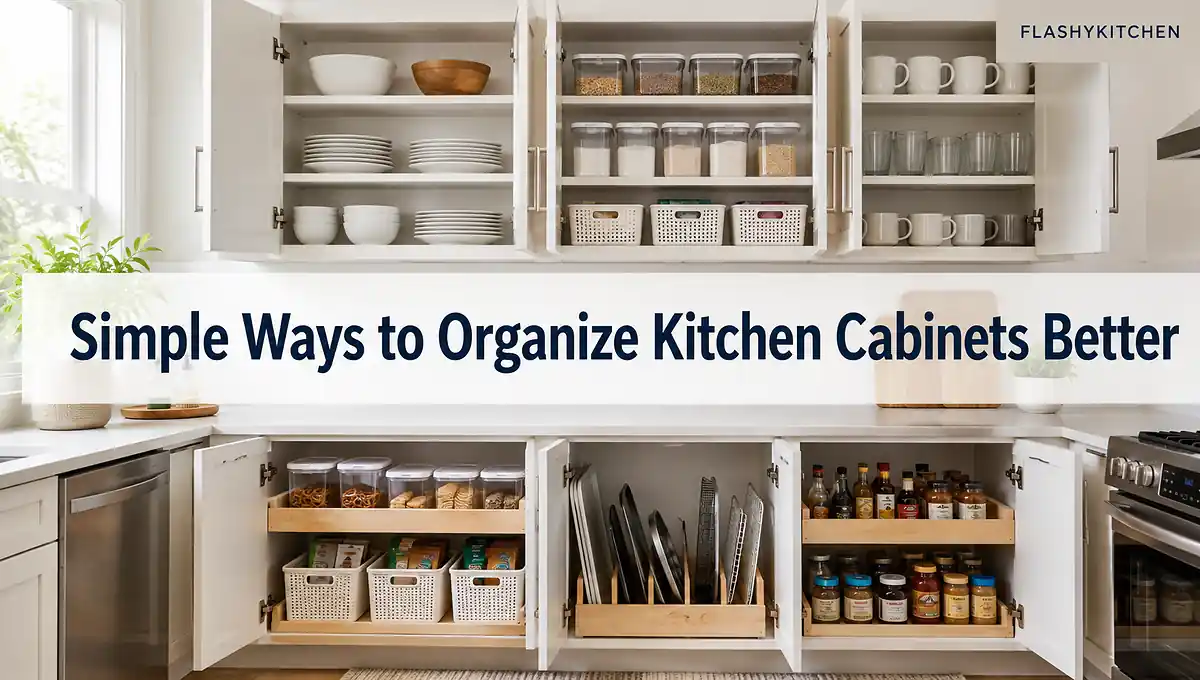
- Pull-out shelves inside base cabinets — no more digging in the back
- Deep drawer stacks for pots and pans — much easier than bending down into a cabinet
- Vertical dividers for baking trays and cutting boards
- Pull-out trash and recycling bins inside a base cabinet
- Tall pull-out pantry column — way more accessible than deep shelf pantries
- Under-cabinet LED lighting — makes everything look better and easier to see
💡 Tip: Spend 10–15% of your cabinet budget on interior organizers. You’ll get more daily value from those than from upgrading to a fancier door.
How Much Do Kitchen Cabinets Cost?
Cabinets are priced per linear foot — that’s the total length of all your cabinet runs combined. A typical 10×10 kitchen has about 20 linear feet.
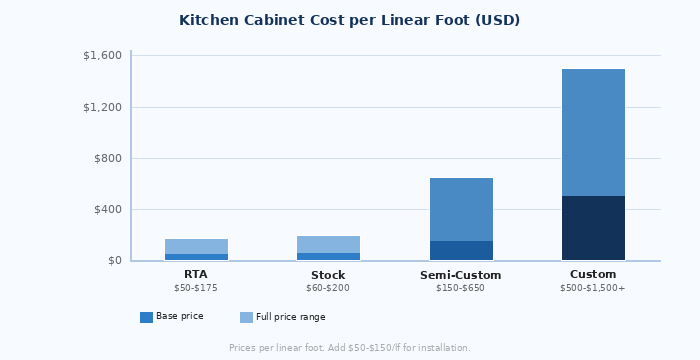
Remember: installation adds another $50–$150 per linear foot on top of cabinet costs. Always ask for a total installed price.
Best Kitchen Cabinets for Small Kitchens
Small kitchens don’t need fewer cabinets — they need smarter cabinets. The goal is maximizing storage without making the kitchen feel cramped or visually chaotic.
- Go tall: Extend wall cabinets to the ceiling. The storage you gain is real; the visual cost (in a small space) is minimal.
- Choose light colors: White or pale gray cabinets reflect light and read as receding rather than advancing.
- Use open shelves selectively: One or two open shelf sections feel lighter than all-cabinet walls, but keep them curated.
- Prioritize drawer bases: Drawers give you full visibility and access to everything. Door-and-shelf bases hide items behind other items.
- Minimize hardware or go handleless: Integrated pulls or J-pulls create fewer visual interruptions in tight spaces.
- Consider glass uppers: Glass-front upper cabinets create visual depth and make the space feel larger.
Best Kitchen Cabinets for Modern Homes
Modern kitchens prioritize clean sight lines, integrated appliances, and minimal visual noise. Cabinet choices need to support that architectural discipline.
- Flat-panel (slab) doors in matte finish or natural wood veneer
- Handle-free design using integrated J-pull profile or push-to-open hardware
- Consistent cabinet height with ceiling-height tall cabinets for a built-in look
- Hidden range hood integrated into cabinet run
- Matching panel-ready refrigerator and dishwasher fronts
- Contrasting lower cabinet color with white or light upper cabinets
- Floating lower cabinets (raised off the floor on a plinth) for a furniture-like look
The most common modern kitchen mistake: going too austere. A completely flat, cold, all-white kitchen without texture or warmth looks clinical rather than modern. Introduce warmth through wood veneer accents, warm stone countertops, or brass hardware details.
Tips When Buying Kitchen Cabinets
- Never order without a confirmed floor plan and elevation drawings from your installer
- Add a 10% overage to your cabinet count for filler pieces, extras, and measuring errors
- Specify finish samples in your kitchen under your lighting before approving the order
- Confirm lead times before purchasing — semi-custom takes 4–8 weeks, custom 10–16 weeks
- Order all cabinets in one batch; dye lots vary between production runs
- Ask for KCMA certification documentation before purchasing
- Visit a showroom in person rather than ordering online only — photos don’t convey scale or finish quality accurately
- Get at least three quotes; cabinet pricing has significant variance between suppliers
- Confirm the warranty: look for a minimum 1-year structural warranty, industry leaders offer limited lifetime
💡 Pro Tip: If you’re installing cabinets in phases, photograph every cabinet number and its location before the installers leave. Future repairs and additions require knowing the exact model and door configuration.
Questions to Ask Before Buying Cabinets
- What is the box material — plywood or particleboard?
- What is the standard shelf thickness, and are shelves adjustable?
- Are soft-close hinges and full-extension drawer slides included or an upgrade?
- What is the door and drawer warranty?
- Is KCMA certification included?
- What is the current lead time for this line?
- Is installation included, and what is the total installed price?
- Are fillers, trim pieces, and hardware included in the quote?
- How are finish repairs handled if doors arrive damaged?
- Can I order extra doors later if a finish is discontinued?
Frequently Asked Questions
What is the best material for kitchen cabinets?
Plywood box with solid wood or MDF doors — strong, moisture-resistant, and lasts 30+ years.
Which cabinet color looks best?
White, warm gray, or navy blue — all timeless choices that look great and age well.
How long do kitchen cabinets last?
Plywood cabinets last 30–50 years; particle board ones typically 10–15 years.
Are custom cabinets worth it?
Only if your kitchen has unusual sizing — for most homes, semi-custom gives the same result for less money.
What cabinets are best for small kitchens?
Ceiling-height white or light-colored cabinets with drawer bases and minimal hardware.
Final Thoughts
Kitchen cabinets are the most used furniture in your home. They’re opened and closed hundreds of times a week, exposed to heat and humidity, and expected to look good for decades. The choices you make on box material, construction quality, and hardware will define your satisfaction with the kitchen long after the initial excitement fades.
Measure before you plan. Prioritize box construction over door aesthetics. Spend on hardware and organization systems — they deliver the highest return in daily use. And ask every supplier hard questions about materials and warranties before signing anything.
The best kitchen cabinets aren’t the most expensive ones — they’re the ones that match your space, your workflow, and your budget while being built well enough to last. That combination is well within reach if you shop informed.
If you still want more ideas before making your final decision, this kitchen cabinets complete guide covers additional cabinet styles, layouts, and expert buying tips.