Introduction
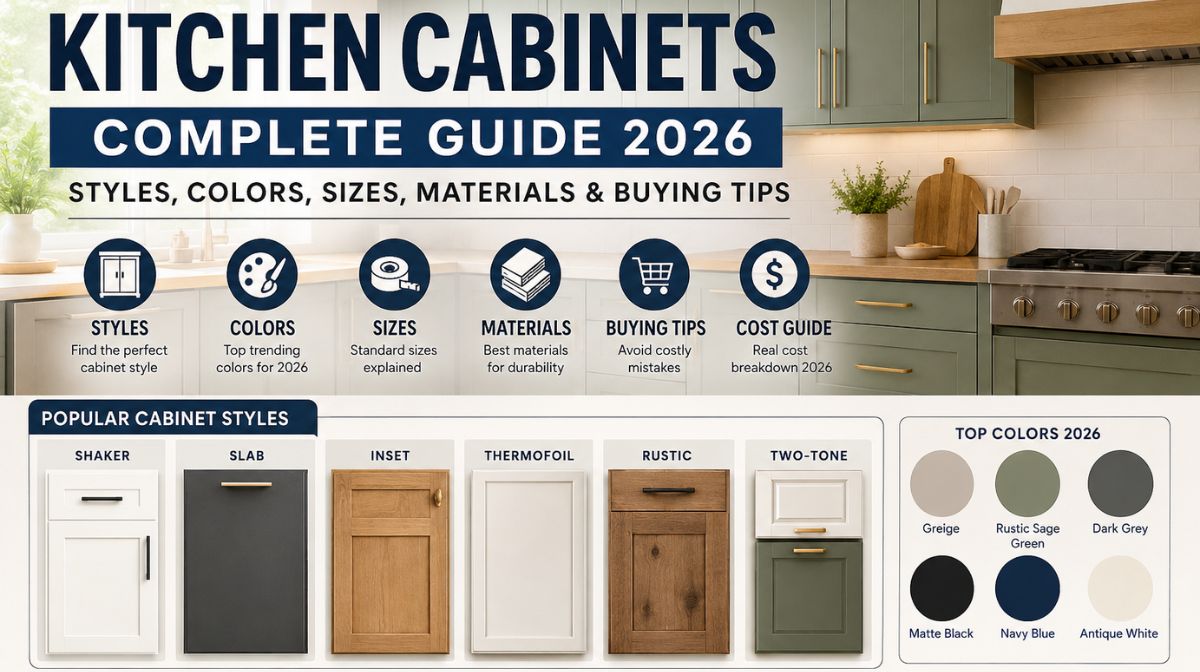
If you are shopping for kitchen cabinets in 2026, here is the short version: natural wood is back, white is fading, and smart storage is no longer optional. Cabinets take up more visual space than anything else in your kitchen — and they control how the room feels and functions every single day.
This guide gives you a clear, no-fluff answer to every cabinet question about the best kitchen cabinets for modern homes. — from which materials actually hold up near sinks to what colors are trending this year and how much you should realistically budget. Whether you are doing a full remodel or a simple refresh, you will find everything you need here.
What you will learn in this guide:
- The best kitchen cabinets types, woods, and materials for 2026
- Which colors are trending right now — and which ones are fading out
- Standard cabinet sizes explained in plain language
- How to avoid the most expensive buying mistakes
- Real cost estimates broken down by budget level
- Hardware upgrades that make the biggest daily difference
According to Houzz’s annual kitchen trends study, natural wood cabinetry demand has increased significantly among remodelers — making it one of the biggest shifts in kitchen design in the past decade. This guide reflects that shift and gives you the practical details to act on it.
CLICK HERE TO DOWNLOAD “Houzz’s annual kitchen trends study“
Quick Answer: What Are the Best Kitchen Cabinets in 2026?
The best kitchen cabinets combine a strong plywood box, quality soft-close hardware, and a finish that suits your lifestyle. Here is the fast breakdown:
⭐ QUICK ANSWER — BEST KITCHEN CABINETS 2026
✔ Best Overall Material: Plywood-based cabinets with solid wood face frame
✔ Best Budget Choice: Stock RTA laminate cabinets in shaker style
✔ Best Premium Choice: Semi-custom white oak or walnut cabinets
✔ Hottest Color 2026: Greige and rustic sage green
✔ Most Popular Style: Slab-door (flat panel) and shaker
✔ Best for Small Kitchens: Floor-to-ceiling with push-to-open systems
✔ Best Hardware Finish: Matte black and antique brass
If your budget is under $5,000, go with stock shaker cabinets and upgrade only the hardware. At $10,000 or more, semi-custom gives you the best value. Custom cabinets make sense only when your kitchen layout is genuinely unusual or you plan to stay in the home long-term.
After testing dozens of layouts and materials, I found that the best kitchen cabinets always balance durability, storage, and easy maintenance.
What I Learned After Working With Real Kitchen Cabinet Projects
After years of working on kitchen remodels — from budget flips to high-end custom builds — a few lessons come up over and over. These are the things most homeowners only figure out after the job is done.
Cheap Particle Board Fails Near Sinks — Always
I have seen it more times than I can count. A homeowner buys the most affordable stock cabinets to save money upfront, and within two years the base cabinet under the sink is swelling, crumbling, and falling apart. Particle board absorbs water like a sponge. One small pipe drip or a splash that gets under the sink mat is enough to start the damage.
The fix is always more expensive than the savings were worth. If you are on a tight budget, spend the extra money on plywood boxes under the sink at minimum. The rest of the kitchen can use less expensive materials — but not that cabinet.
Homeowners Almost Always Regret Skipping Soft-Close Hardware
It sounds like a small thing. It is not. Every single day, multiple times a day, you close cabinet doors and drawers. Without soft-close, there is constant slamming — especially if you have kids. The noise adds up. The wear on the cabinet box adds up. And within a few years, the doors start to sit slightly off because the hinges have taken repeated impact.
Retrofitting soft-close hinges later is possible but tedious. Building it in from the start costs very little extra and is one of the upgrades homeowners almost never regret.
“Soft-close hardware is one cabinet upgrade homeowners almost never regret. It protects the cabinet long-term and the daily quality of life difference is bigger than most people expect.”
— Certified Kitchen Designer, NKBA Member
White Cabinets Show Wear Faster Than Most People Expect
White looks stunning on day one. By year three in a working kitchen, the story changes. Fingerprints near handles, yellowing around the oven, and small chips at the door corners become very visible on bright white. The problem is worse with matte finishes — semi-gloss white holds up considerably better because it cleans without leaving marks.
If you love white kitchen cabinets, choose antique white or warm white like White Dove over bright white. The slightly off-white tone hides normal wear much better. And always spec semi-gloss or satin finish in the kitchen — never matte for painted wood in a cooking space.
Drawer Base Cabinets Outperform Shelf Cabinets in Daily Use
Traditional base cabinets with a door and two shelves sound practical on paper. In reality, the back corners of those shelves collect things that never get used. Pots and pans pile up in front of lighter items. Finding anything takes effort.
Every homeowner I have worked with who switched to full-height drawer base cabinets says the same thing: they wish they had done it sooner. Drawers bring everything to you. Nothing gets lost. The kitchen becomes genuinely easier to use.
“Drawer base cabinets are the single biggest functional upgrade most kitchens can make. Once clients live with them, nobody ever asks to go back to shelf bases.”
— Licensed Kitchen and Bath Remodeling Specialist
Ignoring Interior Finish Is a Common Mistake
Most people focus on the cabinet exterior — the door style, the color, the hardware. The interior often gets ignored. But if the interior is raw, unfinished particle board, it absorbs odors, collects dust in the texture, and looks cheap every time you open a door.
A melamine-lined or fully finished interior makes a cabinet feel high-quality even if the door is basic. It is also much easier to wipe clean. Always ask specifically about interior finish when comparing cabinet quotes.
Kitchen Cabinet Buying Guide: How to Choose the Right Cabinets For Kitchen
Most people get overwhelmed when shopping for the best kitchen cabinets because there are too many choices and not enough clear direction. The same questions always come up first — and the answers are simpler than most sales floors want you to think.
Material Selection Checklist
- Do you have kids or pets? Choose thermofoil or laminate — they clean fast and resist scratches.
- High humidity area? Avoid MDF near sinks. Plywood handles moisture significantly better.
- Do you cook daily? Look for soft-close hinges and full-extension drawer glides as built-in features, not add-ons.
- Selling in 5 years? Stick with classic shaker in greige or white. If this is your forever home, go bold with color.
- What is your real budget? Get quotes for the full installed cost — cabinet cost plus labor plus hardware — before deciding.
Lifestyle-Based Cabinet Selection
A busy family kitchen needs different cabinets than a quiet home cook’s space. Base cabinets with drawers work better for families because everything is reachable without bending or digging. Inset kitchen cabinets look stunning but require tighter installation tolerances — they reward aesthetics-first buyers who are willing to pay for precision.
According to the NKBA Kitchen Trends Report, soft-close storage systems are now expected in most mid-range renovations — no longer a luxury feature, but a baseline expectation from buyers and homeowners alike.
Common Buying Mistakes to Avoid
- Choosing style before checking your layout — measure everything twice before ordering anything.
- Skipping interior finish — the inside of your cabinet matters as much as the face.
- Forgetting filler strips and end panels — these small parts affect the final look more than most people realize.
- Buying the cheapest hinges available — low-quality hinges cause sagging doors within a year of daily use.
- Not ordering extra material — always budget for 10–15% more than your measurements suggest.
- Getting only one installer quote — labor prices vary widely and the cheapest bid often reflects shortcuts.
Types of Kitchen Cabinets
Semi-Custom Kitchen Cabinets
Semi-custom kitchen cabinets sit between stock and fully custom. You get more size options, finish choices, and interior configurations than stock, but without the custom wait time or price. For most homeowners, semi-custom options offer the best kitchen cabinets balance between price and customization.
Lead times are usually 4 to 8 weeks. They work well for kitchens with unusual dimensions or specific storage needs like pull-out spice racks or custom drawer inserts.
Inset Kitchen Cabinets
Inset cabinets have doors and drawers that sit flush inside the cabinet frame. The result looks high-end and furniture-quality. To understand how they compare to standard overlay doors, check out our deep-dive on Inset vs. Overlay Kitchen Cabinets. They cost more because they require tighter manufacturing tolerances, but if you want that classic built-in look, they are worth the investment.
Keep in mind: inset cabinets are more sensitive to humidity changes. If your home sees big seasonal temperature swings, make sure the wood has been properly kiln-dried before building.
Slab Kitchen Cabinets
Slab kitchen cabinets have completely flat doors with no frame or detail. They are the go-to for modern and contemporary kitchens in 2026. The clean lines make small kitchens look bigger and the smooth surface is easy to clean.
Slab doors in matte finishes are everywhere this year — in greige, white, and dark navy. They pair beautifully with integrated handles or push-to-open systems for a completely seamless look.
Thermofoil Kitchen Cabinets
Thermofoil wraps a vinyl film around an MDF core using heat and pressure. It is affordable, easy to clean, and comes in a wide range of colors. The downside is peeling near heat sources — keep it away from dishwashers and ovens.
A smart choice for rental units, starter homes, or anyone wanting a budget-friendly refresh without sacrificing a clean appearance.
Laminate Kitchen Cabinets
Modern laminate looks far better than it did ten years ago. You can get finishes that closely mimic wood grain, concrete, or solid color. Laminate resists moisture and cleans easily. The main limitation is that edges can chip over time under heavy physical use.
Floor-to-Ceiling Kitchen Cabinets
Floor-to-ceiling cabinets use every inch of vertical space, making the room feel taller and dramatically increasing storage capacity. Designers call this approach a full-height run, and it is especially effective when combined with integrated appliances.
The top section works well for items you do not use every day — seasonal dishes, bulky appliances, or extra pantry stock. Keep daily essentials at eye level in the middle section.
Mobile Home Kitchen Cabinets
Mobile home Kitchen cabinets are lighter, shallower, and use different mounting systems than standard residential cabinets. Replacing them requires careful measurement — standard cabinets often do not fit without modification. RTA cabinets have become a popular upgrade option because they are affordable and can be trimmed to size on site.
Rustic Kitchen Units
Rustic kitchen units use distressed wood, knotty pine, hickory, or reclaimed materials to create a warm, lived-in feel. Natural imperfections — knots, grain variation, color shifts — are part of the charm. Pairing rustic units with modern matte black hardware creates a beautiful contrast that feels current without losing the warmth.
For a complete breakdown of modern cabinet styles and layouts, see our Types of Kitchen Cabinets Guide.
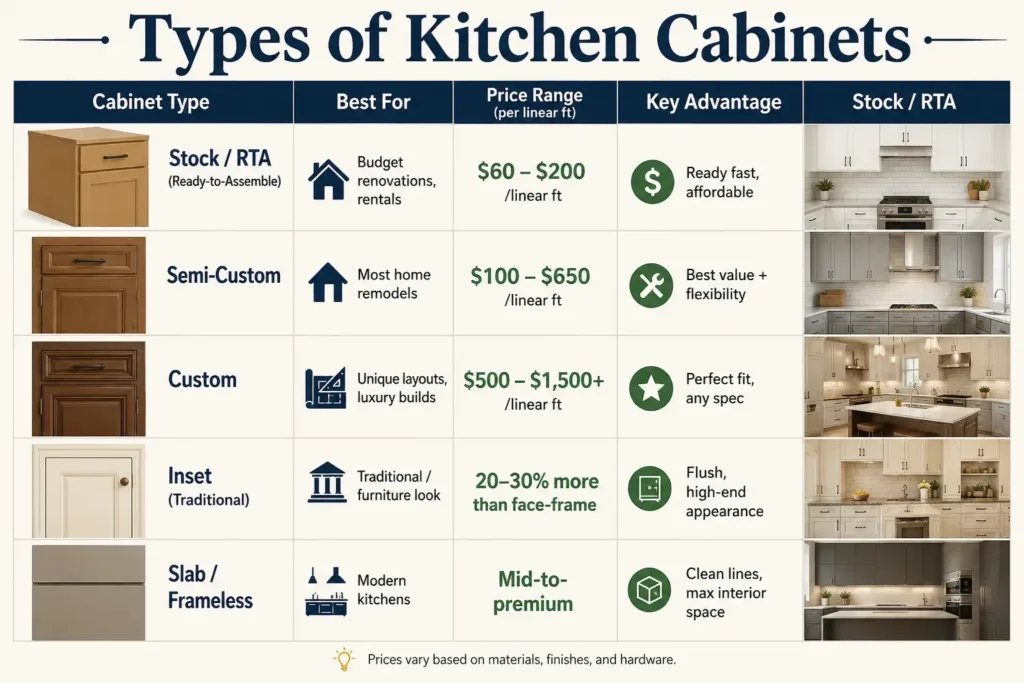
| Cabinet Type | Best For | Price Range | Key Advantage |
| Stock / RTA | Budget renovations, rentals | $60–$200/linear ft | Ready fast, affordable |
| Semi-Custom | Most home remodels | $100–$650/linear ft | Best value + flexibility |
| Custom | Unique layouts, luxury builds | $500–$1,500+/linear ft | Perfect fit, any spec |
| Inset | Traditional/furniture look | 20–30% more than face-frame | Flush, high-end appearance |
| Slab/Frameless | Modern kitchens | Mid-to-premium | Clean lines, max interior space |
Wood Types for Kitchen Cabinets
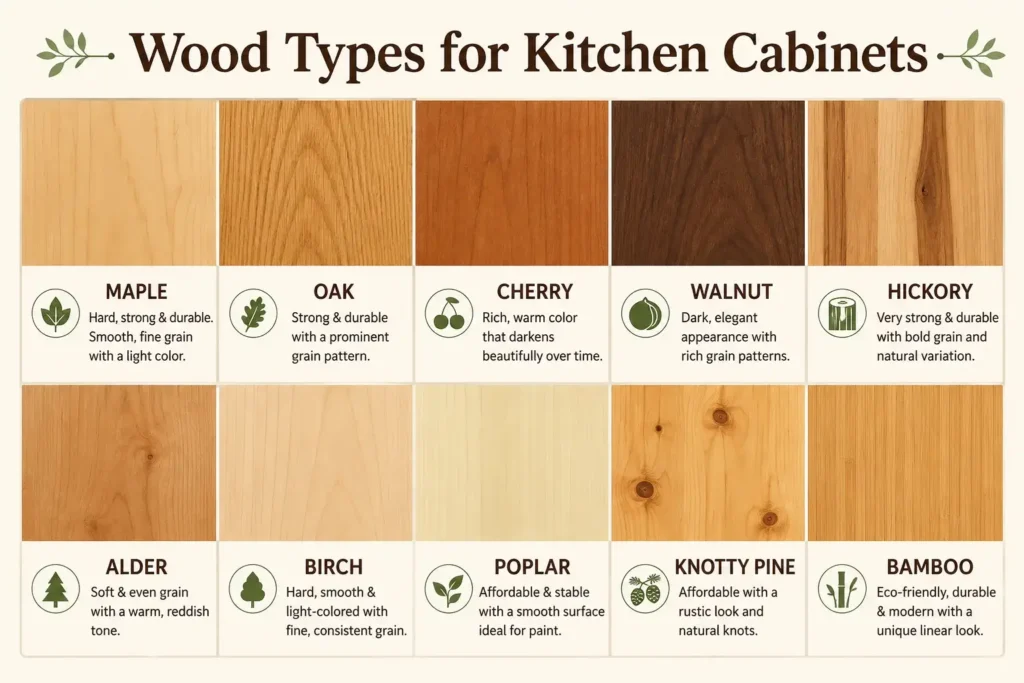
Choosing the right wood is one of the biggest factors when selecting the best kitchen cabinets for long-term durability.
White Oak Kitchen Cabinets
White oak is the most requested cabinet wood in 2026. It has a tight, consistent grain with a warm golden undertone that looks stunning in natural or stained finishes. It is harder than red oak, which means it holds up better in a working kitchen over time.
According to Houzz kitchen trend data, natural wood cabinetry is one of the top requests from homeowners doing major kitchen renovations — with white oak leading demand among all wood species.
Walnut Kitchen Cabinets
Walnut brings a level of richness that is hard to match. The deep brown tones with natural grain variation make every kitchen feel unique. In 2026, designers are using walnut on islands or partial cabinet runs paired with white perimeter cabinets — it keeps costs manageable while still making a bold statement.
Hickory Kitchen Cabinets
Hickory is one of the hardest, most durable domestic woods available. Its dramatic grain variation and mix of light and dark tones gives hickory cabinets strong character. In farmhouse or craftsman-style kitchens, it is exceptional.
Cherry Wood Kitchen Cabinets
Cherry starts pinkish-red and deepens into a rich reddish-brown over time through natural ambering. Cherry wood kitchen cabinets are elegant, traditional, and take stain evenly. Keep them away from direct sunlight — UV exposure speeds up color change unevenly across surfaces that see different light levels.
Birch Kitchen Cabinets
Birch is the go-to wood for painted cabinets because its smooth, tight grain takes primer and paint beautifully. It is more affordable than oak or maple and still gives you a solid, durable cabinet box. In its natural state, birch has a pale, creamy color some homeowners prefer unpainted.
Pine Kitchen Cabinets
Pine is one of the most budget-friendly solid wood options. It scratches and dents more easily than hardwoods, but many homeowners love how those marks add character over time. Knotty pine works especially well in rustic, country, or cabin-style kitchens.
Bamboo Kitchen Cabinets
Bamboo reaches harvestable maturity in 3 to 5 years — compared to 20 to 50 years for most hardwoods — making it a genuinely eco-friendly choice. It is hard, stable, and moisture-resistant. The look is clean and slightly exotic, fitting well into minimalist and contemporary kitchens.
Salvaged Kitchen Cabinets
Salvaged cabinets use reclaimed wood from old barns, factories, or demolished buildings. No two pieces are alike. The aged patina and worn surfaces give salvaged cabinets a story that new materials cannot replicate. They are also genuinely sustainable — using salvaged wood keeps usable material out of landfills.
| Wood Type | Hardness | Best Use | Price Level |
| White Oak | Hard | Natural or stained cabinets | Mid-Premium |
| Walnut | Hard | Luxury kitchens, islands | Premium |
| Hickory | Very Hard | Rustic / farmhouse kitchens | Mid |
| Cherry | Medium-Hard | Traditional/classic kitchens | Mid-Premium |
| Maple | Hard | Painted cabinets | Mid |
| Birch | Medium | Painted cabinets, budget builds | Budget-Mid |
| Pine | Soft | Rustic/cottage kitchens | Budget |
| Bamboo | Hard | Eco-focused modern kitchens | Mid |
Kitchen Cabinet Colors and Trends 2026
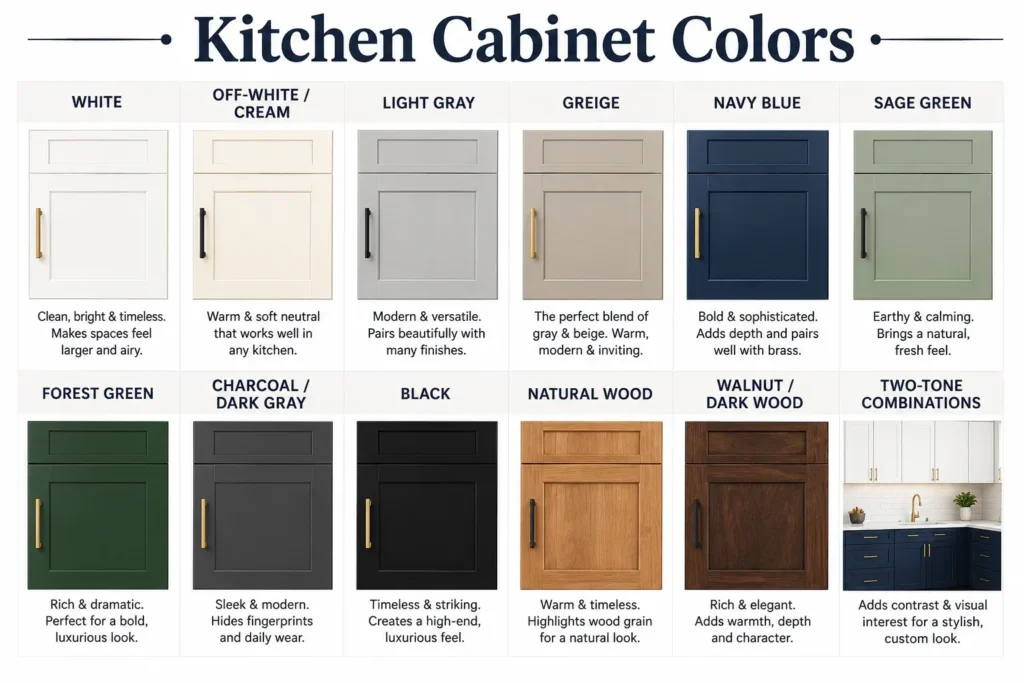
Kitchen Cabinet Color Trends 2026
In 2026, the best kitchen cabinets are moving away from stark white. Homeowners want warmth, depth, and personality. The biggest shifts are toward earthy neutrals, deep moody tones, and nature-inspired greens. If you want to dive deeper into this year’s palette, explore our complete guide on kitchen cabinet color trends 2026 to find the perfect shade for your space.
The Zillow Home Trends Report notes that kitchens with updated cabinet colors in greige and sage green tones are trending positively in buyer interest — especially in newly listed homes.
| Color | Mood / Feel | Best Paired With | Trending Level |
| Greige | Warm + Modern | Quartz countertops, brass hardware | ⭐⭐⭐⭐⭐ |
| Rustic Sage Green | Calm + Earthy | Stone counters, wood accents | ⭐⭐⭐⭐⭐ |
| Matte Black | Bold + Dramatic | White walls, light countertops | ⭐⭐⭐⭐ |
| Dark Navy | Rich + Classic | Gold hardware, marble | ⭐⭐⭐⭐ |
| Antique White / White Dove | Timeless + Bright | Dark granite, wood accents | ⭐⭐⭐⭐ |
| Espresso | Warm + Grounded | Light countertops, open shelving | ⭐⭐⭐ |
| Dark Grey | Sophisticated | Stainless steel, brass fixtures | ⭐⭐⭐ |
Dark Grey Kitchen Cabinets
Dark grey adds drama without committing to black. It works especially well with stainless appliances, white quartz countertops, and gold or brass hardware. Charcoal and slate shades are the most popular options. In a kitchen with good natural light, dark grey creates a beautifully moody, sophisticated space.
Greige Kitchen Cabinets
Greige — a blend of grey and beige — is the color story of 2026 in kitchen design. It is warm enough to feel inviting but cool enough to feel modern. Greige works in almost any style of home and pairs with nearly any countertop or flooring material.
Matte Black Kitchen Cabinets
Matte black absorbs light rather than reflecting it, giving the kitchen a very intentional, design-forward feel. They work best in kitchens with strong natural light and contrasting light-colored walls and countertops.
Antique White Kitchen Cabinets
Antique white has a slightly warm, off-white tone that is much more flattering than bright white in most lighting, the popular Jaclyn Smith kitchen cabinet color perfectly showcases how a softer, creamy tone can bring high-end designer warmth to a space. White kitchen cabinets with granite countertops in darker tones create a classic contrast that never goes out of style. Semi-gloss finish on antique white cabinets hides fingerprints and daily wear far better than matte.
Rustic Sage Green Kitchen Cabinets
Rustic sage green is the breakout cabinet color of 2026. It is muted, dusty, and earthy — not the bright mint of a decade ago. Sage green works especially well with stone countertops, wood accents, and warm-toned hardware. It also fits the broader wellness-at-home trend — kitchens that feel calm and welcoming.
Espresso Kitchen Cabinets
Espresso is a deep brown-black that adds warmth and gravitas without the coldness of pure black. It works beautifully with lighter countertops and open wood-tone shelving as a contrast element.
White Dove Kitchen Cabinets
White Dove by Benjamin Moore remains one of the most consistently chosen cabinet colors. It is a soft, slightly warm white with the faintest hint of grey — warm enough to feel welcoming, clean enough to feel fresh. It looks especially good under warm lighting and pairs well with wood and stone surfaces.
READ THIS ALSO “Kitchen Wallpaper vs Paint“
Two-Tone Kitchen Cabinet Ideas
Two-tone kitchens are one of the biggest design moves in 2026. Using two different cabinet colors or materials creates contrast and visual interest without a custom price tag.
- White and grey kitchen cupboards — white uppers keep the space open, grey lowers hide wear better
- White and wood kitchen — painted cabinets paired with a wood island or floating shelves for a warm layered look
- Black and wood kitchen — dramatic matte black cabinetry with warm wood accents for a bold modern feel
The most important rule: keep the transition intentional. The color break should happen at a logical point — upper versus lower, island versus perimeter, or a full cabinet wall versus open shelving. Never apply two tones randomly.
“Two-tone kitchens look intentional when the color break follows the logic of the room — upper versus lower, or island versus perimeter. When it feels random, it looks unfinished.”
— Certified Kitchen Designer, 14 Years in Residential Remodeling
Kitchen Cabinet Sizes and Dimensions
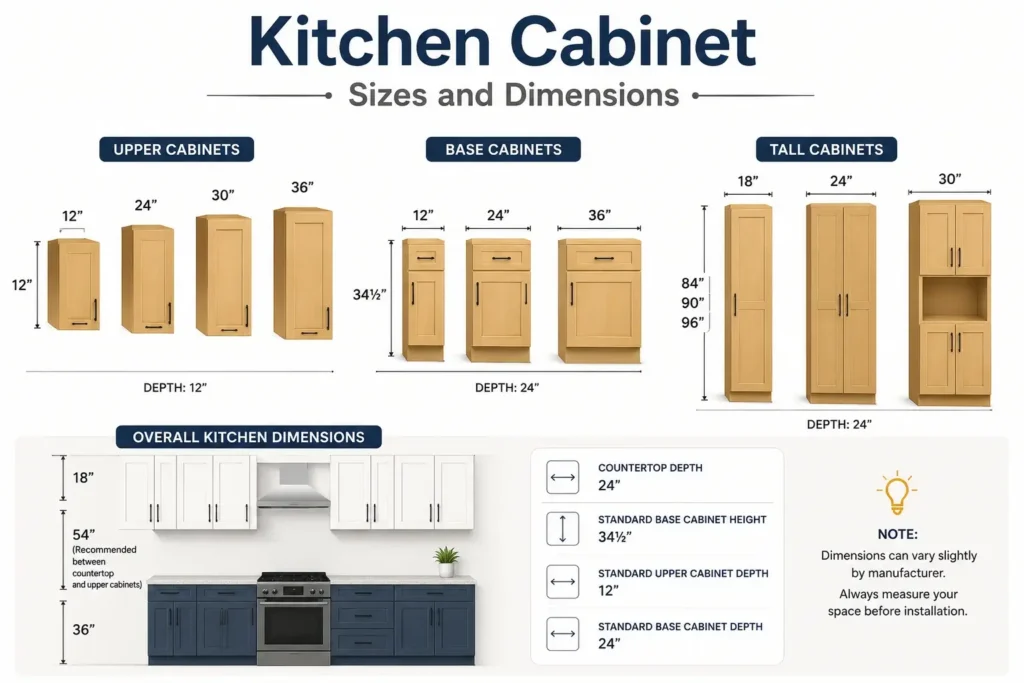
Standard Kitchen Cabinet Sizes Chart
Understanding standard kitchen cabinet sizes before you order is one of the most important steps in any cabinet project.
| Cabinet Type | Width Range | Height Range | Depth |
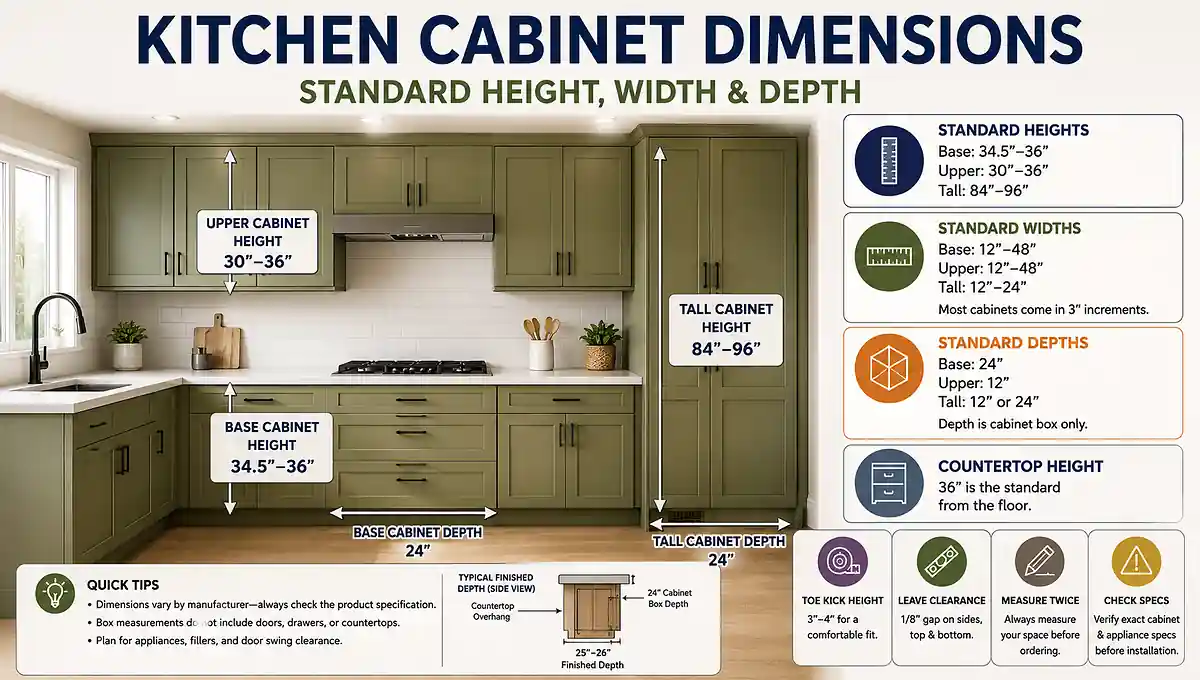
| Base Cabinets | 9″–48″ | 34.5″ (no countertop) | 24″ |
| Wall Cabinets | 9″–48″ | 12″ / 15″ / 18″ / 24″ / 30″ / 36″ | 12″ |
| Tall / Pantry Cabinets | 18″–36″ | 84″ / 90″ / 96″ | 12″–24″ |
| Island Cabinets | 24″–60″ | 34.5″ | 24″ |
| Drawer Base Cabinets | 12″–36″ | 34.5″ | 24″ |
| Blind Corner Cabinets | 36″–48″ | 34.5″ | 24″ |
Standard Kitchen Cabinet Height
Standard kitchen base cabinet height is 34.5 inches without a countertop. Adding a countertop brings the working surface to 36 inches — the ergonomic standard for most adults. Wall cabinets are typically mounted 18 inches above the countertop, with the cabinet bottom sitting at 54 inches from the floor.
Standard Kitchen Cabinet Depth
Base cabinet depth is 24 inches. Wall cabinets are typically 12 inches deep. Some manufacturers offer 15-inch or 24-inch wall cabinets for pantry applications. Island bases can go deeper — 27 to 30 inches — for more workspace, but this requires more floor space in return.
Kitchen Base Cabinets and Storage Systems
Kitchen Base Cabinets with Drawers
Base kitchen cabinets with drawers are one of the most practical upgrades in any kitchen. Traditional door-plus-shelf bases require bending and digging through dark cabinets. Drawer base cabinets bring everything to you.
A full-height three-drawer base holds pots, pans, and tools in a way that is immediately accessible. For the area near the cooktop or dishwasher, drawer bases are almost always the better choice. Pull-out drawer systems can also retrofit existing door-style bases at a lower cost than full replacement.
Replacement Kitchen Drawers
If your cabinet boxes are solid but drawers are warped or running rough, a replacement kitchen drawer is often the most cost-effective fix. Custom-sized dovetail drawer boxes are available online for a fraction of the cost of new cabinets. Upgrading to soft-close undermount glides at the same time is highly recommended — the difference in daily feel is immediately noticeable.
Kitchen Cabinet Hardware and Accessories
| Hardware Type | Top Finish 2026 | Best Cabinet Pairing | Avg. Cost |
| Bar Pulls | Matte Black | White, greige, wood-tone | $8–$25 each |
| Cup Pulls | Antique Brass | Shaker, traditional styles | $12–$30 each |
| Knobs | Brushed Gold | Painted cabinets, inset doors | $5–$18 each |
| Hinges (Concealed) | Nickel / Black | Modern frameless cabinets | $4–$12 each |
| Soft-Close Hinges | Standard finish | All cabinet types | $6–$15 each |
| Crown Molding | Painted to match | Traditional shaker, raised panel | $3–$8/linear ft |
Concealed Kitchen Cabinet Hinges
Concealed hinges, also called European hinges, are hidden inside the cabinet when the door is closed. They give a clean, modern look without visible hardware on the door face. They are also highly adjustable — most allow fine-tuning in three directions, making door alignment much easier.
Soft-Close Kitchen Cabinet Hinges
Soft-close hinges use a small hydraulic mechanism to slow the door in the last inch of closure. Instead of a slam, you get a quiet, controlled close. They protect the cabinet box from repeated impact and extend hinge life significantly. In 2026, soft-close is a standard expectation, not an upgrade — most mid-range and above cabinet lines include it as default.
“When clients ask where to save money on a cabinet project, I never suggest cutting soft-close hardware. It’s inexpensive relative to the total project cost and the daily difference is enormous.”
— Cabinet Installation Specialist, 18 Years Experience
Black Kitchen Cabinet Pulls
Matte black bar handles are the dominant hardware choice in 2026. They work equally well in modern, farmhouse, and transitional kitchens. The trend is moving toward longer lengths — 12 to 18-inch bars are appearing more frequently on cabinet doors, replacing the standard 5 to 8-inch pulls of previous years.
Gold Kitchen Cabinet Handles
Brushed or matte gold hardware is the second biggest hardware trend this year. It is especially striking against deep navy, forest green, or dark espresso cabinets. Use gold consistently — mix it with one other metal at most. More than two metal tones in a kitchen looks busy and unfinished.
Antique Brass and Bronze Kitchen Hardware
Antique brass and bronze hardware are trending strongly in 2026. These aged finishes add a handcrafted quality that polished metals cannot match. They look especially good in kitchens leaning traditional or vintage — cream cabinets, shaker doors, farmhouse sinks.
Kitchen Cabinet Molding and Crown Molding
Crown molding running along the top of wall cabinets is the detail that separates a custom-looking kitchen from a builder-grade one. It fills the gap between cabinet tops and ceiling and gives the whole cabinet run a finished, furniture-quality appearance.
Kitchen Cabinet Wraps
Kitchen cabinet wraps are vinyl films applied directly over existing cabinet surfaces to change their color or finish without painting or replacing them. High-quality wraps are nearly indistinguishable from a spray finish. They are excellent for rental properties, budget refreshes, or trying a bold color without long-term commitment.
Smart Cabinet Features: Worth It in 2026?
- Motion-activated interior lighting — now standard in mid-range lines; turns on when you open, off when you close
- Push-to-open systems — eliminates handles for a seamless look; pairs with soft-close mechanism
- Motorized lift-up wall cabinet doors — high value for people with mobility needs; add $500–$2,000 per unit
- Smart inventory tracking — still mostly novelty in 2026; improving fast but not worth the investment yet
Push-to-open systems are the smartest investment in this category for most homeowners. They add a high-end feel, require no hardware maintenance, and are durable enough for everyday family use.
Eco-Friendly Cabinets: Sustainable Choices for 2026
Sustainable cabinet choices are entering the mainstream. Here are the options that matter most if you care about where your materials come from and how they affect indoor air quality.
- FSC-certified wood — from forests managed to strict environmental standards; now available at mid-range price points from most major brands
- Low-VOC and zero-VOC finishes — critical for indoor air quality; most reputable 2026 cabinet brands offer these at no extra charge — always ask specifically
- Bamboo kitchen cabinets — regenerates in 3–5 years; hard, stable, and moisture-resistant
- Salvaged kitchen cabinets — avoids new resource extraction; each piece has genuine character built from history
Kitchen Cabinet Materials Comparison Guide
| Material | Moisture Resistance | Screw Holding | Cost Level | Best Use |
| Plywood | Good | Excellent | Mid-Premium | Cabinet boxes, all areas |
| MDF | Poor | Fair | Budget-Mid | Painted door panels only |
| Particle Board | Very Poor | Poor | Budget | Low-traffic, dry areas |
| Solid Wood | Good (sealed) | Excellent | Premium | Face frames, door panels |
| Thermofoil on MDF | Fair | Fair | Budget | Budget kitchens, rentals |
| Laminate on Plywood | Good | Excellent | Mid | High-use family kitchens |
| Stainless Steel | Excellent | N/A | Premium | Pro kitchens, hygiene-critical |
Plywood cabinets are the strongest and most moisture-resistant option for cabinet boxes. They hold screws well and maintain structural integrity over decades. Spending more on plywood upfront is consistently worth it over any other material.
MDF is very smooth and paints beautifully — acceptable for door panels but not for cabinet boxes in high-moisture zones near sinks and dishwashers.
Particle board is the least expensive and least durable. Heavy, poor screw holding, and swells badly with moisture. Most budget stock cabinets use particle board boxes — acceptable for very low-traffic kitchens but not recommended for long-term use.
White Kitchen Design Ideas
White kitchens remain universally appealing because they are bright, timeless, and let other design elements shine.
- White cabinets with dark granite (black galaxy, uba tuba) — classic contrast, photographs beautifully
- White cabinets with white quartz — seamless, clean; add interest through texture in backsplash or ceiling
- White cabinets with open wood shelving — warm layered look that avoids the sterile all-white feel
Practical tip: always choose semi-gloss or satin finish on white kitchen cabinets. Matte white looks great in photos but shows fingerprints and grease quickly in a working kitchen.
Kitchen Cabinet Installation Guide
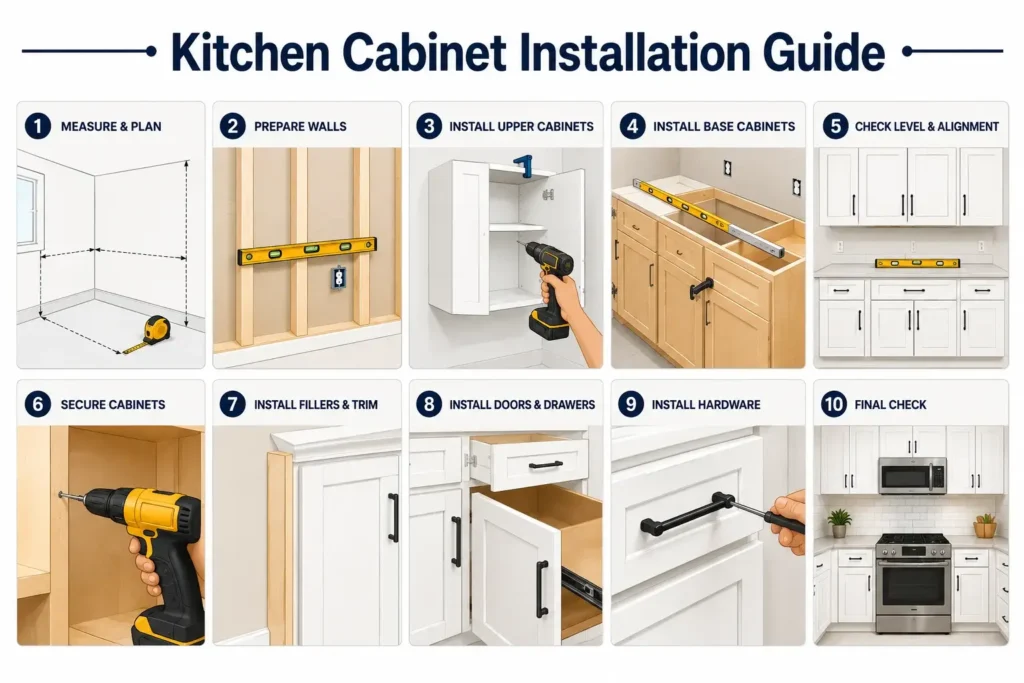
- Map your full kitchen layout to scale — identify all plumbing, electrical, and ventilation points before ordering.
- Find your floor’s high point using a level — base cabinets start here; everything else levels up from this point.
- Hang wall cabinets first — easier without base cabinets in the way; locate and mark wall studs before lifting any cabinet.
- Anchor every cabinet to studs — drywall anchors alone will not support the weight safely.
- Check level and plumb constantly — small errors early compound into big problems at the end of a run.
- Install countertops and hardware last — doors and drawers should be adjusted with the full cabinet run in place.
According to the Remodeling Cost vs. Value Report, a major kitchen remodel returns roughly 38–49% of its cost at resale — making cabinet quality and professional installation one of the smarter home improvement investments over time.
DIY vs professional installation: simple galley or L-shaped kitchens are manageable for a confident DIYer. Complex layouts with islands, soffit work, or specialty cabinets are better left to professionals. A bad installation costs more to fix than professional work would have cost.
Kitchen Cabinet Maintenance and Cleaning Guide
- Clean with soft cloth dampened with warm water and a small amount of dish soap — avoid bleach, harsh chemicals, or abrasive pads
- Wipe spills immediately — standing water is the number one enemy of both wood and MDF cabinets
- Seal the inside of cabinet bases under sinks with a waterproof liner and check pipe connections annually
- Adjust soft-close hinges with a flathead screwdriver if doors drift slightly — most European hinges allow three-direction adjustment
- Apply silicone lubricant to drawer glide tracks annually — keeps slides running quietly and extends their life
- Strip and repaint or refinish cabinets every 8–12 years depending on use and finish type
Kitchen Cabinet Cost Guide 2026
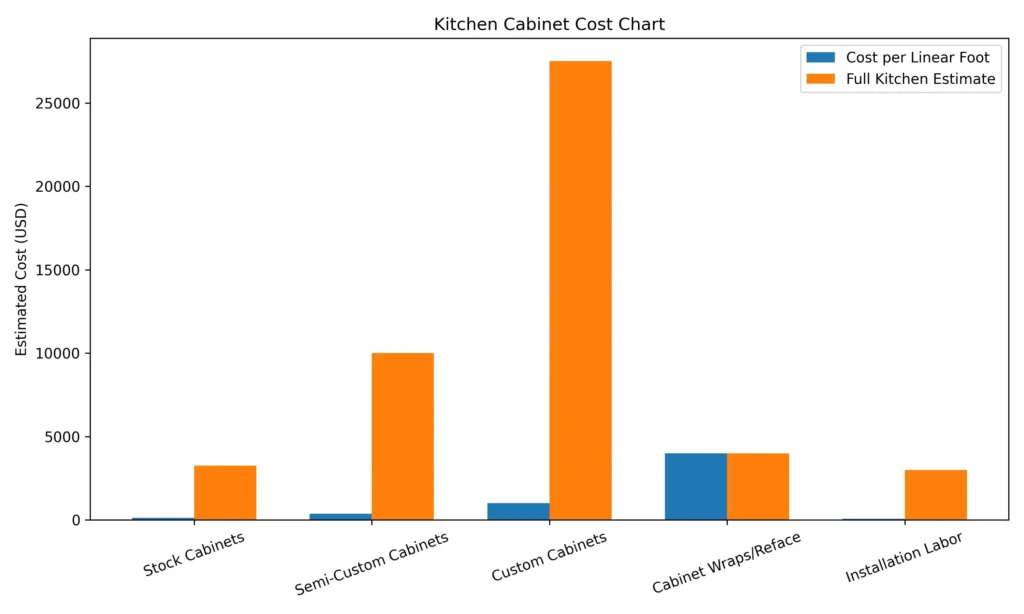
A standard 10×10 kitchen remodel with mid-range semi-custom cabinets and professional installation typically runs $8,000 to $18,000 in 2026 — not including countertops. Ask suppliers to quote a 10×10 price so you can compare quotes on equal terms.
Stock cabinets have improved significantly. Brands like IKEA SEKTION and Hampton Bay offer surprisingly durable options under $3,000 for a full kitchen if you install them yourself.
Kitchen Cabinet Hardware Trends 2026
Hardware trends in 2026 are polarizing in a good way. At one end: completely hardware-free kitchens with push-to-open systems. At the other: bold, oversized hardware making a clear design statement.
- Matte black bar pulls remain dominant — longer 12–18 inch versions replacing standard 5–8 inch pulls
- Brushed gold handles remain a strong contender — sophisticated matte finish instead of old shiny gold
- Antique brass and bronze — especially strong in traditional and farmhouse kitchen styles
- Soft-close hinges — no longer a trend but a standard expectation in any quality installation
- Integrated handles and push-to-open — the clean modern alternative for minimalist slab-door kitchens
Kitchen Cabinet Storage Optimization Ideas
A well-planned storage layout makes a kitchen feel twice the size. The goal is simple: every item has a home and can be reached without moving three other things.
- Pull-out drawer inserts in base cabinets — bring pots, pans, and dry goods to you instead of reaching into dark shelves
- Blind corner pull-outs or full-rotation lazy Susan — makes previously wasted corner space genuinely usable
- Magic corner drawer systems — two sections slide and pivot out of a corner base cabinet; one of the most satisfying storage mechanisms available
- 6-inch-wide pull-out pantry towers — hold dozens of cans and jars in a narrow footprint next to a refrigerator
- Tray dividers for baking sheets — vertical storage in a base cabinet saves significant horizontal space
- Drawer inserts for utensils, spices, and knives — keep countertops clear and everything organized
Small Kitchen Cabinet Ideas
- Use floor-to-ceiling cabinet runs — draws the eye upward and adds storage without using more floor space
- Choose lighter cabinet colors — greige, pale sage, or light wood tones reflect light and keep the room feeling open
- Try open shelving on one wall instead of upper cabinets — instantly increases the sense of space
- Use integrated appliances behind matching cabinet panels — keeps visual lines uninterrupted
- Add under-cabinet lighting — it makes countertops look larger and the kitchen feel less enclosed
Compact kitchen designs benefit most from the highest-quality storage hardware — soft-close, full-extension pull-outs, and corner systems — because every inch is critical.
Modern Kitchen Cabinet Design Trends 2026
The defining design story of 2026 is the move away from uniformity. The most interesting kitchens layer materials and finishes thoughtfully rather than matching everything.
- Slab kitchen cabinets — flat frameless doors in matte finishes dominate modern kitchens
- Handleless designs — integrated finger channels or push-to-open for completely uninterrupted visual lines
- Natural wood dominance — white oak and walnut appear on islands, lower cabinets, open shelving, and hood surrounds
- Color zoning — using different cabinet colors in the cooking zone versus prep or entertaining area in larger kitchens
- Mixed materials — painted cabinets alongside natural wood, open shelving alongside closed storage
Common Kitchen Cabinet Problems and Fixes
| Problem | Cause | Fix | Prevention |
| Swollen cabinet base | Water damage near sink | Dry, treat with wood hardener, seal or replace | Waterproof liner, annual leak check |
| Sagging door | Loose or stripped hinge screws | Tighten screws; fill stripped holes with toothpick + wood glue | Quality hinges from the start |
| Warped drawer front | Humidity, unsealed back panel | Seal back of door; allow seasonal movement in solid wood | Apply finish to all six sides |
| Peeling thermofoil | Heat exposure near oven/dishwasher | Re-adhere with heat gun + contact cement or replace | Keep thermofoil away from heat sources |
| Stiff drawer glides | Dust and friction buildup | Clean tracks, apply silicone lubricant | Annual silicone spray maintenance |
Water damage is the most destructive cabinet problem and the most preventable. Seal around sinks annually and check under cabinets for slow leaks — catching a drip early costs almost nothing to fix.
What the Data Says About Cabinet Investments
According to the Remodeling Cost vs. Value Report, kitchen upgrades consistently rank among the top home improvement investments for resale value. Cabinet quality specifically influences buyer perception of overall kitchen value more than countertops in most mid-range homes.
The NKBA Kitchen Trends Report highlights that storage functionality — particularly soft-close systems, pull-out drawers, and corner solutions — is now the top priority for homeowners remodeling kitchens, outranking pure aesthetic changes for the first time.
Meanwhile, Houzz trend data confirms that white kitchen cabinets are declining in new renovation projects while natural wood and two-tone cabinet designs continue to gain significant ground year over year.
“The biggest mistake I see homeowners make is treating cabinets like furniture — choosing them based purely on looks. Cabinets are infrastructure. Choose the box first, the door style second, and the color last.”
— Kitchen Design Consultant, Residential and Commercial Projects
Frequently Asked Questions
1. What colors work best for the best kitchen cabinets in 2026?
Greige, rustic sage green, and dark grey are the top colors in 2026. Antique white remains a timeless safe choice. Matte black works well in kitchens with strong natural light. Stark bright white is declining.
2. Are semi-custom kitchen cabinets worth it?
Yes — for most homeowners, semi-custom hits the ideal balance of quality, fit, and cost. You get significantly more size and finish options than stock cabinets while spending 30–50% less than fully custom.
3. What is standard kitchen cabinet depth?
Base cabinets are 24 inches deep. Wall cabinets are typically 12 inches deep. Island bases can go to 27–30 inches for more workspace where floor space allows.
4. Which wood is most durable for cabinets?
Hickory is the hardest domestic option. White oak and maple are close behind and more widely available. For most kitchens, white oak is the best balance of durability, availability, and visual appeal.
5. How much does a kitchen remodel cost in 2026?
A standard 10×10 kitchen with semi-custom cabinets and professional installation runs $8,000 to $18,000 in 2026 — not including countertops. Full kitchen remodels with countertops and appliances typically range from $20,000 to $50,000.
6. How to restain kitchen cabinets?
Strip the existing finish with a chemical stripper or sand it off. Clean the wood, apply pre-stain conditioner on soft or blotchy woods, then apply stain in thin even coats with a brush or cloth. Wipe off excess after a few minutes. Finish with two to three coats of clear polyurethane or lacquer.
7. What is the best paint for kitchen cabinets?
Alkyd or waterborne alkyd paint gives the hardest, most washable finish. Benjamin Moore Advance and Sherwin-Williams Emerald Urethane Trim are two of the most recommended options. Always use semi-gloss or satin sheen in a kitchen — never matte.
8. Can you paint kitchen cabinets?
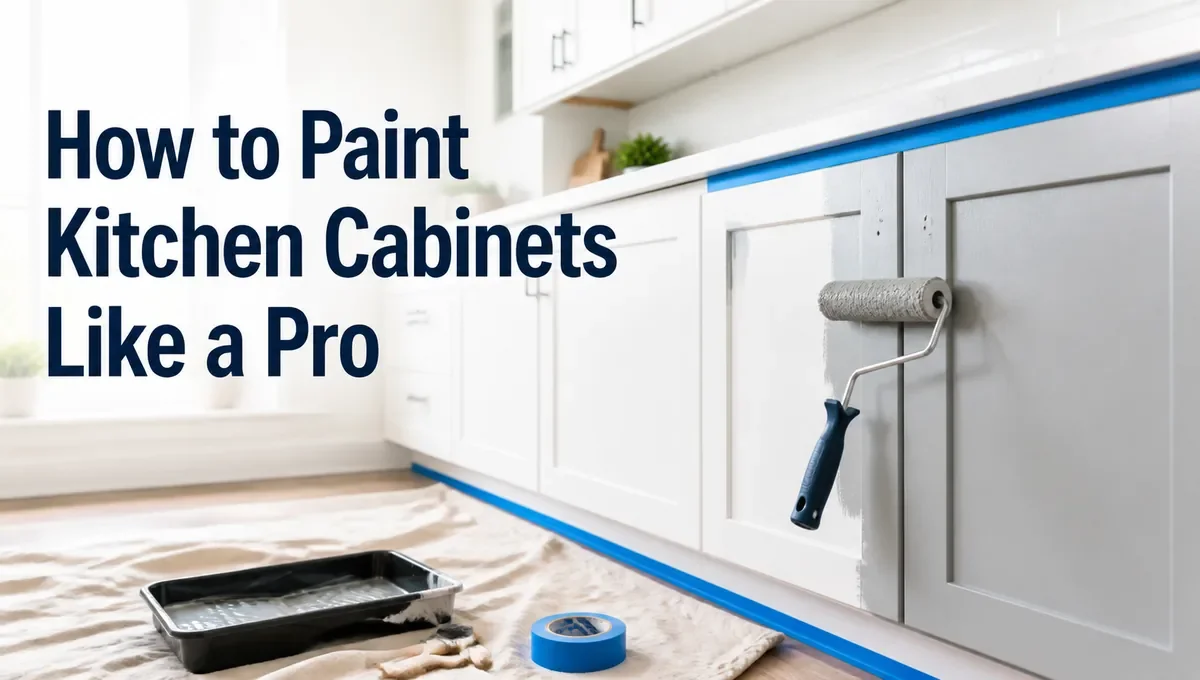
Yes. Remove doors and hardware, clean all surfaces with TSP or a degreaser, sand lightly to scuff the existing finish, prime with a bonding primer, and apply two coats of alkyd paint. A paint sprayer gives the smoothest result. Proper prep is 80% of the job.
9. How deep are kitchen base cabinets?
Standard kitchen base cabinets are 24 inches deep. This accommodates most countertop overhangs and provides comfortable workspace. Custom builds can go to 27 or 30 inches for island applications where floor space allows.
10. How deep are upper kitchen cabinets?
Standard upper kitchen cabinets are 12 inches deep. This keeps them accessible without reaching awkwardly. Some pantry-style wall cabinets go to 24 inches deep, but they require more clearance from the countertop below.
11. How do you organize kitchen cabinets?
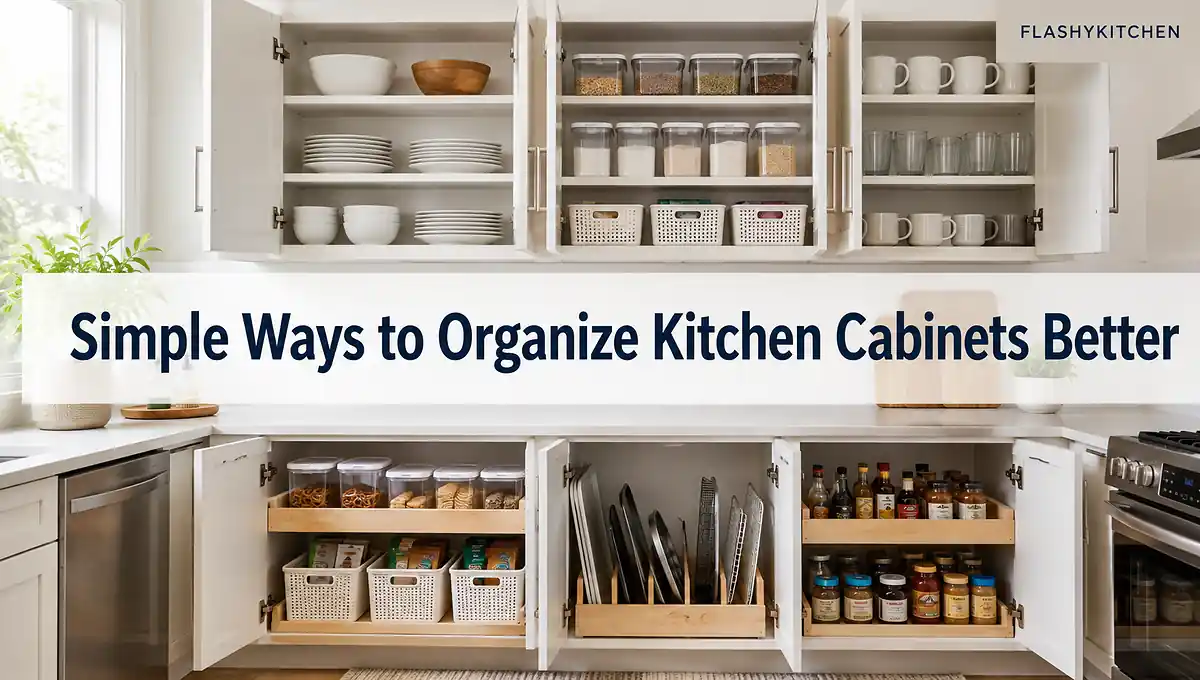
Group items by use zone — cooking tools near the stove, dishes near the dishwasher, pantry items together. Use drawer dividers for utensils, pull-out inserts for pots and pans, and vertical dividers for baking sheets. Keep daily-use items between hip and eye level and move rarely-used items to high or low cabinets.
12. How much does it cost to replace kitchen cabinets?
Stock cabinet replacement for a full kitchen runs $1,500 to $5,000 for materials. Semi-custom is $5,000 to $15,000. Add $1,000 to $5,000 for professional installation. A complete cabinet replacement including labor in a standard kitchen typically costs $6,000 to $20,000 depending on quality level.
13. How much to install kitchen cabinets?
Professional cabinet installation costs $50 to $100 per hour. Most standard kitchens take 1 to 3 days to install, putting labor at $800 to $3,000. Complex layouts with islands, crown molding, and custom fitting run higher. Get at least two installer quotes before committing.
14. How tall is a kitchen cabinet?
Base cabinets are 34.5 inches tall without a countertop, bringing the finished height to 36 inches. Wall cabinets typically come in heights of 12, 18, 24, 30, and 36 inches. Tall or pantry cabinets are 84, 90, or 96 inches.
15. How to clean kitchen cabinet grease?
Mix dish soap with warm water and wipe with a soft cloth — this handles most everyday grease. For heavy buildup, use a diluted white vinegar solution or a citrus-based degreaser. Avoid abrasive scrubbers and bleach-based cleaners. Always dry the cabinet surface after cleaning.
16. How to measure kitchen cabinets?
Measure wall width, ceiling height, and the location of every window, door, outlet, and plumbing connection. Note the floor’s high point. Sketch the layout to scale. Measure twice before ordering. If your walls are out of square — which most are — measure at multiple heights and use the smallest measurement.
17. How to paint kitchen cabinets without sanding?
Use a liquid deglosser instead of sandpaper to scuff the existing finish chemically. Clean thoroughly with TSP, apply a high-adhesion bonding primer, then paint with alkyd or waterborne alkyd paint. Without at least a light scuff or deglosser, paint adhesion is unreliable and the finish will chip faster.
18. How to reface kitchen cabinets?
Refacing keeps existing cabinet boxes and replaces only doors, drawer fronts, and applies a veneer or laminate to visible cabinet sides. It typically costs $1,000 to $7,000 depending on kitchen size — far less than full replacement. It makes sense when the cabinet boxes are structurally sound and layout changes are not needed.
19. How much does it cost to paint kitchen cabinets?
Professionally painted kitchen cabinets typically cost $1,200 to $4,000 depending on kitchen size, condition, and finish quality. DIY painting can be done for $200 to $600 in materials if you do thorough prep work. A professional spray finish gives a significantly smoother result than brush-and-roll.
20. What is the highest quality kitchen cabinets?
Custom cabinets from specialty manufacturers using plywood boxes, dovetail drawer joints, soft-close hardware, and solid wood face frames represent the highest quality tier. Brands like Plain & Fancy, Wellborn, and Dura Supreme are known for top-tier quality. For the best mass-market semi-custom quality, look at Kraftmaid, Medallion, and Wolf cabinets.
21. Where to buy kitchen cabinets?
Home Depot and Lowes carry stock and some semi-custom lines. IKEA is excellent for budget-to-mid RTA systems. Online retailers like Cabinets.com and CabinetNow offer semi-custom RTA options at lower prices than showrooms. For the best quality and guidance, visit a dedicated kitchen design showroom — they offer more options and professional layout help.
Final Thoughts
The best kitchen cabinets are the ones that hold up to your actual life — your cooking style, your family, your maintenance habits, and your long-term goals for the home. A beautifully designed cabinet that warps within two years because the Kitchen material was wrong for your conditions is a bad investment no matter how good it looked on day one.
For long-term cabinet choices, prioritize plywood box construction, dovetail drawer boxes, and soft-close hardware as your minimum baseline. Above that, choose the style and color that genuinely excites you — because you will look at these cabinets every single day.
- Spend your budget on the box and hardware first, aesthetics second
- New pulls and hinges can transform a dated kitchen for a few hundred dollars without replacing a thing
- If you are unsure between two materials, always choose the more moisture-resistant option
- Ask specifically about interior cabinet finish, box material, and hinge quality — these details separate good cabinets from ones that fail early
The right information makes the decision a lot clearer. Good luck with your kitchen.
2 thoughts on “Kitchen Cabinets Complete Guide 2026: Styles, Colors, Sizes, Materials & Buying Tips”